Under $200 the wattage on the box is not a specification, it is a marketing number, and getting that straight is most of the work of choosing. Three of the four machines here headline 3000 watts max; none of the four publishes a continuous rating. So this page ranks on the things the makers do put in writing: head size, gear material, how many grinding plates come in the box, whether there is an auto-reverse, and whether anyone states a pounds-per-minute figure. On that basis the STX Turboforce 3000 Electric Meat Grinderleads, because it is the only machine in the band that documents both a head size and its full plate set. The budget pick — the cheapest grinder here that still puts its gear material in writing — is the Sinyder Electric Meat Grinder (Metal Gears).
Every price in the table above is read live from Amazon with the date it was last checked. The $200 line is our editorial band, not a claim about today’s price — read the live figure before you buy. We do not run a test kitchen, and nothing here is presented as a test result: every spec row cites the maker’s own listing, and where a maker publishes nothing we say so instead of filling the gap.
Why “3000 W max” tells you almost nothing
A peak or maxwattage is the momentary maximum a motor can draw — typically at the instant of stall, when it is about to jam. A continuous rating is what it can sustain while actually grinding, and it is the only figure you could compare between two machines. Under $200 nobody in this band publishes the second number. The LEM machine above the band does it differently again and publishes horsepower instead, which is a third unit; our main grinder roundup covers that machine.
The practical consequence: a grinder claiming 3000 W max and one claiming 2000 W max are not 1000 watts apart in any meaningful sense, and neither claim predicts how either will handle a shoulder with silverskin in it. The same problem shows up across this site with peak-watt claims on food processors, and the rule we apply is identical: record the figure in the maker’s own words, label its basis, and never compute anything from it.
What to rank a sub-$200 grinder on instead
- Head size, if it is stated at all.Grinder heads are numbered — #5, #8, #12 and up — and the number sets both throughput and which replacement plates fit. Only one machine on this page states its head size. That is a bigger deal than any wattage claim: an undocumented head means you cannot buy a finer plate or a replacement knife with confidence two years from now.
- Gear material.The gear train is what fails first on a home grinder, usually by design — a plastic gear is a sacrificial part that breaks instead of the motor. That is a defensible engineering choice and a real limitation, and the only pick here that states metal gears is the budget one.
- Plates and attachments in the box. Plate count and sizes decide whether you can grind coarse for burgers and fine for sausage, and a sausage tube and kubbe cone are the difference between a grinder and a mincer. Count them in the listing before you buy; this is where the cheapest machines quietly save money.
- Auto-reverse. When a tendon wraps the auger, a reverse function backs it out. Without one you strip the head on the counter with cold, greasy hands. One machine here publishes it.
- A published throughput figure. Pounds per minute is the one performance number anyone in this band states, and exactly one maker here does. It makes batch planning possible rather than guesswork.
- Currently purchasable, at a real price. Availability and a live price were verified on all four before this page was written.
Which grinder, for which kitchen
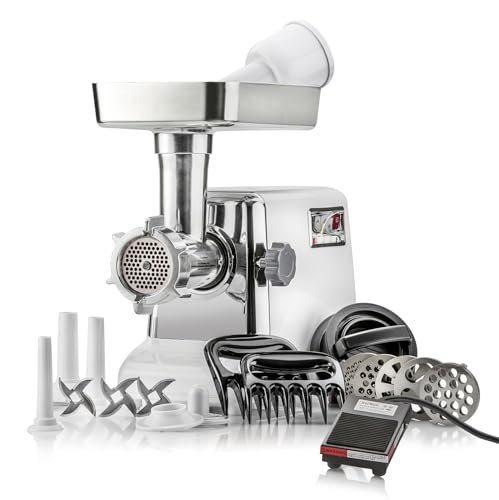
Buy the STX Turboforce 3000 Electric Meat Grinderif you want the machine with the fewest unknowns. It is the only pick here that documents a size #12 head, and it ships five grinding plate sizes, three stainless blades, sausage tubes and a kubbe maker, with a foot pedal so both hands stay on the meat. That combination is why it is also the rank-one pick on our main grinder page. The honest costs: it is bulky and heavy to store, and its gears are plastic by design — the sacrificial part if you overload it. It is also the most expensive machine in this band, and it sits close enough to the top of it that the live price is worth checking before you commit.
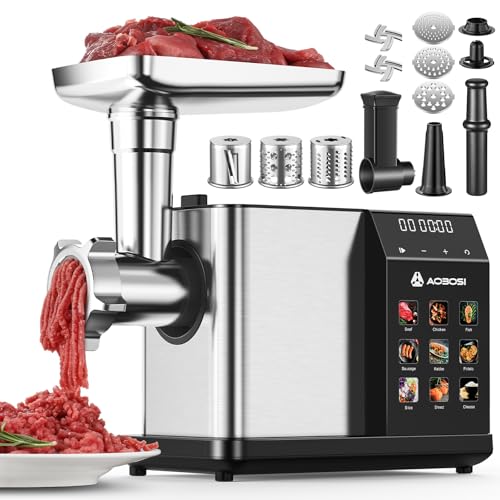
Buy the AAOBOSI Multifunctional Digital Meat Grinderif you would rather press a program than guess a speed, and if jam recovery matters more to you than paperwork. Nine touch-screen presets cover grinding, sausage, kibbe and cheese grating, the accessories store in the body — which is the difference between using a grinder and hunting for its plates — and the auto-reverse is the feature you will be most grateful for the first time a piece of sinew wraps the auger. What you give up is documentation: no head size is stated anywhere in the listing, so future plates are a gamble, and a touch panel is one more thing to fail on a machine that lives under raw meat.
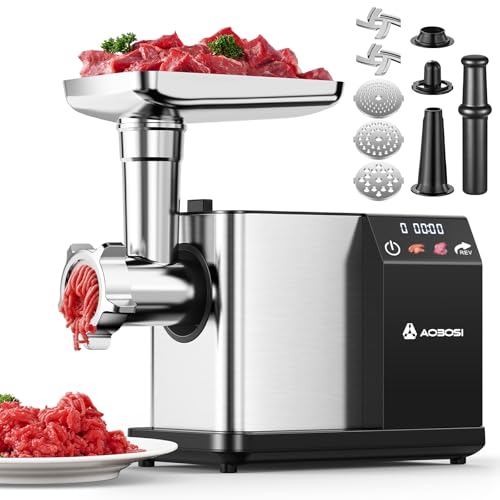
Buy the AAOBOSI 3-Speed Electric Meat Grinderif you want a number you can plan a batch around. It is the only machine in this band that publishes a throughput figure — 4 lbs a minute, the maker’s own — and it carries an LFGB food-contact approval, which is a European standard for materials in contact with food and more than most listings in this price range cite. Three speeds on a touch panel, accessories stored in the body. Its limits are the same as its sibling’s: a peak-watt claim, no stated head size, and noticeably slower going on anything sinewy than a documented #12 machine.
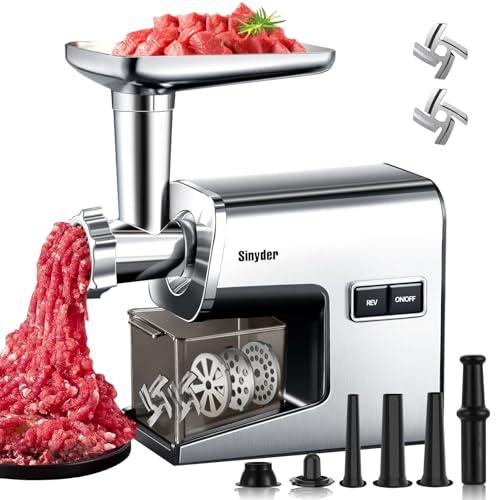
Buy the Sinyder Electric Meat Grinder (Metal Gears)— the budget pick — if you want the most honest spec sheet for the least money. It is the only grinder on this page that puts metal gears and a copper motor in writing, which matters because the gear train is the usual failure point, and it ships two blades, three grinding plates, sausage stuffer tubes and a kubbe kit in a stainless body. No head size, no grind rate, and the same 3000-watt maximum claim as everything else here. For a cook who grinds a few pounds of chuck for burgers now and then, it is the sensible amount of machine.
Be honest about frequency before you buy any of these.A grinder is a large object that lives in a cupboard between uses. If you grind two or three times a year, your butcher’s grind is better value than storage space, and a food processor will do a passable job on a small batch of cold, cubed meat — it chops rather than extrudes, so the texture is different, but for a couple of pounds of burger blend the difference is smaller than the price gap. If the real problem is a tough cut you want to keep whole, that is a tenderizer, not a grinder.
What the $200 line costs you against the machines above it
Three things, in order of how much you will notice them. First, a comparable power figure: above this band makers publish horsepower or a continuous wattage, and you can actually compare two machines. Second, stainless gearing and a real warranty— the step up to a machine like the LEM BigBite buys a permanently lubricated motor, a stainless body and a multi-year factory warranty, where nothing in this band publishes a warranty term in its listing at all. Third, speed under load: the published rate on the grinder above this band is roughly 7 lbs a minute against the 4 lbs a minute claimed by the only machine here that states one, and that gap is what matters when you are processing a whole animal rather than a few pounds of chuck.
What the band does notcost you is the everyday grind. Two pounds of cold cubed beef through a #12 head comes out the same whether the machine cost $90 or $400. The expensive machine wins on volume, on longevity and on recovering from jams — which is exactly the list above. If you process game, read grinders for deer and wild game before you buy anything on this page.
The four rules that decide whether a cheap grinder works well
Technique matters more at this price than at any other, because these machines have less headroom to absorb a mistake.
- Keep the meat cold, near-frozen at the edges. Warm fat smears instead of cutting, which turns the grind pasty and clogs the plate. Thirty minutes in the freezer before grinding changes the result more than any feature on this page.
- Chill the head and the plate too. The same logic. Cold metal keeps the fat in discrete pieces rather than rendering it against the die.
- Trim silverskin and sinew first. Connective tissue is what wraps the auger and stalls a motor, and it is the single most common cause of a jam on a machine in this band.
- Clean it immediately, by hand. Ground meat sets like glue in a plate perforation. Strip the head while it is still wet and dry the steel parts rather than leaving them to sit.
Where a grinder fits among the other prep tools
A grinder does one thing nothing else in a kitchen does: it extrudes muscle through a die, and that is why burger from a grinder has a texture a blade cannot reproduce. But it is a single-purpose machine, and if the broader problem is that prep takes too long, it is rarely the first purchase. A food processor covers more ground for the same money, a manual chopper is faster for the daily onion, and for the purees and soups that a blade does better than a die, the picks on our alternatives to an immersion blender page are the right shelf to be looking at. The full manual prep tool hub puts the whole shelf in order.