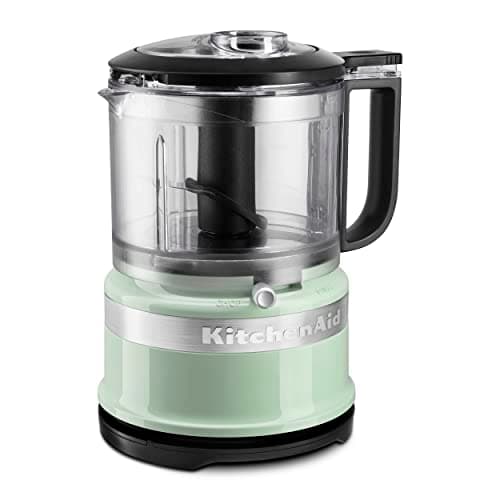
The KitchenAid 3.5-Cup Food Chopper (KFC3516) is the nicely-built option in a category that does not usually bother. A 3.5-cup bowl, a locking lid, two speeds and a pulse, and a drizzle basin molded into the lid. It costs meaningfully more than the Ninja Express Chop, which is our overall chopper pick, and the honest question is whether the two things it adds are worth that gap to you.
The drizzle basin is the real feature
The lid has a shallow well with a small hole in the bottom, so oil poured into it trickles into the bowl at a controlled rate while the blade turns. That is the mechanism behind every emulsion in a home kitchen: vinaigrette, mayonnaise, aioli, pesto. Pour oil in all at once and the fat pools; trickle it in and it breaks into droplets small enough to stay suspended, and the mixture thickens and turns opaque.
Most choppers have a sealed lid, which makes them incapable of this. If you make dressings or pesto with any regularity, the basin is a genuine capability rather than a convenience, and it is the single strongest argument for this machine. If you only ever chop onions, it is a hole you will never use.
Two speeds, and what they are actually for
A single-button chopper gives you one rotational speed and asks you to control the cut with the length of the press. Two speeds plus a pulse is finer control: the low speed keeps soft things — herbs, cooked egg, tomato — from being whipped to paste in the first half-second, and the high speed handles nuts and hard cheese. It is a modest improvement over pulsing well, and pulsing well is free.
What 3.5 cups actually holds. Roughly one large onion, or two medium carrots, or a full bunch of parsley. That is the practical unit of this machine, and it is the same working size as most of the field. Anything above it means batching, and a chopper you have to load three times is a chopper that has become a food processor job.
Where it gives up ground
Two places. First, price: it is the most expensive small chopper we rank, and Ninja Express Chop (NJ110GR)does the core job — turning an onion into an even mince in three seconds — for a lot less. Second, capacity relative to price: 3.5 cups is a normal chopper bowl, not a large one, so the money is not buying you more food per load.
KitchenAid does not headline a wattage figure for it, which is worth knowing but not worth worrying about — as our electric chopper roundup argues, wattage is the least useful number in this category. Bowl size, blade geometry and lid design decide the result; motor power almost never does at this scale.
How it compares
Against the Ninja Express Chop (NJ110GR): the Ninja’s stacked blades cut more evenly and it costs far less; the KitchenAid is better built, has speed control, and can drizzle. Against the Hamilton Beach 3-cup: the Hamilton Beach is the value pick and gives up the speed control and the basin. Against a Fullstar Pro XL Vegetable Chopper & Mandoline-style push-dicer: completely different cut — the KitchenAid minces, the dicer cubes, and neither substitutes for the other.
The buying summary is short. Make dressings, pesto or mayonnaise: this is worth the premium. Chop onions and herbs: buy the Ninja and spend the difference on something else.
On onions specifically, one habit gets more out of this machine than the second speed does: pulse it, then leave the lid on for half a minute before you open it. The gas that stings your eyes is still in the bowl when the blades stop. Our guide to chopping onions without crying explains why, and why a sharper blade beats any gadget here.