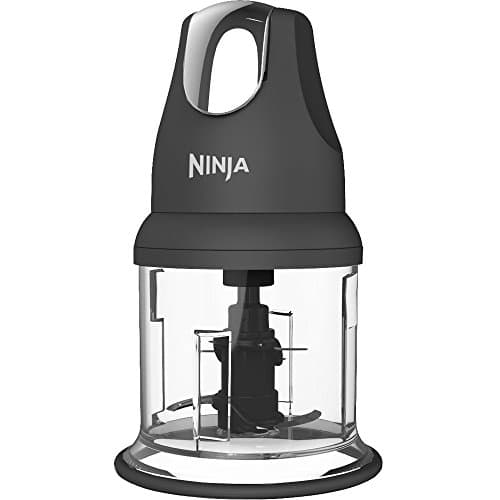
The Ninja Express Chop (NJ110GR) is the food chopper we recommend most often, and its case is almost embarrassingly simple: a 2-cup bowl, one button on top, stacked stainless blades, and an onion reduced to an even mince in two or three one-second pulses. There is nothing to learn and almost nothing to wash. For the single most common prep job in a home kitchen, that combination is very hard to beat at any price.
What the stacked blades actually change
Most small choppers use a single blade near the bottom of the bowl, which means food above it sits untouched until you shake the bowl. The Ninja stacks blades up the central post, so the cutting happens at two heights at once. In practice that means a more even result with fewer pulses and less of the classic chopper failure where the bottom is puree and the top is still in chunks.
It also means the blade assembly is a single piece you lift straight out, which is the part of chopping that decides whether a gadget gets used. Bowl, blade and lid all come apart and go in the dishwasher; the motor base is a lid you press and never washes.
The 200-watt question
Ninja publishes 200 watts, which sounds low next to the four-figure numbers on food processor boxes, and it does not matter. A chopper motor runs for one or two seconds at a time against a small load; the blade geometry and the bowl shape decide the result far more than the wattage does. In this catalog the electric choppers run from 150 to 200 published watts and you would struggle to tell them apart on an onion.
Where wattage would matter — a bowl full of stiff dough, a jar of nut butter, a hard block of parmesan ground continuously — is exactly where a 2-cup chopper is the wrong machine regardless. Those are food processor jobs.
The three things it cannot do
First, it does not dice. Stacked blades mince; they cannot produce the even cube you want for a stew or a pico de gallo. If that is your need, buy a push-dicer from the manual roundupinstead — the two tools are not substitutes and cost about the same.
Second, it does not slice or shred. There is no disc and no feed tube, so cheese, potatoes and cabbage are out. Third, it is small: 2 cups is one large onion, or a good handful of herbs, or a modest batch of pesto. Doubling any recipe means doing it twice, and for a household that batch-cooks, that friction adds up quickly — the Brieftons QuickPull Manual Food Chopper (4-Cup) at 4 cups or a small processor is the better fit.
Who it is for. Anyone who minces onions, garlic, shallots, herbs or nuts several times a week and wants that done in seconds with one thing to rinse. Anyone who wants cubes, slices, shreds or volume should spend the same money somewhere else.
How it compares
Against the Hamilton Beach 3-Cup Electric Vegetable Chopper: the Hamilton is cheaper and holds 3 cups rather than 2, but has a lighter-duty base better suited to soft foods. Against the KitchenAid 3.5-Cup Food Chopper (KFC3516): the KitchenAid is better built, has two speeds and a drizzle basin for dressings, and costs meaningfully more for a result that is broadly the same. Against the Fullstar Pro XL Vegetable Chopper & Mandoline: different tools entirely — the Fullstar cubes, the Ninja minces, and plenty of kitchens sensibly own both.
How we picked
Tools we claim to have lab-tested: 0
Every site in this category tells you they ran twenty machines through a lab. We have not, and we say so. Here is what we do instead: read the manufacturer's manual and spec sheet, record the published bowl capacity, motor rating, blade and disc counts and materials, cross-check the warranty against the manufacturer's own warranty document, and cite all of it so you can check the work. Prices come live from Amazon's API and disappear rather than go stale.
The scores above are judgments from that documented research — not test results. The full rubric, including what disqualifies a product, is published in full.