HUB 04 · Immersion Blenders
How to Blend Hot Liquids Safely
Hot soup in a sealed blender is a pressure vessel, and it fails upward. This is why that happens, why an immersion blender removes the risk entirely, and the handful of rules that still apply.
We earn a commission if you buy through our links. It does not change the price you pay, and it does not decide our picks — our selection criteria are published in full. How this works.
Scalds from blending hot soup are one of the most common serious kitchen injuries, and they are almost entirely avoidable. The mechanism is simple physics, not bad luck: a sealed countertop blender full of steaming liquid is a pressure vessel, and the lid is its weakest point. An immersion blender never seals anything, which is why the safest way to blend something hot is not to move it.
Why a sealed blender erupts
Hot soup is continuously giving off steam. Put it in a jar and clamp a lid on, and that steam has nowhere to go, so pressure builds. Then you switch the motor on, and the blades whip air through the liquid and flash more of it to vapor in seconds. The pressure inside rises fast, the lid is the only thing holding it, and when it lets go the contents leave at speed — upward, toward your face and the hand holding the lid.
The countertop-blender workarounds all exist to manage that: fill no more than a third, remove the center cap and cover the hole with a folded towel, start on the lowest speed, and let the soup cool for ten minutes first. They work, and they are a lot of ceremony. An immersion blendermakes them unnecessary, because there is no sealed vessel — the steam leaves the pan as it always did.
The one-line version. If it is hot, take the blender to the food. Do not take the food to the blender. Everything else on this page is detail.
The six rules for blending hot food
- Take the pan off the heat first. Blending over a live burner means the liquid keeps generating steam while you work, and a pan you are leaning over can be nudged. Move it to a cold, level surface.
- Submerge the head fully before you press the button. This is the rule that prevents most splashing. The bell has to be under the surface, or the blade throws liquid instead of drawing it in.
- Start on the lowest speed.Then increase once the mixture is moving. A blender that starts at full power is a blender that decorates your kitchen — and it is why variable speed is worth having on a stick blender at all.
- Do not fill the pan past about two-thirds. Blending adds volume by whipping air in. A pan filled to the rim will overflow whether or not it splashes.
- Keep the head moving, but keep it under. Small lifts and circles circulate the food. Lifting clear of the surface while the motor runs is the single most common cause of a burn with this tool.
- Unplug it before you touch the blade.Every time, including to scrape something off it. The blade is exposed, unlike a processor’s, and the switch is where your hand naturally goes.
Which specs actually reduce risk
Three, and none of them are power. Shaft length is the biggest: an 8-inch arm like the KitchenAid Variable-Speed Corded Hand Blender (KHBV53)’s lets you reach the bottom of a full stockpot with your hand well clear of the surface, instead of tipping a pot of scalding liquid toward you.
Bell geometry is next. Braun designs the Braun MultiQuick 7 (MQ7035X)’s bell specifically to reduce spatter, and it works — the shape directs flow back into the pan rather than out of it. Variable speed is third: a genuine low setting is what lets you follow rule three, and a machine with nine speeds like the MuellerLiving Ultra-Stick 500W Immersion Blender makes a gentle start effortless.
What about a food processor?
A food processor is a poor choice for hot liquid and for a different reason: its bowls generally are not sealed for liquid at all, and a full bowl of thin hot soup leaks around the central spindle. Most manufacturers publish a maximum fill line for liquids that is well below the bowl capacity. If you want to puree a hot soup and you own only a processor, cool it first and work in half-bowl batches. See food processor vs immersion blender for the fuller comparison — hot liquid is one of the cleanest dividing lines between the two tools.
There is one more reason the immersion blender wins here that has nothing to do with safety: it means one thing to wash instead of a blender jar, a lid and a ladle. That is also why it is the tool we recommend for pureeing baby food, where you are doing this several times a day. If that is why you are here, our immersion blender for baby food roundup applies everything on this page to the specific case of a small pan of hot puree and a non-stick coating you would rather not score.
The hardware
The hardware this guide is about
The products this guide refers to, with prices pulled live from Amazon and dated on every card. Full rankings live in the roundups linked above.
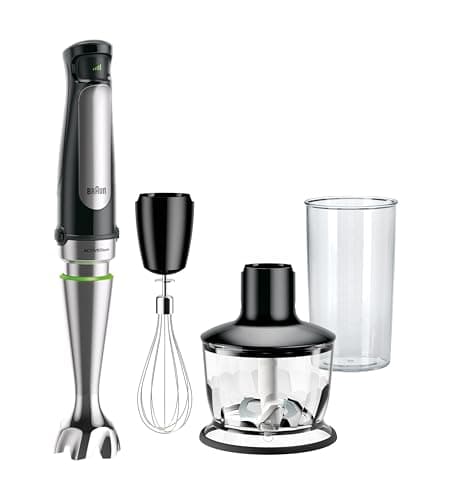
Most kitchens
Braun MultiQuick 7 (MQ7035X)
The one to own: Braun's anti-splash bell and smooth variable speed make it the most controllable stick blender here.
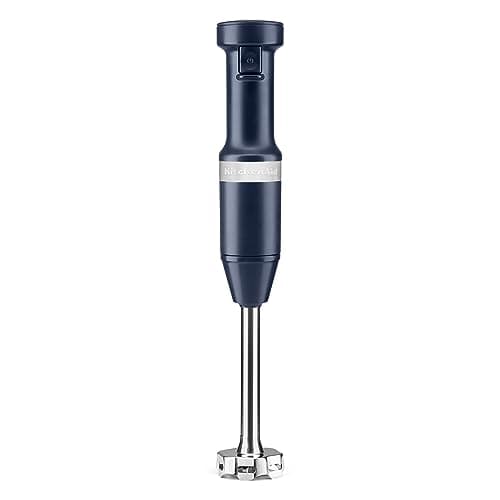
Deep pots
KitchenAid Variable-Speed Corded Hand Blender (KHBV53)
The reach specialist: an 8-inch blending arm that gets to the bottom of a tall stockpot, in solid KitchenAid metal.
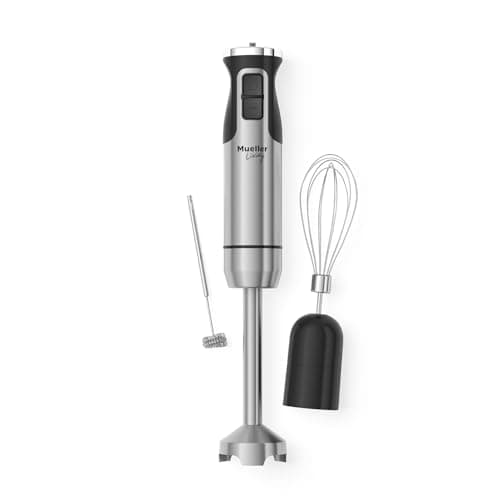
Best cheap immersion
MuellerLiving Ultra-Stick 500W Immersion Blender
The budget champion: a 500-watt, nine-speed stick with whisk and chopper for the price of a basic model.
#ad · As an Amazon Associate we earn from qualifying purchases.
Questions
Frequently asked
Can you put hot soup in a blender?
Is an immersion blender safe for hot liquids?
Can you use an immersion blender directly in the pot?
How full can the pan be when you blend soup?
Keep reading