If you buy one tool for Thanksgiving, buy the OXO Good Grips Stainless Steel Potato Ricer. It is the only thing on this page that changes the result of a dish rather than the time it takes — riced potatoes come out light and separate where mashed ones come out dense, and no amount of technique with a masher closes that gap. It is also the cheapest pick here by a wide margin. Everything else on this page earns its place by letting you finish a dish two days early, which on the one day of the year when four things want the same oven is worth more than speed.
Nothing here is worth buying for one dinner. That is the honest filter we applied to every candidate, and it knocked out most of the things that get recommended in October. A tool you use once a year lives in a cupboard for 364 days and still has to be washed and stored. Every pick below is something we would recommend in March on its own merits — Thanksgiving is just the day you notice you needed it.
The test a Thanksgiving tool has to pass
There are three criteria, and a tool has to clear all three. Plenty of well-reviewed gadgets clear two.
1. The job is actually on the menu, at scale. Five pounds of potatoes, two quarts of stock, a sheet pan of stuffing, four pounds of squash. A tool that saves thirty seconds on one onion saves thirty seconds; a tool that saves ten minutes on five pounds of potatoes changes the shape of the afternoon.
2. The hand method is genuinely worse, not just slower. This is the criterion that does most of the work. A knife slices a potato perfectly well — it just slices it to five slightly different thicknesses, which is why a home gratin has a crunchy layer and a raw layer. A masher mashes potatoes perfectly well — it also crushes the starch cells and makes them gluey if you push it. Where the hand method produces a different and worse outcome, the tool is worth owning. Where it just takes longer, it usually is not.
3. It buys you a day. The actual constraint on Thanksgiving is one oven and one counter. Any tool that moves a dish from Thursday morning to Tuesday evening is worth more than its spec sheet suggests, which is why a cheap push-dicer is on this page and several far more impressive machines are not.
Prices move, so we do not print them in the prose — the table at the top of this page pulls the live number for each pick. Broadly: two of the eight sit in the cheap-gadget bracket, five are mid-priced tools, and one is a full-size appliance in a different bracket entirely.
Mashed potatoes: the one job where the tool changes the result
Potato cells are packed with starch granules. Mashing bursts them and lets the starch out, and once it is out it does what starch does in water — it turns into paste. That is the mechanism behind gluey mashed potatoes, and it is why every piece of advice about them is really advice about handling them less.
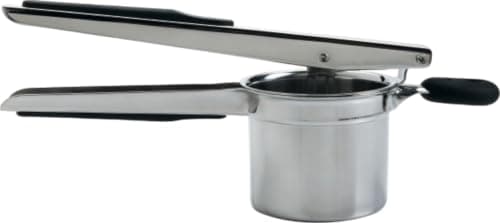
A ricer handles them exactly once. You press the cooked potato through a plate of small holes and it comes out the other side in short, separate strands, already the final texture, with no stirring, folding or working required afterwards. You add warm butter and warm dairy and stop. The OXO Good Grips Stainless Steel Potato Ricer is the one to buy because of a detail that matters more on a crowded stove than it sounds: its listing describes a hook that rests it on the rim of a pot or bowl, so you can work one-handed over the pot you cooked in rather than holding a loaded ricer in the air. The handles need little squeezing force, which is the difference between five pounds of potatoes and three.
Its honest limit is on its card: one disc, so no coarse-or-fine choice. If you want that, the Bellemain ricer ships three discs and our potato ricer roundup puts the two side by side. And if you prefer mash with some texture left in it — a legitimate preference, not a mistake — a ricer is the wrong tool and our masher roundup is the right page. The mechanism comparison across all three tools is in food mill vs ricer vs masher.
Gravy and soup: blend in the pan, not in a blender
Gravy goes wrong in one of two ways: it is lumpy, or it is thin. Both are fixable in the pan with a stick blender, and neither is fixable by pouring hot gravy into a countertop blender, which is also the single most dangerous thing most people do on Thanksgiving. Hot liquid in a sealed jar builds steam pressure and pushes the lid off. We wrote a whole page on it — hot liquid safety— because the emergency-room version of this story is common and completely avoidable.
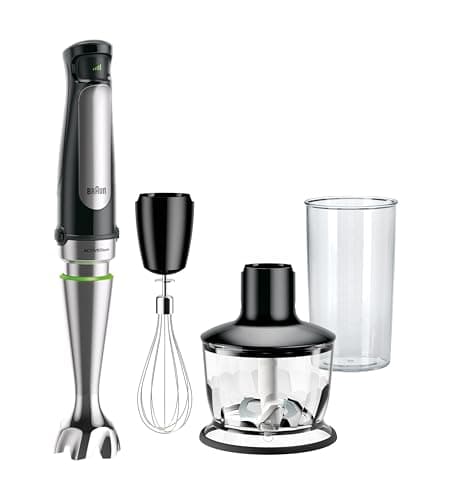
The Braun MultiQuick 7 (MQ7035X) is the pick because of its bell. Braun’s listing describes a splash-control bell shape specifically to reduce spatter, and blending a pan of gravy at the stove is exactly the situation where that matters — you are working in a shallow pan of near-boiling liquid with your forearm over it. Speed is set by trigger pressure rather than a dial, so you can start slow enough not to throw gravy and then push it. The whisk and chopper bowl in the box also quietly cover two other Thanksgiving jobs: whipped cream for the pie, and a small bowl of cranberry relish without washing a full-size processor.
The cons are real and both are about money and storage: it costs more than a single-speed stick, and the attachments need somewhere to live. If gravy and a couple of soups a year are the whole use case, a basic stick blender does that job and our budget immersion blender roundup names the one to get. The full field for pureeing soups is in best immersion blender for soup.
Gratin and scalloped potatoes: the thickness problem
A potato gratin is a stack of slices cooking in liquid, and the recipe time assumes the slices are the same thickness. Hand-cut slices are not. The thin ones at the top go leathery, the thick ones at the bottom stay firm, and the dish spends an extra twenty minutes in an oven that is already booked. Evenness is not a nicety here — it is the recipe.
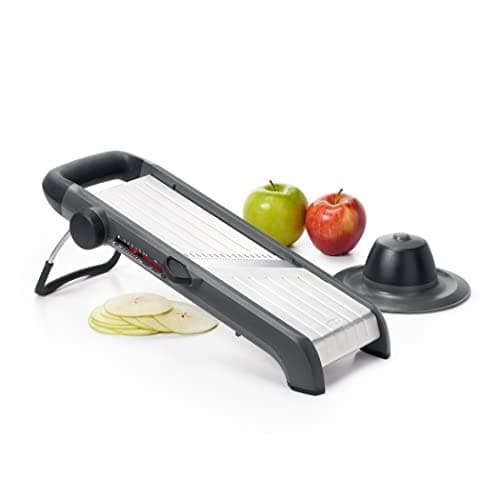
The OXO Good Grips Chef's Mandoline Slicer 2.0 solves it with a dial: OXO’s listing states 21 thickness settings, so you set it once and every slice matches. It includes a food holder and a runway guard, it folds closed for storage, and it is heavy enough not to skate around while you push a potato across it. It is also one of the pricier mandolines we cover, and it is bulkier than a flat handheld — both on its card.
Two things to be straight about. First, a mandoline is the most likely tool on this page to hurt you, and the injuries cluster in the last few slices done freehand and in the washing up. Use the holder every time, read our mandoline safety guide, and buy a glove at the same time — the cut-resistant glove roundup covers the three worth owning. Second, if you own a full-size food processor with a slicing disc, you do not need a mandoline for this job; the disc does it. Which way that decision goes is the whole subject of mandoline vs food processor, and the potato-specific version is in best mandoline for potatoes.
Stuffing, mirepoix and the make-ahead case for a cheap dicer
Stuffing, gravy base, roasted vegetables and most of the sides begin with the same twenty minutes of work: dicing onion, celery and carrot. It is the single largest block of knife time in the whole meal, it is boring, and it is the easiest thing to move to Tuesday.
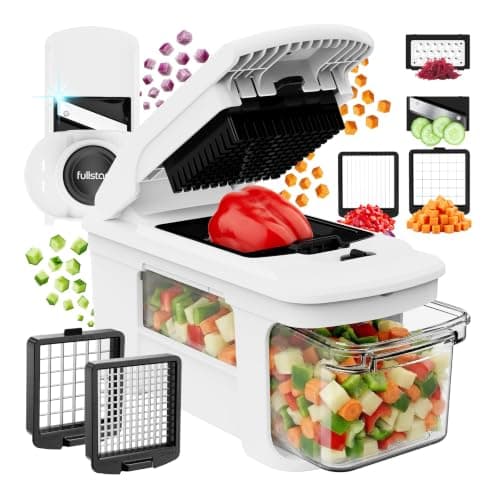
The Fullstar Pro XL Vegetable Chopper & Mandoline is on this page for a reason that has nothing to do with speed. A push-dicer presses food through a stationary grid, so what comes out is even cubes rather than the irregular mince a bladed chopper produces — and even cubes are what you want in stuffing, where the pieces stay visible. Everything lands in a lidded catch container that goes straight into the fridge, which means the output of the job is already stored. That is the entire argument: it turns twenty minutes of Thursday into ten minutes of Tuesday and a box in the fridge.
Its limits are honest and they matter. Hard produce — raw carrot, squash, sweet potato — takes a real, committed push, which is why we say plainly that anyone with weak grip strength or wrist problems should buy an electric chopper instead; our prep tools for arthritis page is the better starting point in that case. And the grid has a lot of small edges to rinse. If you want the other popular push-dicer instead, we set the two against each other in Fullstar vs Mueller; the wider field is in the best vegetable dicers.
The food processor question: only if you would use it in January
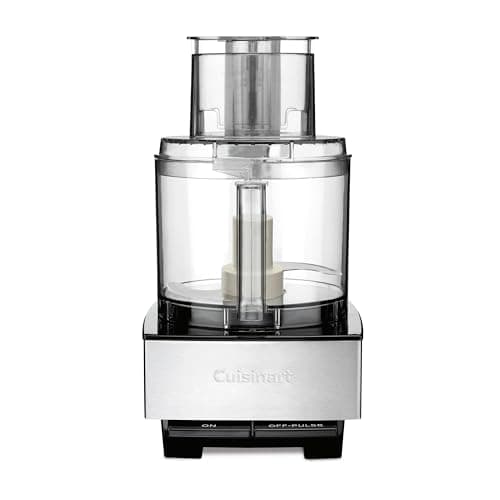
A full-size processor is the only tool here that covers four Thanksgiving dishes at once: pie dough, the mirepoix, cranberry relish, and gratin slices via the disc. The Cuisinart 14-Cup Food Processor (DFP-14BCNY) is the one we recommend for most full-size kitchens — Cuisinart publishes a 14-cup bowl and a 720-watt motor, and the part that actually makes it pleasant to own is that there are only three washable parts, with no drawer of interlocking accessories.
Pie dough is the job where it is genuinely hard to beat. The reason is temperature: the point of dough in a processor is that you cut cold butter into flour in about a dozen pulses with no hand heat touching it, and the butter stays in flakes rather than smearing. That is the mechanism behind a flaky crust, and it is why bakers use the machine for this even when they do everything else by hand.
And now the honest part, which is most of the reason this pick sits in the middle of the page rather than the top. Do not buy a full-size appliance for one dinner. It is a tall machine that does not fit under most upper cabinets assembled, a 14-cup bowl is a chore to wash for half an onion, and if it comes out twice a year it was not worth the counter. If you already own one, use it for all four jobs and skip the mandoline. If you do not, read do I need a food processor in January, not in November. For a smaller, far cheaper machine that handles relish, herbs and nuts — which is most of what a holiday actually asks for — see our Cuisinart Mini-Prep Plus review and the mini food processor roundup. The full-size field is in best large food processors.
Cranberry sauce, apple sauce and the skin problem
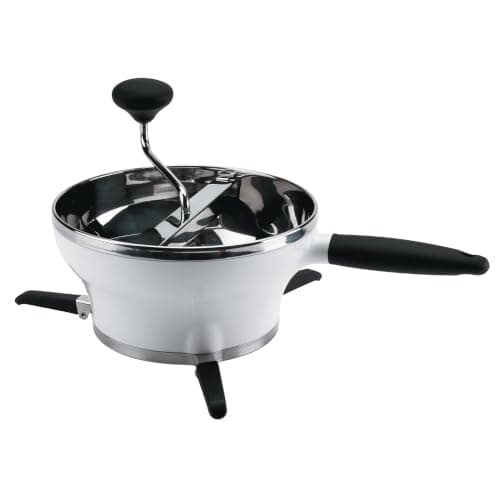
A food mill does one thing nothing else here does: it separates skins and seeds from pulp as it purees. Cranberry skins, apple peel and squash strings all go into the chamber and stay there while smooth puree comes out the bottom. A blender cannot do this — it chops the skins finer and leaves them in. A sieve can, slowly, with a spoon and a sore wrist.
The OXO Good Grips Food Mill ships three discs — fine, medium and coarse — and its listing describes wide legs and a hook that straddle a pot, which is what keeps it from walking around while you crank. For a smooth cranberry sauce, apple sauce from unpeeled apples or pumpkin puree from a real pumpkin, it is the right tool and the only one here that is.
It is also the most skippable pick on the page, and we would rather say so. If your cranberry sauce is the one on the back of the bag and your pumpkin comes out of a can, a mill has no job in your kitchen — it is bulky and it has more parts to wash than a ricer. We cover what it is actually for in how to use a food mill and rank the field in the best food mills.
The turkey itself, and what shears can and cannot do
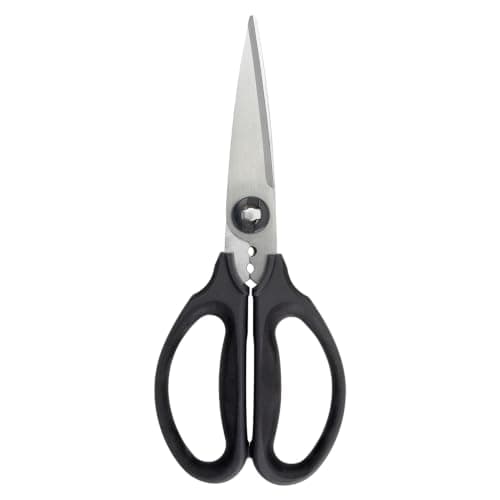
Kitchen shears are the most useful cheap thing on this list and also the pick most likely to be oversold to you, so here is the line. The OXO Good Grips Multi-Purpose Kitchen Shears handles trimming skin and fat, cutting trussing twine, snipping herbs, breaking down a chicken and opening every piece of packaging in the grocery haul. Its micro-serrated edges bite into slippery skin instead of sliding off it, and — the reason it is our pick here rather than the KitchenAid pair — the blades separate, so you can actually scrub the pivot after raw poultry. That is the right priority on a day built around a raw bird.
What they will not do is spatchcock a sixteen-pound turkey. A turkey backbone is a different proposition from a chicken’s, and neither OXO nor any other maker we cover claims poultry-bone capability at that size on its listing. Use a heavy knife, or ask the butcher to do it. Treating a pair of all-purpose shears as poultry shears is how you spring the pivot. The rest of the field, including the take-apart and heavier pairs, is in the best kitchen shears, and what to carve on is in the best cutting boards.
Zest and whole nutmeg: the cheapest upgrade here
Orange zest in the cranberry sauce, lemon zest in the green beans, parmesan over the gratin and whole nutmeg grated into the pie filling and the creamed spinach. All four are small flavor jobs with an outsized effect, and all four want the same tool: a fine rasp.
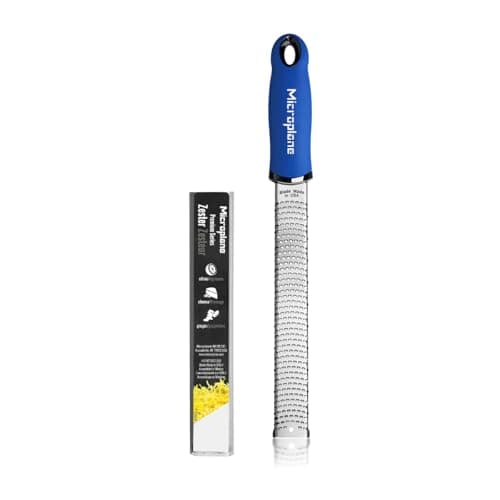
The Microplane Premium Classic Zester is the reference for a reason we can actually point at — it is the only rasp we cover whose listing names the process its teeth are cut by (photo-etching), the steel they are cut from (surgical grade stainless) and the country the blades are made in. The tooth set takes the colored rind and leaves the bitter white pith, which is the entire job. It is magnetic, so it can live on a knife strip rather than loose in a drawer.
Two honest caveats, both on its card: Microplane lists no blade cover for this model, and it is one grate size only, so it is not a stand-in for a box grater. If you want a single tool that both zests and shreds, buy a box grater instead — our cheese grater guide sorts that decision by the cheese, and the rasp field is in the best zesters.
What to buy, in order
If you are buying one thing: the ricer. It is the cheapest pick here and the only one that changes how a dish turns out.
If you are buying two: the ricer and the shears. Between them they cover the one dish a tool improves and the ten small cutting jobs that fill the morning, and both sit in the cheap-gadget bracket — the live total is in the table above.
If you are buying three: add the stick blender. It fixes gravy in the pan, keeps hot liquid out of a sealed jar, and whips the cream for the pie.
Everything beyond that is menu-specific. Gratin or scalloped potatoes on the list? The mandoline. Making sauce or puree from whole fruit? The mill. Doing the vegetable prep days ahead? The dicer. Baking your own pie crust and cooking like this year-round? The processor — in January, when you can think about it properly.
The rules that actually govern your Thanksgiving timeline
No tool on this page helps with any of the following, and all of it constrains the schedule more than knife speed does. These figures are USDA’s, from the FSIS “Let’s Talk Turkey” guidance linked in the sources below — not ours.
Thawing is measured in days, not hours. FSIS allows approximately 24 hours for every 4 to 5 pounds when thawing in a refrigerator at 40 °F or below. A sixteen-pound bird is most of a working week. This is the deadline people actually miss.
165 °F, in three places. FSIS gives the safe minimum internal temperature as 165 °F, checked at the thickest part of the breast, the innermost part of the thigh and the innermost part of the wing. A thermometer is the one piece of Thanksgiving equipment we would call non-negotiable, and it is not on this page because it is not a prep tool.
Two hours on the table. FSIS says to discard turkey, stuffing, side dishes and gravy left at room temperature for longer than two hours. If the meal is grazed over an afternoon, that clock is the one to watch.
Leftovers: shallow containers, 3 to 4 days. Divide leftovers into smaller portions in covered, shallow containers so they cool faster, and eat refrigerated turkey, stuffing, side dishes and gravy within three to four days or freeze them.
What we deliberately left off
Anything shaped like a turkey. Single-use holiday gadgets fail the first test at the top of this page: the job is not on the menu at scale and the hand method is not worse.
A second mashing tool. If you buy the ricer you do not also need a masher, and vice versa. They are the same job done two ways, and the comparison is in potato ricer vs masher.
A countertop blender for gravy or soup. Not because it does not work, but because the version of it that goes wrong goes badly wrong. See hot liquid safety.
Anything we could not verify as currently sold. Every pick above was confirmed live and priced through Amazon’s API on the date stamped at the top of this page. Where a price is missing from the table, the row says so rather than showing a number we cannot stand behind.