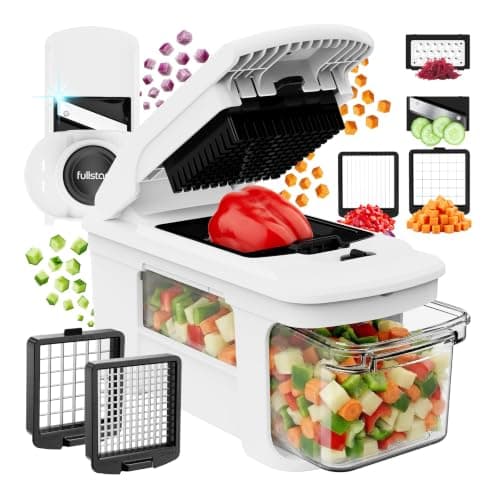
The Fullstar Pro XL Vegetable Chopper & Mandoline is not a cheaper alternative to an electric chopper. It makes a different cut, and that is the whole point. A bladed chopper minces: it hits food repeatedly until the pieces are small and irregular. A push-dicer cubes: you press food through a stationary grid of blades and it falls out the other side in even, square pieces. If you have ever wanted onion that looks like the picture in the recipe, this is the mechanism that gets you there.
The cut, and why it is genuinely different
Look at the two results side by side and the difference is immediate. Minced onion from an electric chopper is a mixture of sizes with some liquid released; diced onion from a grid is uniform cubes that hold their shape in a pan and brown evenly rather than steaming. For anything where the pieces are visible in the finished dish — salsa, a mirepoix, a salad, a stir-fry — the dicer wins outright.
It also slices and grates, via interchangeable blades — the listing names four, in 420J stainless: a fine dicer, a medium dicer, a 2 mm slicer and a grater. What ships with it is a finger guard and a cleaning brush, not a glove, and that matters: the grid is a field of exposed blades, and the most likely injury with this tool happens while you are rinsing it, not while you are using it. Buy a glove separately. Our cut-resistant glove roundup explains what the ratings on that kind of glove mean.
The catch container is half of the value.Everything you dice lands in a lidded box that goes straight to the fridge. That removes the step most people find tedious about prep — scraping a board into a container — and it is a large part of why this design has sold as well as it has.
What it asks of you
Force. A soft onion goes through easily; a raw carrot, a sweet potato or a chunk of squash takes a genuine, committed push with your body weight behind it. That is the honest limit of this tool, and it is why our manual chopper roundup says plainly that anyone with weak grip strength, wrist problems or arthritis should buy an electric chopper instead. No amount of technique substitutes for the force the grid requires.
The second cost is cleaning. A dicing grid has dozens of small edges, and food lodges in them. The supplied cleaning tool pushes most of it through, but this will never be as fast to wash as a bowl-and-blade chopper — call it a minute rather than fifteen seconds.
Where it sits against the electric field
Against the Mueller Pro-Series 10-in-1 Vegetable Chopper, the other push-dicer most people end up choosing between: same cut, same money, four blades against eight — we settle it in Fullstar vs Mueller. Against Ninja Express Chop (NJ110GR), our overall chopper pick: the Ninja is faster, needs no strength and washes in seconds, but cannot cube. Against the onion-chopper field: the Fullstar is the one to buy if you want dice rather than mince, and it does not make you cry any less — nothing does, except a sharp blade and a cold onion.
Against a food processor with a dicing kit: the processor dices too, faster and with no effort, and costs five to ten times as much. If you already own one, you do not need this. If you do not, this is the cheapest route to an even dice by a very wide margin.
Who should buy it
Cooks who prep vegetables in visible pieces and want them uniform, who have the hand strength for hard produce, and who value the catch container. Anyone who mainly wants garlic, herbs and a fast onion mince should buy an electric chopper — the electric roundupcovers those — and anyone prepping in real volume should be reading the processor versus chopper comparison instead.
How we picked
Tools we claim to have lab-tested: 0
Every site in this category tells you they ran twenty machines through a lab. We have not, and we say so. Here is what we do instead: read the manufacturer's manual and spec sheet, record the published bowl capacity, motor rating, blade and disc counts and materials, cross-check the warranty against the manufacturer's own warranty document, and cite all of it so you can check the work. Prices come live from Amazon's API and disappear rather than go stale.
The scores above are judgments from that documented research — not test results. The full rubric, including what disqualifies a product, is published in full.