Almost every recommendation on this site assumes a board underneath it, and the board is the part most kitchens get wrong — usually by owning one, in the wrong material, that slides. Three materials matter, and the honest answer is that a well-equipped kitchen owns two of them: plastic for raw protein and wood or composite for everything else.
The materials, and what each one actually costs you
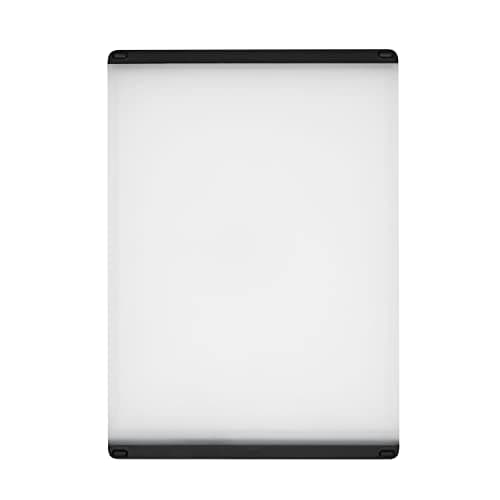
Plastic is non-porous and dishwasher safe, which is the entire argument and it is a strong one: a board you can sanitize at temperature is the right board for raw chicken. The OXO Good Grips Plastic Utility Cutting Boardis the pick, and the reason is not the surface but the feet — a board that does not move is a board that does not cut you. Its price is knife wear: plastic is harder than wood in the way that matters, and it scores, and scored plastic is harder to clean than new plastic.
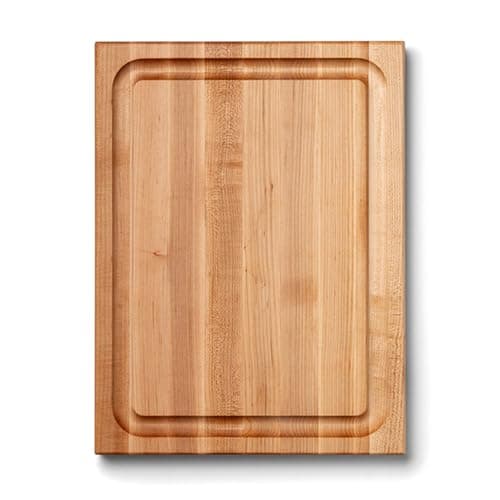
Wood is the opposite trade. The John Boos CB Series Reversible Maple Cutting Board with Juice Groove (20×15)is twelve pounds of edge-grain maple, an inch and a half thick, and it is by a distance the kindest surface here to a knife edge — the wood gives slightly, so the blade does not. It is also the one you must never put in a dishwasher, and it wants oiling a few times a year. That is a small commitment, but it is a commitment, and it is the reason wood should not be your raw-chicken board.
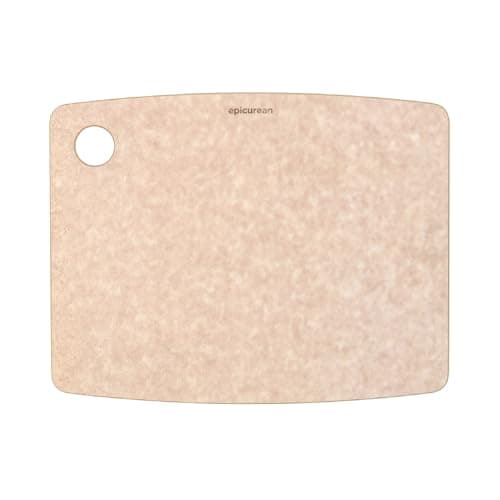
Composite splits the difference. The Epicurean Kitchen Series Cutting Board (11.5×9)is a paper composite: knife-friendlier than plastic, non-porous, needs no oiling, and rated to 350°F so it doubles as a trivet. It is thin and light enough to store upright in a cabinet slot, which is why it is the right answer for a small kitchen where the maple slab has nowhere to live.
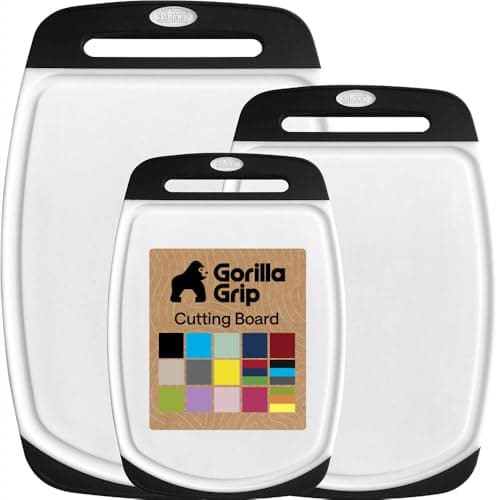
The cross-contamination rule, in one line.Raw meat, poultry and fish get a board that goes in the dishwasher. Everything ready-to-eat — salad, bread, cooked meat, fruit — gets a different board. That is the whole of it, and it is the reason the Gorilla Grip Reversible Cutting Board Set (3) is on this page: three boards for around the price of one makes the rule easy to actually follow.
How they compare
| Board | Material | Size | Dishwasher | Best for |
|---|
| OXO Good Grips Plastic Utility Cutting Board | Plastic | 10.39 × 14.78 in | Yes | Raw meat and everyday prep |
| John Boos CB Series Reversible Maple Cutting Board with Juice Groove (20×15) | Edge-grain maple | 20 × 15 in, 1.5 in thick | Never | Knife work, buy-once |
| Epicurean Kitchen Series Cutting Board (11.5×9) | Paper composite | 11.5 × 9 in | Yes | Small kitchens, doubles as a trivet |
| Gorilla Grip Reversible Cutting Board Set (3) | Plastic (set of 3) | 16 × 11.2, 13.8 × 9.6, 11.8 × 8 in | Yes | Keeping raw and ready-to-eat apart |
Size and stability beat material for safety
A board should be bigger than you think and it must not move. The size rule is simple: if the food you have chopped has nowhere to go, you push it off the edge and you crowd the blade, which is when fingers get hit. Anything under about 12 by 9 inches is a garnish board, not a prep board.
Stability is the other half. The OXO board has non-slip feet, the Gorilla Grip boards have a rubber border, and the Boos block simply weighs twelve pounds. If you own a board with none of those, the fix is free: lay a damp paper towel or a thin cloth underneath it. Do that before you use a mandoline near it — our mandoline safety guide makes the same point about the slicer itself.
What about bamboo, and about glass
Bamboo is a grass, and the boards are made by gluing strips together; they are hard, cheap and reasonably durable, but harder on an edge than maple and prone to splitting at the glue lines. It is a fine budget board and a poor lifetime one. Glass and stone boards should not be used at all for knife work — they are harder than the steel, so every cut damages the blade. Keep them for serving.
If you are building a prep drawer from nothing, the first three purchases are a board, a peeler and a pair of shears. Everything electric on this site comes after those.
The material argument has a page of its own, because the question people actually ask is about hygiene rather than knives: wood vs plastic cutting board works through USDA’s own guidance and the UC Davis research on bacterial recovery, and lands somewhere more interesting than “plastic is cleaner” — a knife-scarred plastic board that is only ever hand-washed is the worst option of the lot.