HUB 06 · Guides
Potato Ricer vs Masher
The difference is not effort, it is what each tool does to the potato's starch cells. That is why one gives fluffy, lump-free mash and the other gives texture — and why a blade gives glue.
We earn a commission if you buy through our links. It does not change the price you pay, and it does not decide our picks — our selection criteria are published in full. How this works.
Use a ricer if you want smooth, fluffy, genuinely lump-free mash, gnocchi dough, or anything where texture is the point. Use a masher if you want rustic mash with some body to it, or you are mashing something other than potato. And use a food processorfor neither — that is the one that produces glue.
What each tool does to the starch
A cooked potato is a mass of cells packed with swollen starch granules. Handle them gently and they separate into individual, fluffy grains. Rupture them and the starch escapes as a sticky gel, and the mash turns gluey. Everything about this comparison follows from that one fact.
A ricer forces the potato through small holes in a single pass. The cells separate rather than burst, which is why riced potato is light and completely lump-free, and why the classic technique for the fluffiest mash is to rice hot potato straight into warm butter and milk.
A mashercrushes from above, repeatedly. Some cells rupture, and how many depends entirely on how long you keep going — which is why mash made with a masher is fine when you stop early and heavy when you do not. That is not a flaw; a slightly denser, more textured mash is what a lot of people actually want.
A blade— a food processor, a blender or a stick blender — ruptures effectively every cell within seconds. The result is wallpaper paste, and it is irreversible. This is the single most common food processor mistake, and it is covered in what a food processor can and cannot do.
The comparison table
| Factor | Potato ricer | Masher |
|---|---|---|
| Texture produced | Light, fluffy, completely lump-free | Rustic, some lumps, more body |
| Risk of gluey mash | Very low | Moderate — rises with over-mashing |
| Effort | Squeeze, in batches | Continuous, in the pot |
| Gnocchi and potato dough | The correct tool | Not really |
| Other foods | Some — cauliflower, apple, squash | Anything: beans, avocado, root veg |
| Washing-up | A hopper and a plate with holes | One tool, rinsed |
| Storage | Bulky | Slim |
The honest case for keeping a masher
A ricer only really does one thing well. A masher does colcannon, champ, mashed swede, refried beans, guacamole, mashed banana and the sweet potato for a pie — and it does them in the pot, with nothing to load in batches. If you mash once a month, a masher is the more sensible drawer occupant. Our potato masher roundup covers which one to buy, and why a wire head and a perforated plate are not the same tool.
The ricer earns its space if mash is a point of pride, if you make gnocchi, or if you are feeding people who notice lumps. It is also the easier tool for large quantities, because ricing is fast once you have a rhythm and mashing a big pot by hand is genuinely hard work. Our potato ricer roundupranks the two we recommend — the OXO Good Grips Stainless Steel Potato Ricer for most kitchens and the Bellemain Large Potato Ricer (3 discs) when you want a choice of disc coarseness.
Three rules for better mash, whichever you use.Start potatoes in cold salted water so they cook evenly. Drain and let them steam dry for a minute before mashing — wet potato makes wet mash. And warm the butter and milk before they go in; cold dairy hitting hot potato is the other reason mash turns dense.
What about a food mill?
A food millsits between the two and is worth knowing about: it presses food through a perforated disc with a rotating blade, giving a result close to a ricer’s while also removing skins and seeds. For potato it is a very good substitute for a ricer. Its real advantage is elsewhere — tomato sauce, apple sauce and berry purees, where the skin-and-seed removal is the whole point. If that is the decision you are actually making, we set all three against each other in food mill vs ricer vs masher.
The hardware
The hardware this guide is about
The products this guide refers to, with prices pulled live from Amazon and dated on every card. Full rankings live in the roundups linked above.
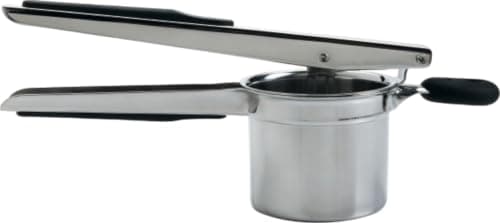
Most kitchens
OXO Good Grips Stainless Steel Potato Ricer
The ricer to buy: comfortable handles, a big hopper and a hook that rests it on any pot for lump-free mash.
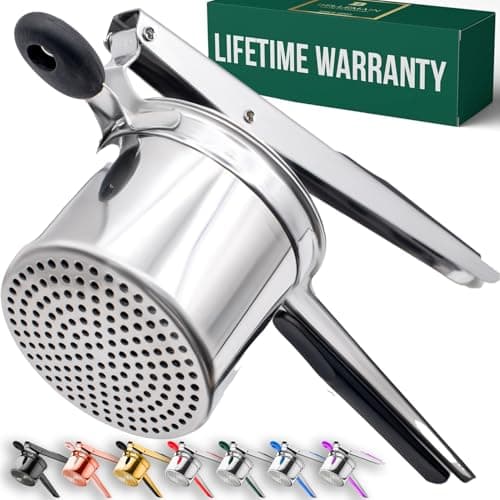
Texture choice on a budget
Bellemain Large Potato Ricer (3 discs)
The versatile budget ricer: three interchangeable discs and a large hopper for a fraction of the OXO's price.
#ad · As an Amazon Associate we earn from qualifying purchases.
Questions
Frequently asked
Is a potato ricer better than a masher?
Why does my mashed potato turn gluey?
Can you use a potato ricer for other foods?
Do you peel potatoes before ricing?
Keep reading