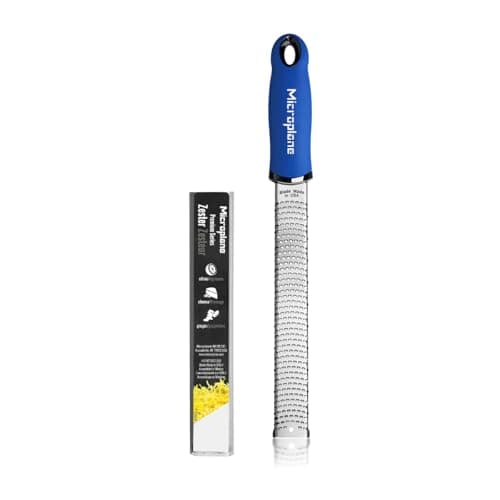
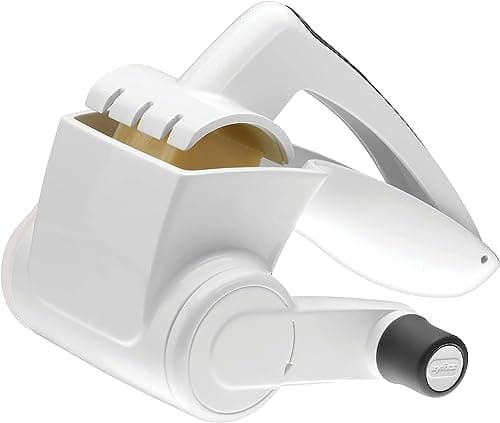
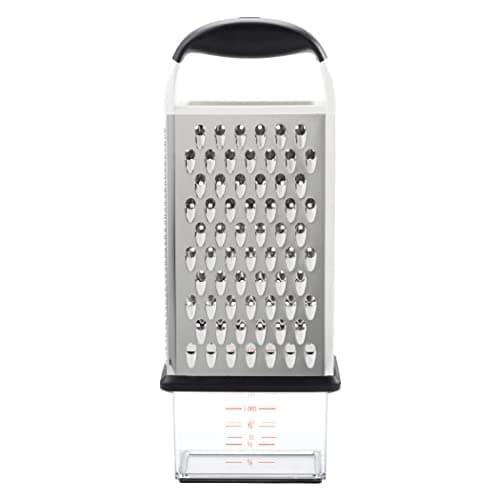
Buy the OXO Good Grips Box Graterif you are buying one cheese grater. It is for the person who grates blocks — cheddar, jack, gouda, mozzarella — because a box grater is the only mechanism here with four different surfaces, a non-slip foot to lean against and a container that catches and measures what comes off. If your cheese is mostly parmesan, buy the Microplane Premium Classic Zester instead, and if you want to grate at the table without putting knuckles near a cutting surface, buy the Zyliss Classic Rotary Cheese Grater. Those three answers cover almost everyone, and the rest of this page is about which one you are.
Match the grater to the cheese, not to the price
Cheese graters are not four grades of one tool. They are four different mechanisms, and each one is good at a different cheese texture. Getting this right is worth more than any amount of spending.
Hard, aged cheese— parmesan, pecorino, aged gouda — is brittle. It wants a fine, sharp cutting surface that shaves rather than drags, which is what a rasp does: the Microplane Premium Classic Zester is the only pick on this page whose listing names the process its teeth are cut by (photo-etching), the steel they are cut from (surgical grade stainless) and the country they are made in. A hand-crank rotary is the other right answer for hard cheese, for a different reason: the cheese goes in a drum, so your fingers are never near the teeth.
Semi-hard block cheese— cheddar, jack, Swiss, gruyere — is what most people actually grate, in quantity, for cooking. It wants a large coarse surface and something stable to push against. That is a box grater, and nothing else here is close on volume. The OXO Good Grips Box Grater publishes four surfaces (coarse, medium and fine grate plus a slicer), a non-slip foot and a removable container with measurement markings.
Soft and fresh cheese— mozzarella, fontina, young provolone — smears. It wants the biggest holes you own and a cold cheese: twenty minutes in the freezer firms it enough to shred instead of paste. A rasp is the wrong tool for soft cheese and a rotary drum will clog with it.
Crumbly cheese— feta, queso fresco, most blues — should not be grated at all. Crumble it with a fork. No grater on this page will do a better job, and several will turn it into a smear you then have to clean off.
The four mechanisms, from the listings
Every cell below is a published surface or capability from the product’s own listing, not a judgment — each one is cited in that pick’s spec chips further down the page.
| Grater | Mechanism | Published surfaces | Fingers near the teeth? | Catches what it grates |
|---|
| OXO Good Grips Box Grater | Four-sided box | Coarse, medium, fine grate and a slicer | Yes — your hand drives the cheese | Yes — removable measuring container |
|---|
| Microplane Premium Classic Zester | Fine photo-etched rasp | One fine grating surface | Yes | No |
|---|
| Zyliss Classic Rotary Cheese Grater | Hand-crank rotary drum | One drum | No — the cheese is enclosed | No — it grates straight onto the plate |
|---|
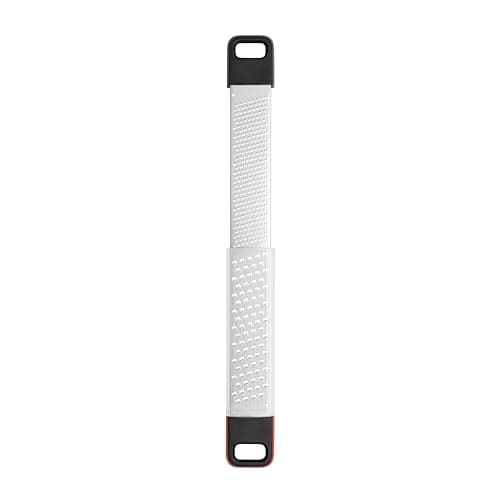
| Cuisipro Surface Glide Dual Grater (Coarse & Fine) | Two-sided handheld | Fine side and coarse side | Yes | No — but it rests across a bowl |
|---|
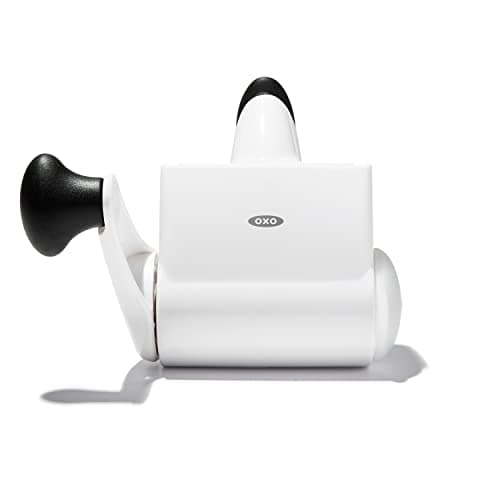
| OXO Good Grips Rotary Cheese Grater | Hand-crank rotary drum | One medium drum | No | Yes — sealing cap stores the leftovers |
|---|
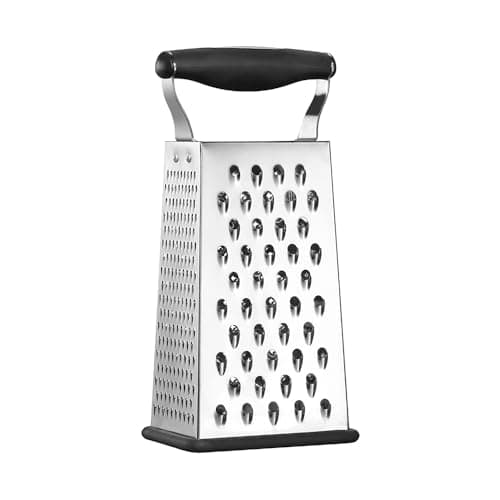
| Cuisinart Box Grater (CTG-00-BG) | Four-sided box | Coarse and fine grate, slicer and zester sides | Yes | No |
|---|
Which one is for you
OXO Good Grips Box Grater— for the cook grating blocks of cheese for cooking, who wants one tool and no thinking. Microplane Premium Classic Zester— for the person whose cheese is parmesan, who also wants citrus zest, nutmeg and ginger from the same tool. Zyliss Classic Rotary Cheese Grater— for grating at the table, and for anyone who has already caught a knuckle on a box grater; it is NSF restaurant certified and dishwasher safe.
Cuisipro Surface Glide Dual Grater (Coarse & Fine)— for the kitchen with no box grater and no drawer space for one, because it is the only handheld here with both a fine and a coarse surface plus a sliding cover. OXO Good Grips Rotary Cheese Grater— for the household that grates half a block of parmesan and wants the rest to go back in the fridge in the same tool, which its sealing cap allows. Cuisinart Box Grater (CTG-00-BG)— for the lowest price that still buys four stainless sides, accepting no non-slip base and no container.
The last inch is where people get cut. Nearly every injury a box grater causes happens in the final inch of a shrinking block, when your knuckles run out of room above the teeth. Stop grating while there is still a piece to hold and either eat the end, chop it with a knife or save it for a soup. The same rule is why a rotary drum is worth owning if you grate hard cheese often: there is no last inch, because your hand never goes near the cutting surface. Our cut-resistant glove picks and the glove rating scales cover the other answer.
Where this page stops
This page sorts graters by cheese. If you have already decided a box grater is what you want and you only need to know which one, our box grater roundup ranks them against each other on grip, base and container. If what you want is a fine rasp for zest as much as for cheese, the zester roundup compares five of them on how their blades are cut. And if you are grating cheese by the pound — a party, a lasagne for twenty — a hand tool is the wrong answer entirely: a food processor with a shredding disc does in thirty seconds what takes ten minutes here, which is the case our shredding guide makes.
What actually separates a good cheese grater from a bad one
How the teeth were made.There are two ways to produce a grating surface: stamping it, which pushes a burr up out of sheet metal, and etching it, which cuts a tooth chemically. Etched teeth shave; stamped teeth tear and need more pressure. Almost no listing says which it used — which is why it is worth noting that Microplane publishes photo-etching and US blade manufacture on both of its picks here, and that Cuisipro’s “Surface Glide Technology” is a brand name with no published measurement behind it. One is a checkable claim; the other is a word.
What it does when you lean on it. Hard cheese needs force, and force needs a base. A non-slip foot (the OXO box grater publishes one) or feet that let the tool sit across a bowl (the Cuisipro dual grater publishes those) is the difference between grating and chasing. The budget box grater here has neither, and that is the main thing you are giving up for the lower price.
Whether the gratings are caught.This sounds like a nicety until you grate a cup of cheddar onto a board and then have to get it into a bowl. Two picks here catch: the OXO box grater’s removable container has measurement markings, and the OXO rotary has a cap with a silicone seal, so a half-grated block goes back in the fridge without dirtying a second container.
Whether it goes in the dishwasher. Cheese fat sets hard in a grating surface, and a grater you have to scrub by hand is a grater you use less. The Zyliss rotary and both Microplanes publish dishwasher-safe care.
Whether the blade is covered when stored. A bare rasp in a drawer is a hazard and it also dulls against everything else in there. The Cuisipro dual grater publishes a sliding cover; the Microplanes publish a magnetic body so they can live on a knife strip instead, but neither lists a cover. That is a real trade-off and it is on their cards above.
What is notworth paying for: a “professional” label, or a count of surfaces you will never use. A four-sided box grater where you only ever use one side is still a one-sided grater, and the fourth side on most of them is a slicer that a knife does better.