HUB 06 · Guides
Julienne vs Batonnet
They are the same cut at two scales - a long square stick, thin or thick. The distinction is worth knowing because it decides cooking time, and because every dice in classical cookery starts as one of them.
We earn a commission if you buy through our links. It does not change the price you pay, and it does not decide our picks — our selection criteria are published in full. How this works.
A julienne and a batonnet are the same shape at two sizes. Both are long square-sided sticks; the julienne is the thin one, conventionally described as about an eighth of an inch square, and the batonnet is the thick one, about a quarter inch square. Both are usually cut around two inches long. That is the entire difference, and the reason to care is practical: the thin stick cooks in a minute or two and the thick one takes four or five, so swapping them changes a recipe’s timing more than its appearance.
Why the words exist at all. In classical kitchen vocabulary the stick cuts are the parents of the dice cuts. Cut a batonnet across at its own width and you get a large dice. Cut a julienne across at its own width and you get a brunoise, the fine dice used for garnish and delicate sauces. So “julienne” is not a decorative flourish — it is step one of a dice, and that is why professional recipes name it.
The two cuts side by side
| Cut | Conventionally about | Becomes, cut across | Used for |
|---|---|---|---|
| Julienne (matchstick) | 1/8 in square, 2 in long | Brunoise / fine dice | Stir-fries, slaws, garnish, spring rolls, quick pickles |
| Batonnet | 1/4 in square, 2–2.5 in long | Large dice | Crudités, French fries, roasted sticks, crisp salads |
| Allumette (fine julienne) | Thinner again — a hair under 1/8 in | Very fine dice | Delicate garnish, straw potatoes |
| Chiffonade | Ribbons, not sticks | Nothing — it is a leaf cut | Basil, mint, leafy herbs and greens |
Those are the conventional culinary definitions, given as approximations because that is how they are used in practice: no kitchen measures a carrot stick with callipers, and recipes that say “julienne the carrot” mean “thin matchsticks, roughly even”. Chiffonade is in the table only because it is the cut most often confused with julienne, and it is not a stick at all — it is a rolled leaf sliced into ribbons.
Which one does the recipe actually want?
If it goes in a hot pan for a short time, julienne. Stir-fries, noodle dishes and anything finished in minutes need the thin stick, because a batonnet will still be raw in the middle when the dish is done.
If it is eaten raw and should crunch, batonnet. Crudités, a carrot stick with dip, a crisp slaw that must not wilt. The thicker stick holds its structure and keeps its snap; a julienne goes limp in dressing within half an hour.
If it is roasted or fried, batonnet. A fry is a batonnet by definition, and the whole category of French fry cutters exists to make one at a consistent size. A julienne in a hot oven becomes a crisp, which is sometimes exactly what you want and never what the recipe said.
If it is a garnish, julienne or allumette. The point is that it reads as a deliberate line on the plate rather than as a piece of vegetable.
Cutting them by hand
The method is the same for both; only the measurement changes. Square the vegetable first — trim it into a rectangular block, which is the step that makes every later cut even and the step everyone skips. Keep the trimmings for stock. Slice the block into planks of the target thickness: an eighth of an inch for julienne, a quarter for batonnet. Stack two or three planks and cut them into sticks at the same width. If your planks and your sticks are both the same measurement, the cross-section is square, which is the whole definition.
For a dice, stop there and cut across the sticks at that same width one more time. That is the entire relationship between the stick cuts and the dice cuts, and it is why our dicing guide starts with planks and batons too. The long-form knife version of this page, with the vegetable-by-vegetable notes, is how to julienne vegetables.
Cutting them with a tool
A mandoline comb cuts julienne, not batonnet. A mandoline makes a matchstick by passing food over a comb of standing teeth that score it, then over the flat blade that lifts the scored layer away as strips. The Benriner Super Slicer (Japanese Mandoline) is the tool in this catalog that publishes a count of dedicated julienne blades — three, plus the flat blade — which is the only way to get more than one coarseness from one frame. The OXO Good Grips Chef's Mandoline Slicer 2.0 states julienne and French-fry cuts, and the French-fry setting is the one that reaches batonnet-and-thicker territory.
A julienne peeler cuts short julienne only. The Zyliss Julienne Y Peeler is a Y-peeler with a toothed head: one stroke, one set of strips, limited to the length of that stroke. It is the fastest way to julienne one carrot and it cannot produce a batonnet at all, because the teeth are fixed at one width.
A food processor does neither properly. Its julienne disc, where one is offered, produces a short stick whose length is limited by the feed tube and the disc geometry, and nothing in a processor makes a true batonnet. We cover what the discs actually do in food processor blades and discs explained.
The honest gap: nobody publishes a width
We have checked every julienne tool in this catalog — mandolines, peelers and processor discs — and not one maker states the width of the strip its teeth cut, in millimetres or in inches. So the figures on this page are the classical culinary conventions, labelled as such, and we attach none of them to a particular tool. If you need a precise, repeatable eighth-inch stick, a knife and a ruler will get you there and no box on the shelf will promise it. This is the same finding our julienne peeler roundup and our mandoline-for-julienne page both record, and we would rather repeat the gap than fill it with a number from somewhere else.
Vegetables that suit each cut
Julienne: carrot, courgette, daikon, celeriac, pepper, cucumber (seeded), apple, mango, spring onion, ginger. Anything dense and straight.
Batonnet: potato, carrot, celery, cucumber, swede, parsnip, halloumi. Things that need to stay rigid.
Neither: tomato, avocado, mushroom, aubergine and anything ripe and soft. They have no internal structure to hold a square section, and a comb will tear them. Cabbage is also not a julienne — it is shredded, which is a flat-blade job and has its own page.
What we are not claiming
The dimensions above are the conventional descriptions of these cuts in classical kitchen vocabulary, stated as approximations, and they are not measurements of any product. Every claim about a tool — blade counts, cut types, thickness settings, blade covers — is the manufacturer’s own published wording, cited below. Where no maker publishes a strip width, this page prints none. We have not tested these tools. Prices come live from Amazon with the date attached.
The hardware
The hardware this guide is about
The products this guide refers to, with prices pulled live from Amazon and dated on every card. Full rankings live in the roundups linked above.
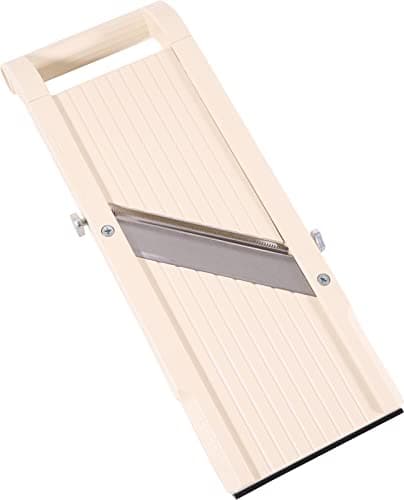
Sharpest slices
Benriner Super Slicer (Japanese Mandoline)
The professional's mandoline: a wide Japanese slicer whose razor-sharp blades chefs quietly rely on.
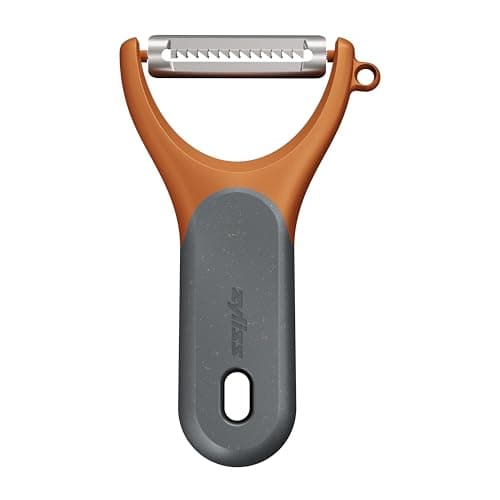
Most kitchens
Zyliss Julienne Y Peeler
The cheapest julienne peeler here that ships with a blade cover — and a cover is the feature that matters most on a tool whose teeth are the most finger-hostile edge in the drawer.
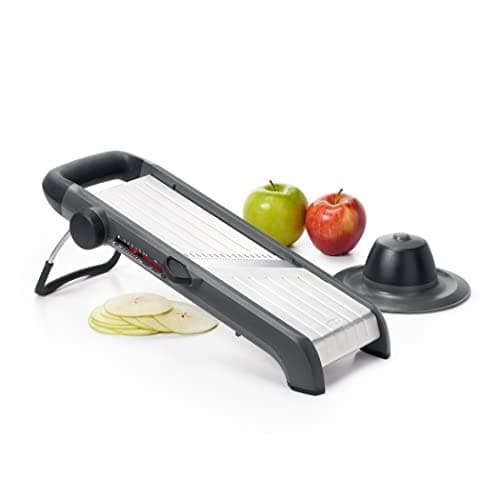
Most home cooks
OXO Good Grips Chef's Mandoline Slicer 2.0
The mandoline to buy: a solid, foldable slicer with a runway of thickness settings and a genuinely usable hand guard.
#ad · As an Amazon Associate we earn from qualifying purchases.
Questions
Frequently asked
What is the difference between julienne and batonnet?
Is a batonnet the same as a French fry?
What dice does each cut become?
Can a mandoline cut a batonnet?
How thin is a julienne from a julienne peeler?
Keep reading
Related
Receipts
Sources
- Amazon listing - Benriner Super Slicer Japanese mandoline (flat blade plus 3 interchangeable julienne blades, extra-wide slicing surface, screw-set thickness dial)
- Amazon listing - Zyliss Julienne Y Peeler (fixed julienne head, extra-hardened blade, blade cover included; no strip width published)
- Amazon listing - OXO Good Grips Chef's Mandoline Slicer 2.0 (straight and crinkle slices plus julienne and French-fry cuts, 21 thickness settings, food holder and runway guard)
We do not run a testing lab and we do not pretend to. Specifications come from the manufacturer's own published documents and from published standards; prices come from the live Amazon API. Where a figure is not published, the page says “not published” rather than guessing. Read the full method.