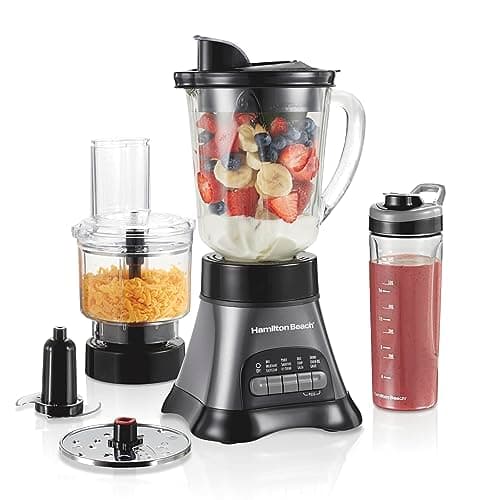
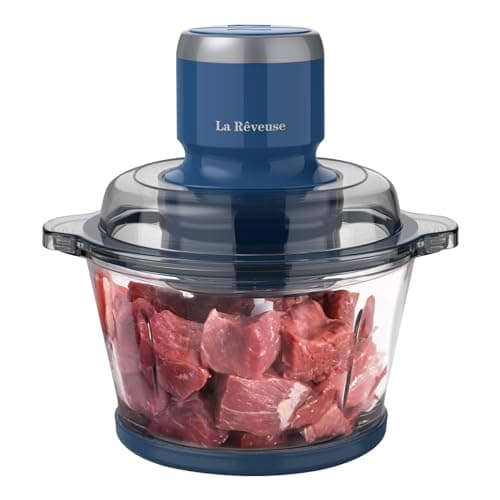
For most kitchens the answer is the La Reveuse 7-Cup Glass Bowl Food Processor (LARB4016): a real 7-cup glass bowl, two pulse speeds and a whisking disc, at the price of an ordinary plastic chopper. If you want no plastic bowl in the house at all, the Ganiza Dual-Bowl Food Processor, 8-Cup Glass + 8-Cup Stainless (GC10) ships one glass bowl and one stainless one. If you want the biggest glass bowl on sale, the COOKZHOM 12-Cup Glass Bowl Food Processor holds three liters. And if you want a brand with a service department, the Hamilton Beach Blender & Food Processor Combo (58163) is the only one here — with a catch we state plainly below.
Read this before you compare anything. No major appliance brand makes a glass food-processor work bowl. Cuisinart, KitchenAid, Breville and Ninja all use polycarbonate, and the reason is mechanical rather than cynical: a disc-and-feed-tube bowl has to take a twist-lock collar, a tall chute and the torque of a 700-to-1,450-watt drive, and glass is the wrong material for all three. So every machine on this page is a bladed chopper-style processor from a smaller brand. None of them slices or shreds with discs. On all of them the lid is still plastic. If that rules the category out for you, you have saved yourself an hour — go to the main food processor roundup instead.
What we looked for
The criteria below are what separated six machines worth naming from a page of near-identical listings. They are deliberately boring, because in a category with no household brands the specification sheet is all the evidence there is.
- The glass has to be the work bowl. Several machines that rank for this search are blenders with a glass jar and a plastic chopping attachment. That is a different product, and where it applies we say so on the pick itself.
- A published wattage. Not a marketing adjective. Every pick here states a motor figure on its own listing, and we repeat it in the maker’s own words — including when it is a peak rating, which is not comparable with a continuous one.
- Two speeds or a real pulse. A single on/off button is how a glass bowl full of onion becomes a glass bowl full of onion water. Five of the six give you either two speeds or a momentary pulse.
- Stated care instructions. Glass is dishwasher-friendly; the lid on these machines frequently is not. A listing that spells out which parts can be washed how is a listing we can hold to account.
- In stock when we checked. Every ASIN on this page was resolved through Amazon’s Creators API on 15 October 2026 and then re-checked for availability before it was allowed on the page. This category churns badly, and a dead listing is worse than no recommendation.
What we did not use as a criterion is brand reputation, because in this corner of the market there is almost none to use. Five of these six names will be unfamiliar. That is a genuine risk and it belongs in your decision: a $30 machine from a brand with no parts catalog is a consumable, not an heirloom. The one familiar name here is the Hamilton Beach, and it is familiar precisely because its glass is somewhere else.
The picks
1. La Reveuse 7-Cup Glass Bowl Food Processor (LARB4016) — the one most people should buy
Seven cups — 1.7 liters — of glass is the size at which this category stops being a novelty. It takes a whole head of broccoli, a batch of salsa or a pound of cooked chicken, which covers the overwhelming majority of what a home processor is asked to do. La Reveuse publishes 300 W behind a double-layer, four-leaf stainless blade, and the controls are two one-touch pulse buttons rather than a single switch: the low button is for onion and herbs, the high one for meat and nuts. A whisking disc, a spatula and an anti-slip mat are in the box.
The honest limit is the motor. 300 W is the lowest published figure on this page and it shows on anything dense — a chunk of parmesan, raw carrot, a frozen banana. It is also bladed only, so there is no feed tube and no slicing or shredding disc; if a mandoline-style cut is what you are after, our best food processor for slicing page is the one you want, and nothing on it has a glass bowl.
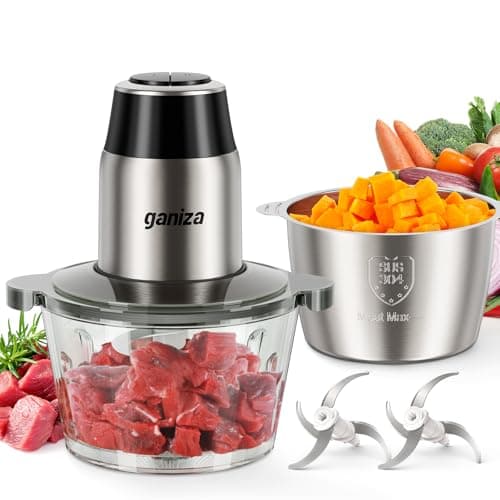
2. Ganiza Dual-Bowl Food Processor, 8-Cup Glass + 8-Cup Stainless (GC10) — no plastic bowl at all
This is the pick for the reader whose search was really “glass food processor no plastic”. Ganiza ships two 8-cup bowls in two different materials — one glass, one 304 stainless — and the maker’s stated reason for doing so is hygiene: keep raw meat in one and produce in the other so the two never share a vessel. At 450 W with two speeds it handles raw meat, which the La Reveuse does slowly. The blades are spring-loaded and stop the moment the motor head is lifted, which addresses the thing people are most nervous about with a bladed chopper.
It is the bulkiest thing here: two bowls and two blade sets take real cupboard space, and if you only ever chop one kind of food the second bowl is the entire premium you are paying. Ganiza also warns that the overheating cut-out will stop the machine until it cools, so back-to-back heavy batches need a pause built into your plan.
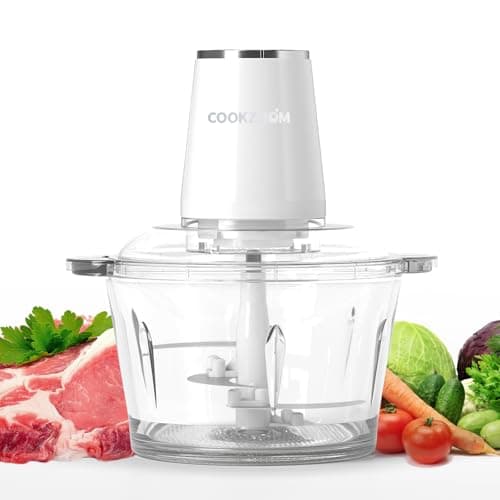
3. COOKZHOM 12-Cup Glass Bowl Food Processor — the biggest glass bowl on sale
Twelve cups, three liters. That is full-size-processor capacity in a material no full-size processor offers, and COOKZHOM states a 2 to 4 lb batch of meat in a single pass, which puts burger mince and meatball mix genuinely within reach. The motor is 500 W with two speeds, and bowl and blades are dishwasher safe.
Two real costs. The lid is PE and the listing says explicitly that it cannot go in the dishwasher — so the part that gets dirtiest is the part you wash by hand. And three liters of glass is heavy when it is full: this is a two-handed lift to the sink, and the bowl is the one component you cannot cheaply replace. For one or two people it is more machine than the job deserves; see pick 5.
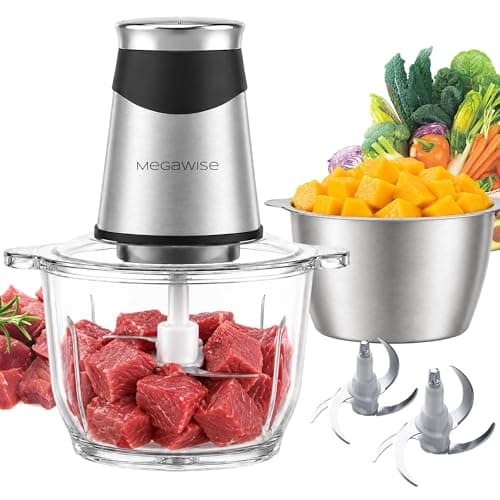
4. MEGAWISE 800 W Dual-Bowl Food Chopper, 2.2 L Glass + 1.2 L Stainless (AMJ-217A) — the most power
800 W is more than double the La Reveuse, and MEGAWISE points it squarely at firmer ingredients and raw meat. You get a 2.2 L glass bowl for produce and a 1.2 L stainless bowl for the messier jobs, a 304 stainless blade assembly, two speeds, and a safety switch that refuses to run until the machine is assembled correctly.
The control scheme is the thing to understand before buying: press-and-release. You hold the button for as long as you want the blades turning. That is excellent for pulsing — arguably the correct way to use any bladed chopper — and tiring for a long continuous run. The glass bowl’s lid and the motor unit both stay out of the dishwasher. It is also the most expensive dedicated glass machine on the page, which for a brand with no service network is a harder sell than it would be from Cuisinart.
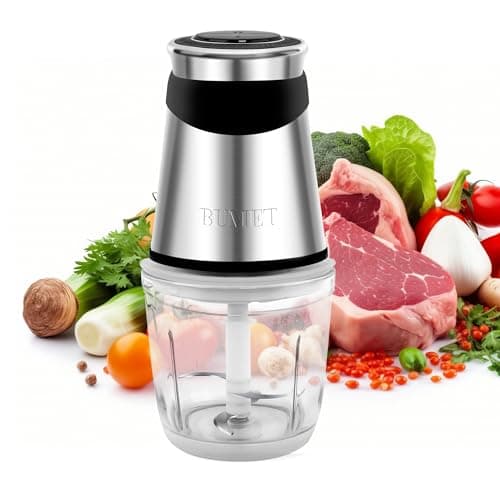
5. BUMET 2.5-Cup Glass Bowl Mini Chopper (B302MINI) — the small-batch answer
Two and a half cups, 500 W, a safety lock, a four-piece blade set with a storage guard, and dishwasher-safe bowl and blades. This is the size at which a glass bowl is genuinely nicer than plastic rather than merely different: garlic, herbs, a single shallot, baby purees — the jobs where plastic picks up smell and stain fastest, and where you do not want to wash a three-liter bowl afterwards. If you are buying for a baby’s first months, read it alongside our best food processor for baby food picks.
BUMET is unusually honest about the limits and we will repeat them rather than soften them: not for hard nuts, nut butter, bones, heavy sinew, dry chili or dry grains. It minces and purees; it does not slice or shred. And the recommended half-capacity fill leaves roughly 1.25 usable cups, so it is smaller in practice than the spec implies. For nut butter specifically, the right machine is on our nut butter page, and it is not this one.
6. Hamilton Beach Blender & Food Processor Combo (58163) — the only name brand, with a caveat
Hamilton Beach is the one manufacturer in this group with a parts catalog, a printed manual and a phone number, and the 40 oz glass jar is the real article: the company says it is built for extreme temperatures, which is why hot soup can go into it — the single job a plastic jar is worst at. Peak power is 700 W and a 3-cup food chopper attachment and a 20 oz travel jar come with it.
Here is the caveat, and it is the reason this pick sits last rather than first: the listing attributes glass only to the 40 oz blending jar. The 3-cup chopper attachment is not described as glass. So if your search was for a glass bowl to chop in, this machine does not give you one — it gives you a glass blender jar plus a conventional chopper. That is a good buy on its own terms and the wrong buy for this page’s question. Note also that 700 W is a peak figure, not a continuous rating, so it cannot be lined up against the 450 W and 500 W numbers above.
What each one publishes
| Pick | Glass part | Published motor | Controls | The stated catch |
|---|
| La Reveuse 7-Cup Glass Bowl Food Processor (LARB4016) | 7-cup (1.7 L) work bowl | 300 W | Two-speed one-touch pulse | Lowest wattage here; bladed only |
|---|
| Ganiza Dual-Bowl Food Processor, 8-Cup Glass + 8-Cup Stainless (GC10) | 8-cup work bowl (plus an 8-cup stainless bowl) | 450 W | Two speeds | Overheating cut-out needs a cooling pause |
|---|
| COOKZHOM 12-Cup Glass Bowl Food Processor | 12-cup (3 L) work bowl | 500 W | Two speeds | PE lid is not dishwasher safe |
|---|
| MEGAWISE 800 W Dual-Bowl Food Chopper, 2.2 L Glass + 1.2 L Stainless (AMJ-217A) | 2.2 L work bowl (plus a 1.2 L stainless bowl) | 800 W | Two speeds, press-and-release | Glass lid and motor unit stay out of the dishwasher |
|---|
| BUMET 2.5-Cup Glass Bowl Mini Chopper (B302MINI) | 2.5-cup work bowl | 500 W | One-touch | Maker rules out nuts, nut butter and dry grains |
|---|
| Hamilton Beach Blender & Food Processor Combo (58163) | 40 oz blender jar — not the chopper bowl | 700 W peak | Blender controls plus chopper attachment | The chopping bowl is not the glass part |
|---|
We have deliberately left the annual running-cost column off this table, which other pages on this site carry. Five of these machines publish continuous watts and one publishes a peak figure, and quietly mixing the two into one arithmetic would produce a tidy table of numbers that does not mean anything. Our food processor running-cost page explains how that calculation works where the inputs are comparable.
What “plastic-free” actually gets you
A large share of this search is really about plastic rather than about glass, so it is worth being precise about what the category can and cannot deliver. On every machine above, the lid, the motor housing and the blade collar are plastic. The glass replaces the bowl — the part your food sits in longest, and the part that stains and holds smell — and that is a genuine improvement. It is not a plastic-free appliance, and no appliance in this class is one.
If removing plastic from food contact entirely is the goal, the honest route is not an appliance at all. A mortar and pestle is stone. A box grater and a vegetable peeler are steel with a handle. A food mill is stainless throughout. Between the Ganiza’s stainless bowl and that shelf of manual tools, a kitchen can get most of the way there — it just cannot get there with a motor and a lid.
Glass, plastic or stainless: the real trade
Glass wins on neutrality. It does not stain from turmeric or tomato, does not hold garlic or onion smell, and does not scratch into the cloudy, scuffed finish that an older polycarbonate bowl develops. Clear glass also lets you see the texture you are actually producing, which matters more than it sounds when the difference between minced and pureed is two seconds.
Glass loses on weight and shock. A full 3-liter glass bowl is a two-handed lift, and glass is unforgiving of thermal shock: a hot bowl into cold water, or boiling stock into a cold bowl, is how these break. Treat the bowl the way you treat a casserole dish and it will outlive the motor; treat it like a Pyrex measuring cup in a hurry and it will not.
Stainless wins on durability and loses on visibility. You cannot see what is happening inside, which is why the Ganiza and the MEGAWISE both pair a stainless bowl with a glass one rather than shipping two of either.
Plastic wins on everything mechanical. It is light, it takes a locking collar and a feed tube, and it tolerates the torque a 1,450-watt motor applies. That is the whole reason the serious machines use it, and why the Cuisinart DFP-14 still does things nothing on this page can.
If the answer is “none of these”
That is a legitimate conclusion, and the alternatives split cleanly by what you were trying to avoid. If you wanted glass because of staining and odor, a stainless chopper bowl solves the same problem with none of the weight. If you wanted glass because of heat, an immersion blender blends hot soup in the pot and never needs a bowl at all — and it makes mayonnaise in a jar in thirty seconds. Read our hot liquid safety guide first. If you wanted glass because of scratched old plastic, a replacement bowl for a Cuisinart or KitchenAid costs a fraction of a new machine. And if what you actually need is even dice rather than mince, no glass machine does it: that is the push-dicer field, where the widest-ranging tool is the one in our Mueller Pro-Series review, and our food processor vs chopper comparison explains which side of the line your cooking sits on.
Four rules for living with a glass bowl
Never pour boiling liquid into a cold bowl. Thermal shock is the single most common way a glass work bowl dies. Let soup drop below a simmer, or warm the bowl under the tap first. Hamilton Beach is the only maker here that states its glass is built for extreme temperatures; the others make no such claim, so do not assume it.
Fill to the line, and on the mini, to half. A bladed chopper works by throwing food at a spinning edge. Overfill it and the bottom third turns to puree while the top third stays whole — which is not the machine failing, it is physics. BUMET recommends half capacity on the 2.5-cup bowl specifically.
Pulse, do not run. Two one-second pulses, a look, then two more. Every complaint about a chopper producing mush comes from holding the button down, and the press-and-release control on the MEGAWISE exists to make that mistake harder.
Check which parts the dishwasher gets. Across these six, glass bowls and steel blades are generally dishwasher safe and lids frequently are not — COOKZHOM and MEGAWISE both say so explicitly. A lid washed in a machine it was not rated for is how a seal perishes and starts leaking.
What we are not claiming
We have not tested these six machines. Every capacity, wattage, blade count, safety feature and care instruction above is quoted from the maker’s own live listing, each one linked in the sources below, and the ranking is an argument from those published facts plus the structural point about work-bowl materials that opens the page. Prices are pulled live with the date attached and are never typed into the copy. Our how we pick page sets out the method in full.