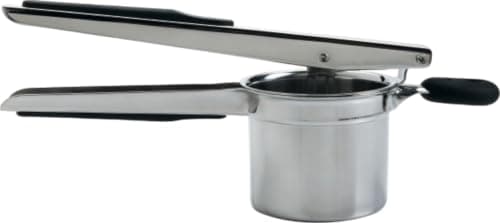
A potato ricer is a single-purpose tool that is very hard to improve on, which makes the differences between them small and specific. The OXO Good Grips Stainless Steel Potato Ricer wins on two of those specifics: a frame that hooks over the edge of the pot so you are not holding the whole assembly in mid-air, and handles soft enough that a full hopper of hot potato does not become an ordeal.
Why a ricer beats a masher at all
It is worth restating, because it is the reason to own one. A masher crushes and folds, which means it works the potato repeatedly and ruptures starch cells; too much of that and mash goes gluey. A ricer extrudes: the potato goes through the holes exactly once, in one direction, and comes out as fine strands that need only butter and a gentle fold. That single pass is why riced mash is smooth and light rather than sticky.
The full argument, including the case for keeping a masher anyway, is in ricer vs masher.
The frame is the feature
OXO’s listed design point is that the ricer hooks over the edge of most pots and bowls. That sounds trivial and it changes the job. Riced potato has to land somewhere, and without a rest you are holding a heavy stainless tool over a pan with one hand while squeezing hard with the other. Resting the frame on the rim means both hands are on the handles, which is where the leverage is, and the hot potato is not traveling across your kitchen.
The body is stainless with soft non-slip handles. On a tool whose entire operation is a hard squeeze, handle comfort is not a nicety — it is the difference between doing four hoppers of potato and doing two and giving up.
What else it does
OXO lists it for potatoes and for pureeing soft foods, and that second use is the underrated one. Cooked apple for applesauce, cooked cauliflower, cooked squash, chestnuts, hard-boiled egg yolks for a garnish or a dressing, and squeezing the water out of cooked spinach — all of them work, none of them needs a machine, and none of them wakes the house.
What it does not do is separate skins and seeds. That is a food mill, and the two tools are frequently confused. If your goal is smooth tomato sauce or applesauce from whole fruit, you want the mill, not the ricer.
Rice them hot, and do not rinse.Potatoes rice easily while hot and turn stubborn as they cool. Work straight from the drained pot, rice into a warm bowl, and fold the butter in before the milk — the fat coats the starch first, which is a large part of why restaurant mash is silky. Riced potato also cools fast because of the surface area, so have everything ready.
What OXO publishes, and what it does not
Four claims, and they are worth reading literally. OXO states that it is for smooth, fluffy mashed potatoes; that the body is durable stainless steel with soft handles and is dishwasher safe; that a non-slip knob holds the ricer in place over the bowl or pot; and that it also rices carrots, cauliflower, yams and baby food. Every one of those is a design claim you can check the moment it arrives.
What OXO does not publish is just as informative. There is no hole diameter, no hopper capacity and no stated weight, which means this ricer cannot be compared on paper with a rival that does publish those numbers — the Bellemain states roughly a 15-ounce hopper, the OXO states nothing. We are not going to invent a figure to fill the gap. It is the same reason our masher roundup gives credit to the one brand that publishes a wire gauge.
The warranty is OXO’s standard satisfaction guarantee rather than a term of years, which is worth knowing if you are the sort of buyer who chooses on warranty length. In this category it matters less than usual: there is no motor, no seal and no electronics, and the failure mode of a stainless ricer is essentially a bent handle from misuse.
Cleaning it, which is the real objection
A perforated plate is the part everyone dreads, and the honest answer is that it is fine if you rinse it immediately and a nuisance if you do not. Starch sets hard as it dries, and a plate you left in the sink through dinner takes a brush and some patience. Run it under hot water while the pan is still on the stove and it clears in seconds.
OXO lists the ricer as dishwasher safe, so it can go in the machine, though the plate still benefits from a rinse first for the same reason. Compare that with a masher, which is one piece and rinses in a moment, and with a food mill, which is a body, a disc, a blade and a scraper. On washing-up alone, the ricer sits in the middle.
Ricer, mill or masher?
This is the question most people are really asking when they land on a ricer page, and the short version is that a ricer is the specialist. A masher is the general-purpose tool and the one to own first; a food mill is the one that separates skins and seeds and therefore owns sauces; a ricer is the one that gives the fluffiest, most reliably lump-free mash and the right texture for gnocchi. We set all three against each other, with a table, in food mill vs ricer vs masher.
Where the Bellemain wins
The Bellemain Large Potato Ricer (3 discs) is the direct alternative and it beats the OXO on one axis: it ships with three interchangeable discs (fine, medium and coarse) and a larger hopper. If you want a coarser, more rustic mash sometimes and a fine one other times, or you are ricing for a crowd and want fewer refills, that is a real advantage at a lower price.
What you give up is the squeeze. The OXO’s handles are more comfortable and the pot rest is better resolved, which is exactly what you notice on the fourth hopper. Our potato ricer roundup puts the two side by side.
Who should buy it
Anyone who makes mash more than a couple of times a year and wants the simplest possible route to a good result. It is also the better of the two for anyone with hand or wrist issues, for the handle reason above.
Skip it if you want texture options — buy the three-disc Bellemain — or if what you actually need is skins and seeds removed, in which case a food mill is the tool. And if mash is a once-a-year event, a hand masher and a bit of patience is a perfectly honest answer.