HUB 06 · Guides
Food Processor vs Immersion Blender
These two overlap far less than people expect. One cuts dry solids into pieces; the other blends wet food where it already sits. Here is the job-by-job split.
We earn a commission if you buy through our links. It does not change the price you pay, and it does not decide our picks — our selection criteria are published in full. How this works.
Buy a food processor if your problem is cutting: slicing, shredding, chopping, dough, dry mixtures. Buy an immersion blender if your problem is blending something wetthat is already in a pot or jug. They are much less interchangeable than the shared word “blend” suggests, and the small number of jobs they both do — dips, baby food, pesto — is where all the confusion comes from.
The job table
| Job | Food processor | Immersion blender |
|---|---|---|
| Slicing and shredding | Excellent | Cannot |
| Dough and pastry | Excellent | Cannot |
| Chopping onions and herbs | Excellent | Only with a chopper attachment |
| Hot soup | Poor — leaks and needs pouring | Excellent |
| Sauces and gravy in the pan | Cannot | Excellent |
| Hummus and thick dips | Excellent | Workable with extra liquid |
| Mayonnaise | Good | Excellent |
| Small quantities | Poor in a large bowl | Excellent |
| Washing-up | Bowl, lid, blade, discs | One shaft under the tap |
Why the overlap is smaller than it looks
A food processor holds food still in a wide bowl and drives a cutting edge through it. That works brilliantly when the food is solid and you want it in pieces — and badly when the food is liquid, because the bowl leaks past about half full and there is nothing to keep a thin mixture circulating.
An immersion blender is the opposite: a small blade on a stick, designed to be pushed into whatever container the food is in. It cannot cut a slice, shred cheese or knead dough, because there is no disc, no feed tube and no bowl. Within wet food it is unbeatable for convenience.
Buy first: whichever matches your cooking.If you make soup, sauce and baby food, the immersion blender is a fraction of the price and does more of your real cooking. If you slice, shred or bake, the processor is the only one of the two that can. A great many kitchens end up with both precisely because they barely overlap — and together they cost less than one high-end blender.
The three jobs where the choice is genuinely close
Hummus and thick dips. The processor gives the better texture without extra liquid; the stick blender is quicker to wash and can do it in the serving bowl, but usually needs thinning. Our hummus guide takes a side.
Baby food.Small batches favor the immersion blender heavily — a 14-cup bowl for two portions of carrot is absurd. A mini processor narrows the gap.
Pesto. Processor for texture, immersion blender for speed and washing-up. If you like visible flecks of basil, the processor wins; if you want it smooth and gone in a minute, the stick blender does fine.
Cost, counter space and the order to buy in
There is a genuine price gap here, and it points one way. A capable immersion blender with a whisk and a chopper attachment costs a fraction of a full-size food processor, and it stores in a drawer rather than occupying a permanent square foot of counter. If your budget only stretches to one appliance this year, the stick blender does more of most people’s real cooking per dollar spent.
That is not the same as saying it is the better tool. It is saying that the processor’s advantages — slicing, shredding, dough, volume — are concentrated in jobs that many households do occasionally, while the stick blender’s advantages show up every time a pot of anything needs blending. Buy for the cooking you actually do rather than the cooking you intend to do; the second kind is what fills cupboards with unused appliances.
Neither one replaces a knife or a chopper
Worth stating plainly, because both machines are sold as if they do. A food processor is bad at small chopping jobs — a single shallot in a large bowl gets flung against the walls and you still wash the whole bowl afterwards. An immersion blender cannot chop at all without its optional bowl attachment, and that bowl holds a couple of cups.
For the everyday job of mincing an onion or a handful of herbs, a cheap food chopperbeats both, costs less than either, and washes in twenty seconds. A great many kitchens would be better served by a stick blender plus a twenty-dollar chopper than by a single mid-range processor — and that combination is why our prep gadget guide ranks the small tools alongside the big ones.
Storage, noise and the things nobody lists
A food processor assembled is usually taller than the gap between a counter and an upper cabinet, so it either lives out permanently or gets lifted in and out of a cupboard. It is also loud — loud enough that people put off using one early in the morning. An immersion blender is quieter, lighter and stores flat, and its only real storage problem is keeping the attachments together.
On durability, both are simple machines with few failure points, but they fail differently. Processor bowls crack and lids warp; the motor usually outlives them, and replacement bowls are a real cost to check before you buy. Stick blenders more often fail at the motor or the shaft coupling, at which point the whole unit is replaced. Neither is a reason to choose one over the other — it is a reason to check what parts are available for whichever you buy.
The hardware
The hardware this guide is about
The products this guide refers to, with prices pulled live from Amazon and dated on every card. Full rankings live in the roundups linked above.
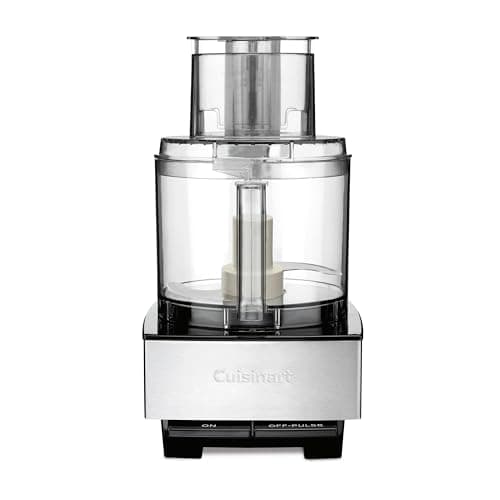
Most full-size kitchens
Cuisinart 14-Cup Food Processor (DFP-14BCNY)
The default full-size processor for a reason: a big, simple, 720-watt workhorse with the shortest parts list to go wrong.
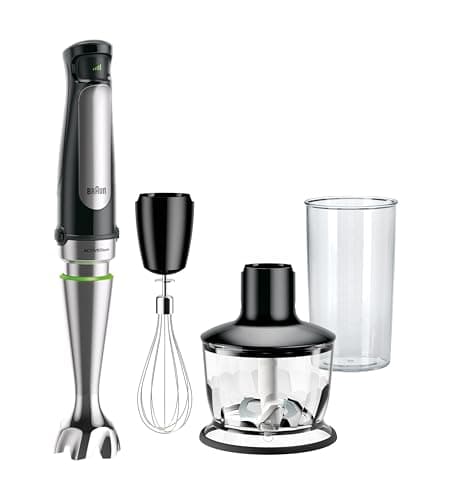
Most kitchens
Braun MultiQuick 7 (MQ7035X)
The one to own: Braun's anti-splash bell and smooth variable speed make it the most controllable stick blender here.
#ad · As an Amazon Associate we earn from qualifying purchases.
Questions
Frequently asked
Can an immersion blender do what a food processor does?
Which should I buy first?
Can you use an immersion blender for hummus?
Do some food processors come with an immersion blender?
Keep reading