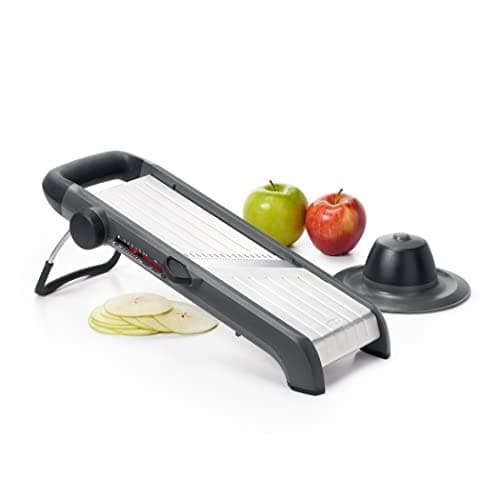
The OXO Good Grips Chef's Mandoline Slicer 2.0 is the mandoline we recommend to most home cooks, and the reason is that it is the one most likely to be used withits safety features rather than around them. Twenty-one thickness settings on a dial, four cut styles, a food holder and a runway guard — and, critically, a design where using the guard does not make the job noticeably slower.
The adjustability is the feature
A mandoline’s whole purpose is a slice thinner and more even than a knife gives you. The OXO’s dial runs through twenty-one settings, which in practice means you can dial in translucent potato for a gratin, a sturdier slice for roasting, and something close to a chip in between, without changing a blade. On top of that it does straight and crinkle slices plus julienne and French-fry cuts, so it covers most of what people buy a mandoline for.
That range is what makes it a genuine alternative to buying a food processor for slicing alone — a comparison we work through in mandoline vs food processor. It is also why it beats the fixed-thickness handheld models for anything beyond an occasional cucumber.
How its safety design actually works
Two mechanisms, and they solve different problems. The food holder is the spiked cap you push the vegetable with; it keeps your palm above the blade rather than in its path, and it is the thing that matters most for the last third of any vegetable. The runway guardis the raised edge along the slicing surface that stops your hand sliding forward onto the blade if the food gives way suddenly — which is exactly how most mandoline injuries happen.
Neither works if you do not use them, and that is the honest weak point of every mandoline ever made. The food holder feels fussy on the first half of a potato, so people skip it, and then keep skipping it into the dangerous part. Our mandoline safety guide covers the technique that makes this stick.
The rule that prevents most injuries. Decide before you start that the last third of every vegetable goes in the compost or the stock pot, not through the blade. Almost every serious mandoline cut happens on a piece too small to hold safely, being pushed by someone who did not want to waste it.
Where it gives up ground
Two places. First, sharpness over time: the OXO’s blade is good but the Benriner Super Slicer (Japanese Mandoline) is sharper out of the box and stays that way longer, which is why serious slicers often prefer the Japanese design despite its far more basic guard. Second, footprint and cleaning: the OXO is a full-size mandoline with a folding leg, more to wash than the OXO Good Grips Hand-Held Mandoline Slicer, and it does not tuck into a drawer as easily.
Price is the third consideration but not really a criticism — it costs more than the Mueller Austria Multi-Blade Adjustable Mandoline, which offers five blades and adjustable thickness for less. The Mueller is the value pick; the OXO is the one whose safety features you are more likely to keep using, which is the whole point of the category.
One capability worth calling out, because it is the reason several people buy this model: the dial produces julienne and French-fry cuts without swapping a blade in. If matchsticks are what you are after, our guide to julienning vegetables compares that against a knife, a julienne peeler and a processor disc, vegetable by vegetable.
How we picked
Tools we claim to have lab-tested: 0
Every site in this category tells you they ran twenty machines through a lab. We have not, and we say so. Here is what we do instead: read the manufacturer's manual and spec sheet, record the published bowl capacity, motor rating, blade and disc counts and materials, cross-check the warranty against the manufacturer's own warranty document, and cite all of it so you can check the work. Prices come live from Amazon's API and disappear rather than go stale.
The scores above are judgments from that documented research — not test results. The full rubric, including what disqualifies a product, is published in full.