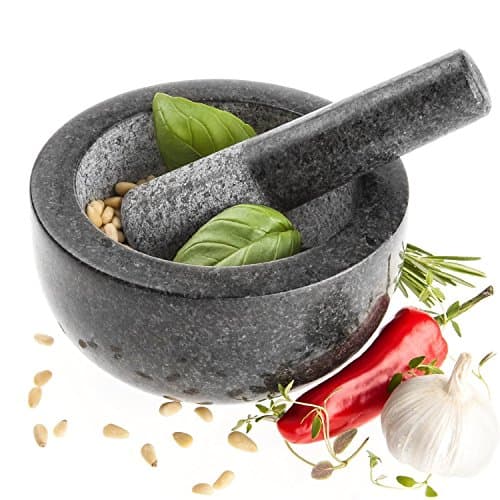
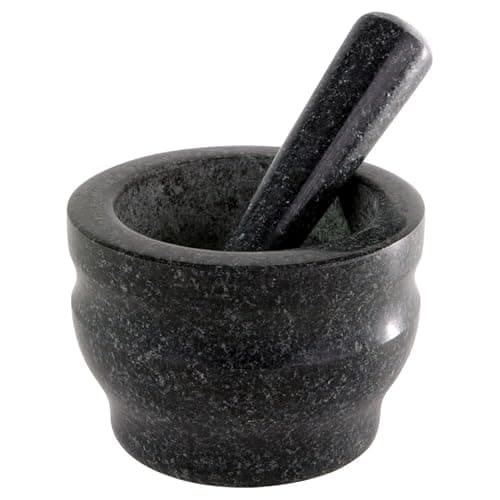
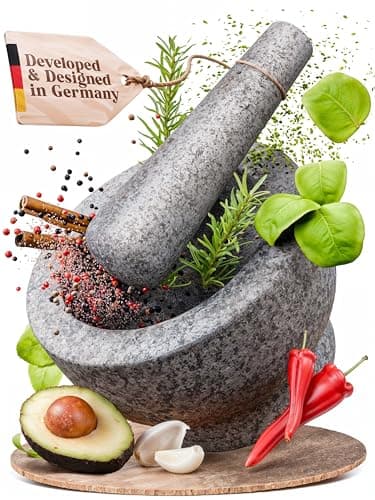
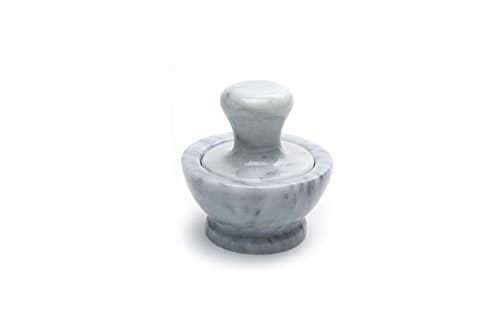
For dry spices and nothing else, buy the Fox Run Marble Mortar and Pestle Set (4 in). It is the cheapest set on this page and the smallest, and both of those are advantages here: a 4-inch bowl keeps peppercorns and coriander seed underneath the pestle instead of letting them skate out to the rim, it states a rough unpolished interior, and at 1.9 lb it lives in a drawer so you actually reach for it. If spices are only half the job — if you also want pesto, curry paste or guacamole — buy the Kota Japan Large Black Granite Mortar & Pestle instead and accept that a teaspoon of cumin in a 2-cup bowl takes a little more chasing. Nothing on this page is ranked on brand; the ranking is bowl size and surface texture, because those are the only two things that decide a spice grind.
This page deliberately reverses our main ranking. The best mortar and pestle ranks the Kota Japan first and the Fox Run last, because that page answers “which mortar for a kitchen” — and for general use capacity and mass win. This page answers “which mortar for spices”, where capacity is a liability and the small bowl wins. Both rankings are honest; they are answers to different questions, and that boundary is stated on both pages.
Why a spice mortar is small
A pestle grinds by trapping something between its face and the bowl wall. A dry seed is hard, round and almost weightless, so the moment it is not trapped it rolls away from the pestle rather than breaking. In a wide, shallow bowl most of your strokes miss: you push seeds around a floor rather than crushing them against a wall. In a small, deep bowl the seeds have nowhere to go and every stroke lands.
That is the whole mechanism, and it explains the apparent paradox of this page. Wet ingredients behave in the opposite way — garlic, basil, chillies and avocado stay where you put them and need room to be worked, which is why a paste mortar is wide and a molcajete is wider still. One tool genuinely cannot be optimal for both, and our size guide works through the numbers.
The second thing that decides it: an unpolished surface
A polished stone bowl is a decorative object. Grinding needs friction, and a smooth interior gives the pestle nothing to bite against — the seed slides instead of shattering. Every pick on this page states an unpolished or rough interior on its own listing, and that is why these four are the four. If you are shopping elsewhere and a listing does not say “unpolished”, “rough” or “unfinished” anywhere, assume it is polished.
The Cole & Mason set is the only one here that states the pestle tip is unpolished as well as the bowl, which is the half most makers leave out — a smooth pestle in a rough bowl still slides. It also publishes its own seasoning routine, which matters because every unpolished stone bowl sheds grit until it is broken in. Our seasoning guide collects the methods the makers themselves publish.
What each one publishes
Every figure below is the maker’s own wording from the listing the buy button points at. Where a listing contradicts itself, the table says so rather than picking the flattering number.
| Pick | Stone, as stated | Size / capacity | Weight | For spices |
|---|
| Fox Run Marble Mortar and Pestle Set (4 in) | Unpolished rough interior; title says marble, two bullets say granite | 4 × 4 × 4.25 in | 1.9 lb | Best — small bowl traps seed |
|---|
| Kota Japan Large Black Granite Mortar & Pestle | Solid unpolished granite | Interior bowl 3-3/4 × 2-3/4 in; 2 cups | 8 lb | Good — the only set publishing its interior bowl size |
|---|
| Cole & Mason Granite Mortar & Pestle (5.5 in) | Unpolished interior and unpolished pestle tip; finish stated as unfinished | 5.5 in; 5.9 in bowl diameter; 2 cups in the spec table, 3 cups in the bullets | 8 lb | Good — widest bowl, so small amounts need chasing |
|---|
| ChefSofi Granite Mortar and Pestle Set (2 cups) | Unpolished granite | 500 ml, about 2 cups; no dimensions published | About 7 lb | Fine — but you cannot check the bowl shape before it arrives |
|---|
Two things in that table are worth saying out loud. First, a stated cup capacity tells you almost nothing about a spice grind — two mortars can both hold 2 cups with completely different bowl shapes, and shape is what decides whether a peppercorn escapes. Only the Kota Japan set publishes the interior dimensions, which is why it is the one large set we will recommend for mixed duty. Second, two of these four listings argue with themselves: Fox Run calls the stone marble in its title and granite in two bullets, and Cole & Mason gives two different capacities on the same page. We record both rather than choosing, and our granite vs marble guide explains why the stone claim matters less than the finish.
The pick that is on the site but not on this page
The catalog’s lava-rock molcajete is deliberately absent from the ranking above, and it is the clearest illustration of what this page is about. A molcajete is a wide, open, porous bowl built to grip soft ingredients — it is the right tool for guacamole and roasted salsa and the wrong shape for a teaspoon of coriander seed, which will scatter across eight inches of lava rock. The maker’s own framing supports that, and we say the same thing in molcajete vs mortar and pestle. If someone sells you a molcajete as a spice grinder, that is the sale talking.
What a mortar does that a machine cannot
A blade cuts a seed into pieces and leaves the aromatic oil inside the pieces. A pestle ruptures the cell walls and the oil comes out into whatever else is in the bowl. That is why a hand-ground spice mix smells different from a machine-ground one, and it is the entire argument for owning a mortar in a kitchen that already has an electric chopper. It is also why we put the mortar rather than a chopper at the top of the spice job on the best chopper for Indian cooking. The full version of that argument, with the jobs each tool wins, is in mortar and pestle vs food processor.
How to grind a dry spice properly
Toast first, grind second. Whole seed in a dry pan over medium heat until it smells of itself, then cool it. Warm seed is slightly brittle and grinds faster; hot seed steams and clumps.
Work in small batches. A quarter of the bowl, not three quarters. A deep layer of seed cushions itself and you will be grinding the top layer for a long time.
Press and twist, do not pound. Pounding is for breaking things open; the grind happens on the twist, where the pestle face drags the fragments against the wall. Crack first with two or three taps, then switch to a grinding rotation.
Add a pinch of coarse salt for anything oily. Salt crystals are an abrasive and they give the pestle something to work against in nutmeg, fennel or cardamom. This is the oldest trick in the category and it costs nothing.
Do not use soap. Unpolished stone is porous. Rinse with water, scrub with rice or coarse salt if something is stuck, and dry it fully. The seasoning guide covers the break-in and the cleaning rule in full.
What we are not claiming
We have not ground spices in any of these four bowls. Every stone, dimension, weight, capacity and seasoning instruction above is the maker’s published wording, cited below, and where a maker publishes nothing we say so. The ranking is an argument from bowl geometry and surface finish, both of which are published facts you can check before you buy. Prices come live from Amazon with the date attached.