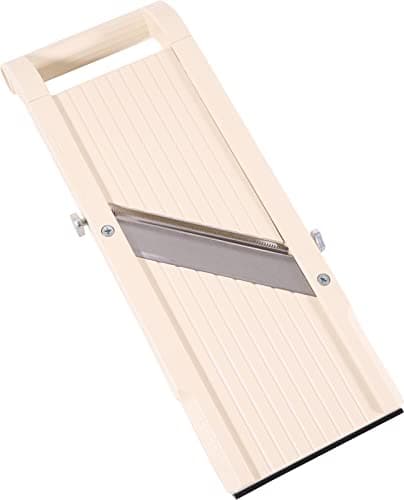
“Japanese mandoline” is not a marketing label; it describes a genuinely different design. A Western mandoline is a folding frame with legs, a dial, a runway and a guard system. A Japanese one is a flat plate with a blade set into it, a screw to adjust the depth, and a bracket to rest it on a bowl. The whole difference — better and worse — follows from that.
What the flat-plate design changes
Three things, in order of how much they matter.
The blade sits closer to the food. With no runway and no mechanism between the vegetable and the edge, the cut happens right where your hand is applying pressure, and the slice releases immediately instead of traveling down a ramp. That is why a Japanese mandoline feels effortless: less of your push is being spent on friction.
The bed is wider. The Benriner Super Slicer (Japanese Mandoline) lists an extra-wide slicing surface, and width is what decides whether a half-cabbage or a large potato travels across the blade in one clean movement or catches on the edges and gets sawed sideways. It is the single most underrated spec in this category.
There is nothing to go wrong. No hinge, no folding leg, no plastic dial with detents to wear out. A screw-set thickness adjustment is cruder than a 21-position dial and it does not drift.
The trade you are making
Safety features. The Benriner’s own listed weakness is that the included guard is minimal, and that is not a manufacturing shortcoming — it is the design philosophy. A professional using one all day has a specific technique and, usually, a cut-resistant glove. A home cook slicing a shallot at the end of a long day has neither.
This is the honest reason we do not put a Japanese mandoline at the top of the main ranking. It makes the best cut of anything here. It also has the least between a moment of inattention and a serious injury, and mandolines are already the tool most likely to send a home cook for stitches.
If you buy one, buy a glove with it. Not afterwards. A cut-resistant glove costs a small fraction of the mandoline and it is the difference between a scare and an emergency room. Our glove roundup explains what the EN388 and ANSI ratings on the packet mean, because most of them are not what buyers assume.
Japanese versus Western, side by side
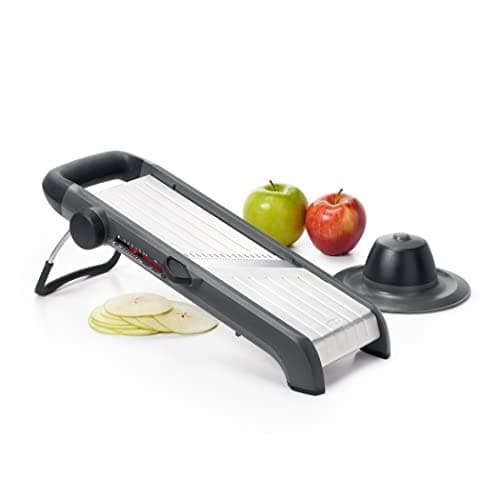
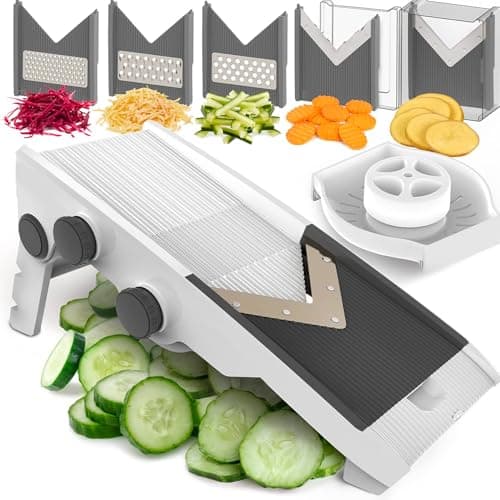
Only the Benriner Super Slicer (Japanese Mandoline) is a Japanese-style mandoline. The other two are the Western designs it is usually compared against, included so the trade is visible.| Tool | Style | Adjustment | Guard |
|---|
| Benriner Super Slicer (Japanese Mandoline) | Japanese flat plate | Screw-set dial | Minimal by design |
|---|
| OXO Good Grips Chef's Mandoline Slicer 2.0 | Western folding frame | 21-position dial | Food holder plus runway guard |
|---|
| Mueller Austria Multi-Blade Adjustable Mandoline | Western, budget | Adjustable dial | Hand-guard food holder |
|---|
Who should buy the Japanese one
Cooks who slice often enough to have a technique, who want the thinnest and cleanest cut available at home, and who will wear a glove without being reminded. If you make crisps, raw shaved salads, potato pave or large volumes of slaw and kraut, this is the tool that does those best — our full Benriner review goes through it in detail, and the cabbage roundup is where the width advantage shows most clearly.
Who should not
Anyone nervous around sharp tools, anyone who will use a mandoline a handful of times a year, and anyone buying one for a household where somebody else might pick it up. For those cases the OXO Good Grips Chef's Mandoline Slicer 2.0 is the better buy: the cut is very slightly less fine and the guard is genuinely usable, which is a trade worth making when the alternative is not using the tool at all.
And if the honest answer is “a few times a year, for gratin”, the Mueller Austria Multi-Blade Adjustable Mandoline does that job for a fraction of the price of either. Read the safety guidewhichever you buy — the habits are the same, and they are what actually prevent injuries.
The other practical advantage of the Japanese design is that its blade is a spare part rather than a sealed component, which is the whole subject of how to sharpen a mandoline blade — a slicer whose cutting edge can be bought for a few dollars never needs honing, and that is a reason to spend more once.