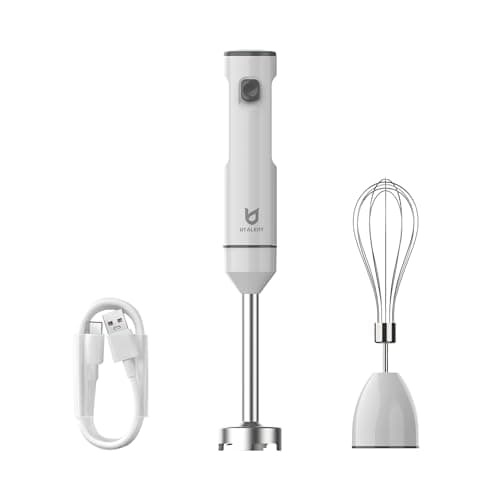
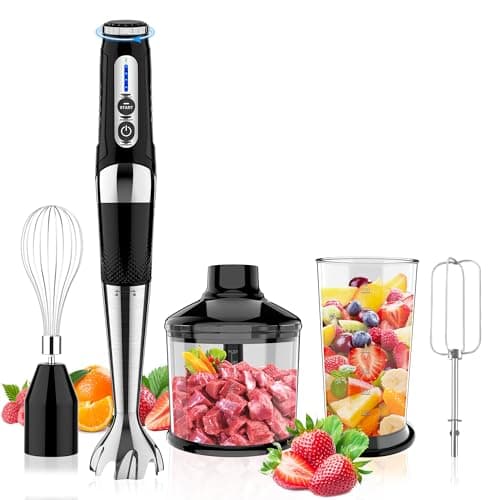
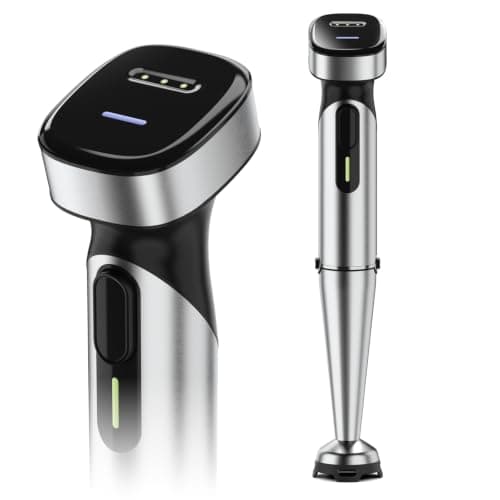
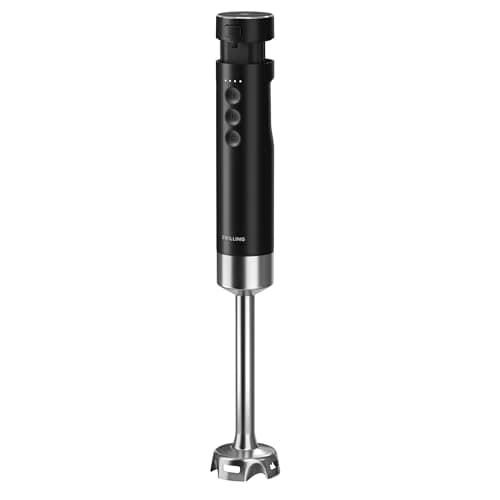
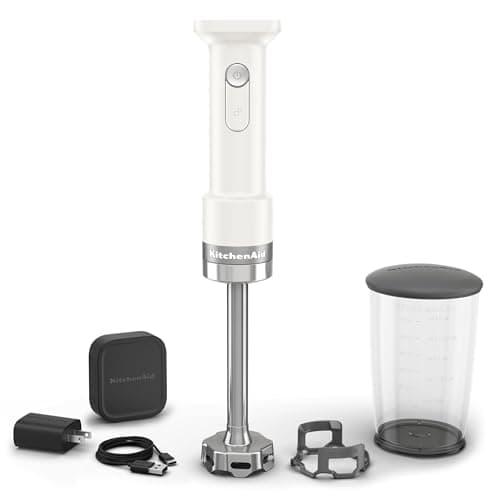
For most kitchens the best cordless immersion blender is the KitchenAid Go Cordless Hand Blender (KHBRV71, battery included): the battery is in the box, it is removable, and KitchenAid publishes its voltage and runtime with the caveats attached rather than as a headline. If the budget is half that, the UTALENT Cordless Hand Blender with Whisk (TL6001) is the built-in-battery stick that publishes the most about itself, including the one limit the others leave out. And if you want a chopper, a whisk and a beaker in the same box, the Toogel 4-in-1 Cordless Immersion Blender (21-Speed)is the only pick here that bundles all three — with a charge-time claim you should read twice.
What cordless changes, and what it does not
Every corded stick on our main immersion blender ranking shares one awkward habit: the cord. Blending soup in the pot it cooked in means the cord runs across the stovetop, over a burner you may only just have turned off, to an outlet that is never quite where you need it. On an island with no outlet, or at the table, a corded stick simply does not reach. A cordless blender removes all of that, which is why it is the version people keep asking for and why the corded reviews on this site have been sending readers here before this page existed.
What it does not change is the blending. The blade, the guard, the vessel and the technique are the same, and everything in our hot-liquid safety guideapplies exactly as it does to a corded model. What changes is that you have bought a battery, and a battery is a consumable with a charging habit, a runtime, a lifespan and — on the tools where it is built in — the power to retire the whole blender when it fades. Those are the things this page ranks on, because they are the things cordless makers actually publish.
The spec cordless makers do not publish: watts
Every corded immersion blender in our catalog is compared on its published motor wattage, because on a corded stick that figure predicts what it will push through. Not one of the five cordless makers on this page publishes a wattage. KitchenAid and Turelar state a 12-volt maximum battery; ZWILLING states a speed range in RPM and a motor type; UTALENT and Toogel state neither. We are not going to convert a voltage into a wattage nobody claimed, so the running-cost block on every card below says “not published” — which is the honest answer, and also the practically correct one, since a battery you charge from a USB port costs a rounding error to run.
What replaces watts as the thing to read is the runtime claim, and the useful question is not how big the number is but what it is based on. KitchenAid says up to 30 minutes of continuous runtime and then tells you the number was measured without a workload and will vary with the recipe and the attachment. UTALENT says 60 bowls of soup and tells you the bowl was 12 ounces, the soup was tomato basil and there were 15 batches. Turelar says up to 30 cups, depending on viscosity. Toogel gives three different runtimes for three attachments and no basis for any of them. ZWILLING gives two different figures for the same blender in the same listing. A claim with a stated basis is a claim you can compare against your own soup; a bare number is marketing.
First question: is the battery in the box? It sounds absurd, and it is the single most expensive mistake on this page. The ZWILLING Xtend Cordless Immersion Blender, 2-pc Set (battery not included)is a cordless blender sold without its battery, and KitchenAid sells the same Go blender two ways — KHBRV71 with the battery and KHBRV00 without. Both listings say so plainly, in the title. Read the title.
Built in, or removable?
The second thing to read is whether the battery comes out. On the KitchenAid Go Cordless Hand Blender (KHBRV71, battery included)it does: the listing calls it a removable 12V MAX battery, and the fact that KitchenAid sells the blender without it and the pack on its own (model KRB12) is the tell that it is designed to be swapped for a charged one and replaced when it ages. ZWILLING’s Xtend battery is the same idea — a pack the brand states is shared across its Xtend cordless appliances — with the difference that ZWILLING makes you buy it separately.
The UTALENT Cordless Hand Blender with Whisk (TL6001), the Toogel 4-in-1 Cordless Immersion Blender (21-Speed) and the Turelar Cordless Immersion Blender (HB-8809R)all describe a built-in or internal cell. None of the three says it can be replaced. That is not a reason to avoid them — they cost a fraction of the KitchenAid, and a lithium cell that is charged sensibly lasts years — but it does mean you are buying a tool with a lifespan set by its battery rather than its motor. If you expect a stick blender to last a decade, as the corded metal ones do, buy the one whose battery comes out.
The five blenders
The KitchenAid Go Cordless Hand Blender (KHBRV71, battery included) is the pick because it answers the two questions above correctly and publishes the most careful battery figures on the page. The 12V MAX battery is in the box and removable; a wall adapter is included, not just a USB-C cable; the runtime claim comes with its own footnote about workload and attachments; and the blending arm is removable, with a 4-point stainless blade, a variable-speed trigger and the same patented removable pan guard that makes the corded KHBV53safe on non-stick. What it is not is generous: the 3-cup jar is the only accessory, the whisk, chopper and 4-cup pitcher are in the pricier KHBRV75 kit, the arm is 7 inches to the corded KitchenAid’s 8, and KitchenAid publishes no charge time at all.
The UTALENT Cordless Hand Blender with Whisk (TL6001)is the value pick, and it earns that on documentation as much as price. It is the only listing here that states the basis of its runtime claim in full, it publishes a charge time (3.5 hours over USB-C), a combined weight (1.4 lb with the arm), a brushless motor, an unlock button against accidental starts, and — the detail we most respect — that it cannot operate while charging. The arm is 8 inches, the longest on the page. The honest marks against it: the battery is not described as removable, there is no beaker in the box, and 3.5 hours is a long charge for a tool you cannot use on the cable. UTALENT sells the same TL6001 as a kit with a 600 ml vessel and a 500 ml chopper for a little more, which is the version to choose if you do not already own a tall narrow container.
The Toogel 4-in-1 Cordless Immersion Blender (21-Speed)is the kit. A blending shaft, a 700 ml chopper, a whisk and a beaker in one box, 21 speed levels, and a handle that locks at three angles — genuinely useful in a deep pot or a shallow bowl — with the attachments stated as dishwasher safe. The problem is the listing. It gives the charge time as 45 minutes at 5V/2A in one bullet and about 3 hours in another; it quotes the runtime as 60 minutes, 12 cups and 12 uses depending on which attachment you read about, with no bowl-and-recipe basis behind any of them; and its 2000 mAh cell is the smallest stated on the page and built in. Buy it for the attachments and plan on the 3-hour figure.
The Turelar Cordless Immersion Blender (HB-8809R) is here for one number and one switch. It states a 12V MAX, 2500 mAh cell, the only built-in-battery pick to publish a capacity above 2000 mAh, and it will not start unless both of its buttons are pressed, which is the most deliberate interlock on the page. It has a nylon blade guard and Turelar states it is safe in hot pots. Against that, it was priced above both the UTALENT and the Toogel when we checked and ships with nothing but the blender: no beaker, no whisk, no chopper. It publishes no charge time, its electronics and plastic parts must be wiped rather than washed, and its claim of twice the efficiency of standard cordless blenders comes with no stated basis.
The ZWILLING Xtend Cordless Immersion Blender, 2-pc Set (battery not included)is the most interesting body on the page and the least complete product. It has the only bell-shaped anti-suction head here — the feature that makes the corded Braun and Brevillethe cleanest sticks to use — a brushless motor with a published 7,000 to 11,000 RPM range, a 20-ounce beaker with a scale, and a removable battery pack shared across ZWILLING’s Xtend system. It also has no battery in the box. The listing says so in the title, then states a runtime of up to 120 minutes in one bullet and up to 45 minutes in another, and the Starter Set that would have made it a working blender in one purchase was down to its last unit when we checked. It is ranked last for that reason and no other: if you already own an Xtend battery, it is a very good buy.
How they compare
Every entry below is the maker’s own published claim from the product’s Amazon listing. Wattage is not in the table because no maker here publishes one.| Blender | Battery in box | Removable | Stated cell | Runtime claim | Charge time | In the box |
|---|
| KitchenAid Go Cordless Hand Blender (KHBRV71, battery included) | Yes | Yes | 12V MAX (10.8 V nominal) | Up to 30 min continuous, basis stated | Not published | 3-cup jar, pan guard, wall adapter |
|---|
| UTALENT Cordless Hand Blender with Whisk (TL6001) | Yes (built in) | Not stated | Li-Ion, capacity not stated | 60 bowls, basis stated | 3.5 h; no use while charging | Whisk, cable |
|---|
| Toogel 4-in-1 Cordless Immersion Blender (21-Speed) | Yes (built in) | No | 2000 mAh | 60 min / 12 cups / 12 uses, no basis | 45 min or about 3 h, stated both ways | Chopper, whisk, beaker, cable |
|---|
| Turelar Cordless Immersion Blender (HB-8809R) | Yes (built in) | Not stated | 12V MAX, 2500 mAh | Up to 30 cups, depends on viscosity | Not published | Blender only |
|---|
| ZWILLING Xtend Cordless Immersion Blender, 2-pc Set (battery not included) | No | Yes (sold separately) | Not stated | 120 min and 45 min, both stated | Not published | 20-oz beaker |
|---|
Which one to buy
Buy the KitchenAid Go Cordless Hand Blender (KHBRV71, battery included) if you want the blender to outlive its first battery and you would rather pay once. Buy the UTALENT Cordless Hand Blender with Whisk (TL6001)if the budget is tight and you can live with a built-in cell and a 3.5-hour charge — and buy its kit version if you need the beaker. Buy the Toogel 4-in-1 Cordless Immersion Blender (21-Speed) if the chopper and whisk would otherwise be separate purchases, and read its charge time as three hours.
Buy the Turelar Cordless Immersion Blender (HB-8809R) if the two-button start matters to you and you already own a tall narrow vessel. And buy the ZWILLING Xtend Cordless Immersion Blender, 2-pc Set (battery not included)only if there is already an Xtend battery in your kitchen — in which case it is the cleanest blending head on the page for very little money.
Charging habits that decide how long it lasts
A lithium cell dislikes two things: sitting empty, and sitting on the charger forever at full. Charge a cordless blender after you use it rather than before, so it is never stored flat, and if the maker states a charger rating — Toogel specifies 5V/2A and its own cable — use that and not whatever brick is nearest. Two of the built-in-battery picks here charge over a USB-C cable with no wall adapter listed; the KitchenAid includes one. If you have ever wondered why a cordless tool arrives without a plug, that is the reason the KitchenAid costs more.
The UTALENT states outright that it will not run while it is charging. The others do not say either way, and you should assume the same. A cordless blender is a tool you charge on a schedule, not one you can rescue mid-soup by plugging in.
Where cordless is genuinely the better tool
At the stove, blending in the pot, with no cord crossing a burner: this is the job that sells cordless, and it is a real safety gain as much as a convenience. On a kitchen island or a dining table with no outlet. In a small kitchen where the one free socket is behind the toaster. Anywhere you would otherwise be blending in the pan with your other hand holding a cord clear of the heat.
It is also the more pleasant tool for the small, frequent jobs that make a stick blender worth owning at all — a jar of mayo, a vinaigrette, a single portion of smoothie — because there is nothing to plug in and nothing to unplug. Our guide to what an immersion blender is for lists the jobs; most of them take under a minute, which is exactly where a battery does not matter.
Where corded still wins
Thick, sustained loads. A stiff hummus, a dense bean puree, a full stockpot of a chunky vegetable soup that needs several minutes of work: these are the jobs where the corded All-Clad’s published 600 watts earns its place, and where a cordless tool with no published wattage and a 30-minute runtime is being asked to do something its maker never quantified. If that is your regular job, our best immersion blender for soup page is the right one, and a corded stick is the right buy.
Reach, too. Only the UTALENT here matches the 8-inch arm of the corded KitchenAid, and none publishes a longer one. In a tall pot, a short arm means tilting the pot or bringing your hand to the surface — the exact problem the KHBV53 review exists to solve.
Safety, and the switches that help
A cordless blender has one hazard a corded one does not: it is always live. There is no plug to pull, so a tool in a drawer with a charged battery can be started by anything that presses its trigger. That is why the interlocks on this page are worth reading. The Turelar needs both of its buttons pressed to start; the UTALENT fits an unlock button before the trigger; the KitchenAid uses a trigger switch. None of the listings states an automatic lock-out after a period of idleness, so store the blade arm detached if there are small hands in the house.
Everything else is the same as corded. Take the pot off the heat before you blend, keep the head fully under the surface before you switch on, start slow, and use a pan guard on non-stick. The hot-liquid safety guide has the full version.