HUB 06 · Guides
Are Vegetable Choppers Worth It?
Yes, if you dice regularly and care about evenness, and they cost less than a decent knife. No, if you cook for one, enjoy knife work, or have no drawer space - and the reason most of them end up in a cupboard has nothing to do with how they cut.
We earn a commission if you buy through our links. It does not change the price you pay, and it does not decide our picks — our selection criteria are published in full. How this works.
Yes — if you dice the same few vegetables most weeks and want them even. A push-down dicer like the Fullstar Pro XL Vegetable Chopper & Mandoline costs less than a mid-range chef’s knife and produces a more uniform cube than most home cooks manage by hand, which matters because an even cube cooks evenly. No — if you cook small amounts for one, if you actively enjoy knife work, or if you have no room for another object with eight parts. Those are the two honest answers, and which one applies to you is decided by how often you dice, not by how good the tool is.
The question that settles it. Not “is it faster?” but “will I wash it?” A dicing grid is a field of exposed edges, and a chopper that is annoying to clean gets used twice and then lives in a cupboard. If you are the kind of cook who rinses tools while cooking, a chopper will earn its place. If you stack everything by the sink until later, buy a better knife instead — dried-on onion in a grid is a ten-minute job, and you will not do it twice.
What a chopper is actually good at
Evenness, not speed. This is the part most reviews get backwards. On a single onion, a competent knife user is about as fast as a push-dicer once you count setup and washing. What the dicer gives you is a cube decided by a grid rather than by your concentration — every piece the same, which is why restaurant kitchens care about cut size at all. Even cubes finish cooking at the same moment; uneven ones give you mush and raw bits in the same pan.
Volume without fatigue, for the right vegetables. Four onions, three peppers and a head of celery for a batch of sauce is where a chopper pulls clearly ahead, and it is also where the mess advantage shows up: the cubes land in a catch container rather than on a board you then have to scrape.
Taking the knife out of the equation. For cooks with limited knife confidence, shaky hands, or anyone cooking with children around, a push-dicer removes the sharpest moment in the recipe. It has a finger guard and the blade stays in a housing. That is a real safety argument, not a marketing one — and for arthritis it cuts the other way, which we come to below.
Electric choppers are a different purchase. A bladed chopper such as the Ninja Express Chop (NJ110GR) does not dice at all — it minces, fast and slightly unevenly, which is exactly right for onions, garlic, herbs, nuts and a coarse salsa. If what you actually want is “I hate mincing garlic and onion”, the electric is worth it for most people and the push-dicer is not. We split the two in electric vs manual.
Who should not buy one
If you cook for one, most nights. Half an onion does not justify assembling and washing a chopper. A small knife and a small board win on total time, every time.
If you have grip, wrist or hand-strength problems. A push-dicer works by you supplying the force to drive food through a grid, and hard vegetables — carrot, sweet potato, swede — take a genuine shove. This is the most important caveat on the page, and it is the opposite of the usual accessibility framing. If this is you, an electric chopper is the right tool and our arthritis-friendly prep tools page is the right starting point.
If you enjoy using a knife. Then the chopper removes the part of cooking you like, and the evenness argument will not move you. Spend the money on a better board and keep practising — the knife method is genuinely not hard.
If your kitchen is small. A push-dicer with eight inserts is nine objects. Mueller’s own eight-blade set is its selling point and its storage problem at the same time, which we say on its card: if you only ever dice, you will never touch six of them.
Worth it, by the kind of cook you are
| If you | Worth it? | Buy | Because |
|---|---|---|---|
| Batch cook or meal prep weekly | Yes, clearly | A push-dicer with a lidded container | Even cubes straight into the box you store them in |
| Hate mincing onion and garlic | Yes — but electric | A 2 to 4-cup bladed chopper | Mince in two pulses; a dicer does not mince |
| Cook for one or two, simply | Usually not | A sharp knife and a board | Setup and washing outweigh the cutting |
| Have grip or wrist problems | Not a push-dicer | Electric, or a rocking chopper | The force comes from your hand, not a motor |
| Cook with children around | Yes, on safety grounds | A push-dicer with a finger guard | Removes the sharpest step in the recipe |
| Enjoy knife work | No | Nothing — or a board | It removes the part you like |
The three reasons they end up in a cupboard
1. Washing. Covered above, and it is the big one. The grid must be back-flushed from the underside — the opposite way the food went in — or the cells clog. Our chopper-cleaning guide exists because this single habit decides whether the purchase was worth it.
2. Force on hard vegetables. People buy a dicer for carrots and sweet potato and discover it is a workout. Cut hard vegetables smaller before they go in, press in one committed stroke, and know that a dead-ripe tomato or a soft avocado will burst rather than cube.
3. Buying the wrong mechanism. Half the disappointment in this category is someone who wanted a mince buying a dicer, or someone who wanted cubes buying a bladed chopper. They are not variations of one product; they make two different shapes. If you are not sure which you want, read mandoline vs vegetable chopper first, because naming the shape you want settles the purchase.
What about durability?
The honest position: these are inexpensive tools with plastic housings and thin stainless blades, and the blades are generally riveted into grids that are not designed to be sharpened. Fullstar publishes 420J stainless for its four blades; Mueller publishes eight stainless blades without naming the grade. Neither publishes a sharpening procedure, and a grid that has genuinely gone dull is usually replaced rather than restored — we cover what is and is not possible in sharpening chopper blades. Price the tool as a few years of use rather than a lifetime purchase, and the maths still works comfortably.
The verdict in one paragraph
A vegetable chopper is worth it for the cook who dices the same vegetables most weeks, wants them even, and rinses tools as they go. It is worth it for a different reason — removing the sharpest step — for anyone nervous with a knife. It is not worth it for small-volume cooking, for weak grip, or for people who like chopping. And whichever camp you are in, buy the mechanism that makes the shape you actually want: a grid for cubes, a blade for mince.
What we are not claiming
We have not timed these tools against a knife, and we have not run a durability test. The blade materials, grades, counts, container volumes and motor figures referred to above are each maker’s own published wording, cited below and on each product card. The judgments about washing, force and abandonment are mechanism arguments and ordinary kitchen experience, offered as reasoning you can check rather than as measurements. Prices come live from Amazon with the date attached.
The hardware
The hardware this guide is about
The products this guide refers to, with prices pulled live from Amazon and dated on every card. Full rankings live in the roundups linked above.
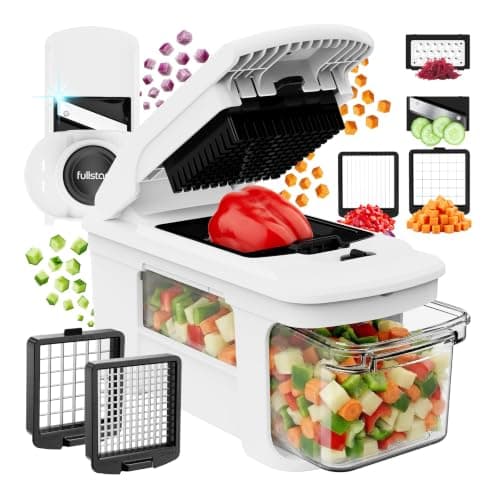
Even manual dicing
Fullstar Pro XL Vegetable Chopper & Mandoline
The best-selling push-down dicer: press the lid and vegetables fall through a grid into neat, even cubes.
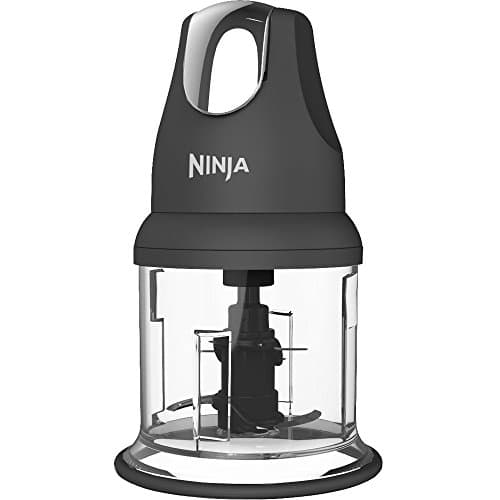
Fast electric chopping
Ninja Express Chop (NJ110GR)
The electric chopper to beat: a 200-watt, one-touch bowl that turns onions and nuts to an even mince in seconds.
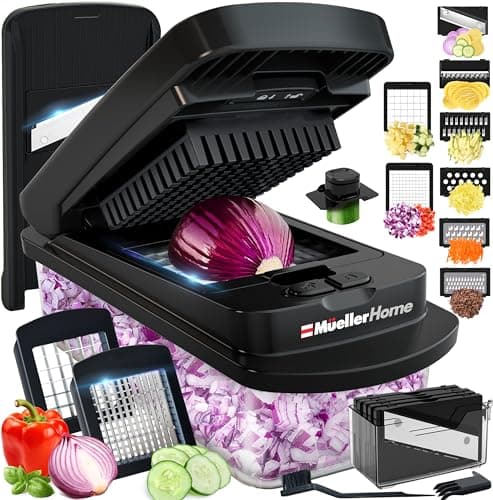
Most blade options
Mueller Pro-Series 10-in-1 Vegetable Chopper
A push-dicer with the widest blade set here — eight inserts covering dice, slice, grate and spiralize.
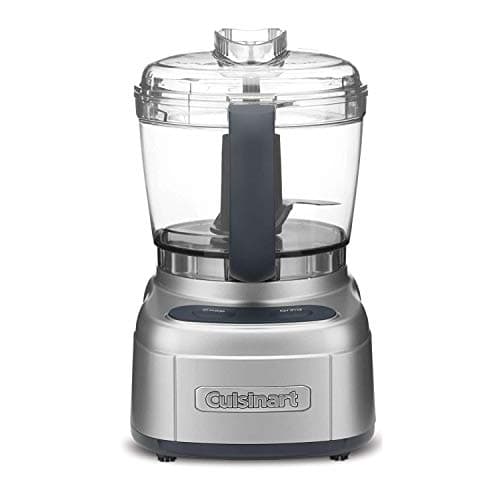
Larger electric batches
Cuisinart Elemental 4-Cup Chopper/Grinder (ECH-4SV)
A 4-cup chopper/grinder with an auto-reversing blade and a separate grind pad — the step up when 2 cups isn't enough.
#ad · As an Amazon Associate we earn from qualifying purchases.
Questions
Frequently asked
Are vegetable choppers actually faster than a knife?
Do vegetable choppers work on hard vegetables?
Is a vegetable chopper better than a food processor?
Why do so many people say their chopper broke?
Which chopper should I buy if I decide it is worth it?
Keep reading
Related
Receipts
Sources
- Amazon listing - Fullstar Pro XL Vegetable Chopper & Mandoline (4 blades in 420J stainless, 1.8 L container with lid, 8-cup XL body, finger guard and cleaning brush)
- Amazon listing - Ninja Express Chop NJ110GR (16 oz bowl, 200 W, stacked stainless blades, dishwasher-safe parts)
- Amazon listing - Mueller Pro-Series 10-in-1 Vegetable Chopper (8 interchangeable stainless blades, 1.2 L catch container)
- Amazon listing - Cuisinart Elemental 4-Cup Chopper/Grinder ECH-4SV (4-cup work bowl, chop and grind touchpads, auto-reversing blade, dishwasher-safe removable parts)
We do not run a testing lab and we do not pretend to. Specifications come from the manufacturer's own published documents and from published standards; prices come from the live Amazon API. Where a figure is not published, the page says “not published” rather than guessing. Read the full method.