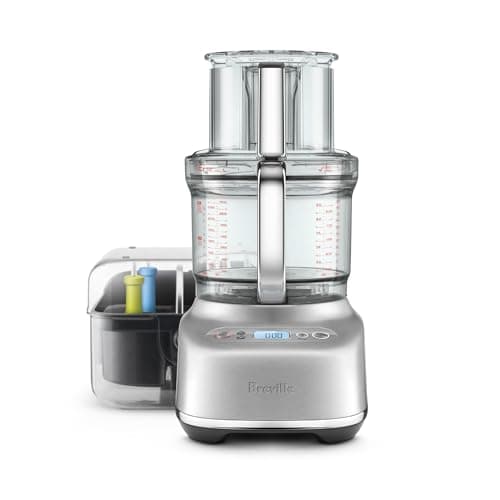
The Breville Sous Chef 16 (BFP810)is the most capable machine in this catalog and, by a distance, the most expensive. Two specs justify the gap and one does not. The adjustable slicing dial — 0.3 to 8.0 mm on a single disc — is genuinely transformative. The 1,450-watt motor is real headroom for dough and nut butter. The 16-cup bowl is the least useful of the three for most buyers, and is the spec the marketing leans on hardest.
The slicing dial is the reason to buy it
Most food processors come with a fixed slicing disc, so slice thickness is whatever the manufacturer chose — typically somewhere around 2 mm — and any other thickness means buying another disc. Breville replaces that with a dial that moves the blade relative to the deck, giving a continuous range from paper-thin to nearly a third of an inch.
In practice that means one machine covers translucent potato for a gratin, a chip-thick slice for roasting, and a chunky cut for a stew, without changing anything but a setting. If you have ever used a mandolinefor that adjustability and disliked how exposed your fingers were, this is the safe version of the same capability — and it is the one thing here you cannot get by spending less.
What 1,450 watts changes, and what it does not
It changes dough and nut butter. A stiff two-pound bread dough or a jar’s worth of almond butter is a sustained load, and this is the machine in our catalog least likely to bog down or heat up doing it. That matters if you bake weekly.
It changes nothing at all for chopping, slicing and shredding, where the disc does the cutting and any of the machines in the large processor roundup will keep up. And it costs nothing to run either way: at a generous 3 minutes a day, 365 days a year the published wattage works out to about $4.62 a year in electricity. Wattage is a capability figure here, not an operating cost.
Where it gives up ground
Three places, all predictable and none of them about performance. First, price: it costs multiples of the Cuisinart 14-Cup Food Processor (DFP-14BCNY), which does most of the same jobs well. Second, parts: the extra discs, the second smaller bowl and the accessory storage box are more things to wash, store and lose than the Cuisinart’s three-part simplicity — and a machine that is a chore to reconstitute is a machine you use less. Third, footprint: sixteen cups assembled is a tall, heavy object that will almost certainly live on your counter permanently.
Who it is for.The cook who bakes regularly, slices a lot, and wants one machine to do all of it properly. Everyone else — and that is most people — should read the Cuisinart 14-cup review and put the difference toward groceries.
How it compares
Against the Cuisinart 14-Cup Food Processor (DFP-14BCNY): the Breville wins on slicing adjustability and dough headroom, the Cuisinart wins on simplicity, price and the number of things you have to wash. Against the KitchenAid 13-Cup Food Processor (KFP1318): the KitchenAid’s dicing kit does a cut the Breville does not, but KitchenAid publishes no wattage, so there is no motor comparison to make. Against the Ninja Professional Plus Food Processor (BN601): the Ninja is the value dough machine and costs a small fraction as much; the Breville is better made and slices far better.
How we picked
Tools we claim to have lab-tested: 0
Every site in this category tells you they ran twenty machines through a lab. We have not, and we say so. Here is what we do instead: read the manufacturer's manual and spec sheet, record the published bowl capacity, motor rating, blade and disc counts and materials, cross-check the warranty against the manufacturer's own warranty document, and cite all of it so you can check the work. Prices come live from Amazon's API and disappear rather than go stale.
The scores above are judgments from that documented research — not test results. The full rubric, including what disqualifies a product, is published in full.