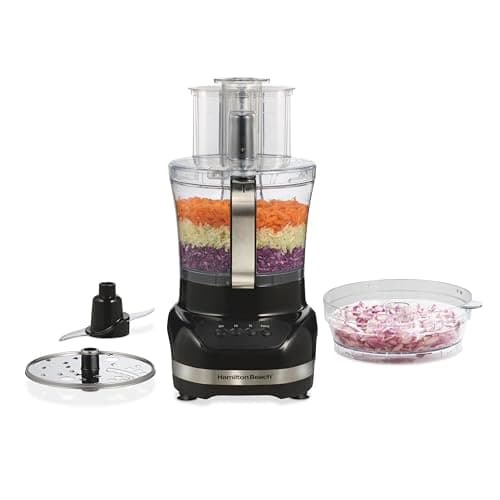
Most people who buy a 12-cup food processor end up buying a small chopper as well, because a big bowl is the wrong tool for half an onion and a handful of herbs. The Hamilton Beach Big Mouth Duo Plus 12-Cup answers that in the box: Hamilton Beach ships a 4-cup bowl that nests inside the 12-cup one, so one machine and one motor cover both ends of the job. At well under a hundred dollars, that is the most useful thing any budget processor does.
The two bowls are the feature
Hamilton Beach’s own listing puts it plainly: the 12-cup bowl is “ideal for larger batches, slicing and shredding” and the 4-cup bowl “works great as a vegetable chopper”, with the two nesting together for storage. The practical consequence is that the machine gets used for small jobs instead of being left in the cupboard until there is a batch worth the washing-up — and that, not any spec, is what decides whether a processor earns its counter space.
It is not free. Two bowls means two lids, and the small bowl has to live somewhere even when it nests. If your objection to food processors is the number of parts, this is the wrong direction and the Cuisinart 14-cup— a bowl, a lid, a blade and two discs — is the machine to read about instead.
The 500-watt motor, and what it will not do
Hamilton Beach publishes a 500-watt rating with two speeds plus pulse, which is more motor documentation than most machines at this price offer at all. Five hundred watts is comfortably enough for the jobs a 12-cup bowl is for: chopping onions, shredding a block of cheese, slicing a bag of vegetables, pureeing a soup base.
What it will not do is dough, and the reason is the box rather than the motor: there is no dough blade. The S-blade chops, mixes and purees, and the reversible disc slices and shreds. If bread or pizza is why you are shopping, read the dough roundup— a machine with a dough blade and more headroom is the honest buy, and no pulse technique substitutes for either.
Where the saving shows.This is a budget-priced full-size machine, and the money comes off in refinement rather than capability. There is no adjustable slicing dial, no dough blade, and the plastic is plainer than a Cuisinart’s. What you get is a big bowl, a small bowl inside it, a published motor figure, and a feed chute Hamilton Beach lists as taking whole tomatoes, potatoes and onions.
Cleaning and the running cost
All removable parts are listed as dishwasher safe and all food zones as BPA free, and the controls are a flat touchpad you wipe rather than a switch bank you pick crumbs out of. On electricity, the 500-watt rating works out to the figure in the running-cost column on the main ranking— a sum small enough that it should not enter the decision. Buy on capacity and on what is in the box.
How it compares
Against the Cuisinart 14-Cup Food Processor (DFP-14BCNY), the long-running full-size default: the Cuisinart has two more cups, a published 720-watt motor, a dough-capable build and a better long-term parts story; the Hamilton Beach costs a fraction of it and throws in the small bowl. Against the BLACK+DECKER 8-Cup Food Processor (FP1600B) at the bottom of the market, this is the better buy for anyone who wants genuine full-size capacity rather than the cheapest possible way in.
Against the Cuisinart Elemental 8-Cup Food Processor (FP-8SV), the sensible 8-cup middle option: that is the machine to choose when counter and cupboard space are tight, and this is the machine to choose when capacity matters more than footprint. Our size guide settles that trade properly, and the cost guide covers where this sits on the price ladder.
It replaces the Hamilton Beach Stack & Snap 12-cup in our ranking, which Amazon no longer sells new. The Stack & Snap’s no-twist assembly was its own trick and the Duo Plus does not have it — a straight trade of that design for a second bowl and a published motor rating.
Who should buy it
Anyone who wants a genuinely full-size bowl without a full-size price, and anyone who knows they will use a processor for small jobs as often as big ones. A first kitchen that cooks for more than two is the clearest case: it answers the real question — will this get used? — before anyone spends Cuisinart money.
Skip it if you make dough, if you want adjustable slice thickness, or if you would rather wash the fewest possible parts. And if 12 cups sounds like more bowl than you will ever fill, the mini roundup is the honest place to start.
One job where this machine gives away nothing at all to the expensive ones: breadcrumbs. A deep bowl and a plain S-blade is the entire specification for that, and a 12-cup bowl takes most of a loaf in one go.