HUB 06 · Guides
How to Clean a Food Processor
Most people wash the bowl and the blade and stop. The three places food actually hides are the lid seam, the underside of the drive collar and the gasket — and one of them is why your machine smells.
We earn a commission if you buy through our links. It does not change the price you pay, and it does not decide our picks — our selection criteria are published in full. How this works.
A food processor is not hard to clean. It is easy to clean badly, because three of the places food collects are not obvious, and because the single most effective step takes thirty seconds and has to happen before you sit down to eat. Do that one thing and everything below becomes a formality.
The thirty-second self-clean
Do this the moment the bowl is empty, while everything is still wet. Put the bowl back on the base with the blade in, add warm water to about a third and a drop of dish soap, lock the lid, and pulse five or six times. The blade drives the soapy water at every interior surface, including the underside of the blade and the inside of the lid, which are the two places a sponge does worst. Tip it out, rinse, and either finish by hand or let it drain.
For anything oily — hummus, nut butter, pesto — scrape the bowl out with a spatula first. Fat plus cold water is how you end up washing an emulsion off everything you own, and a spatula recovers food you would otherwise send down the sink.
What must never go in the dishwasher
The motor base. It contains a motor and a switch and it is not sealed. Wipe it with a damp cloth and dry it. If food has run down into the drive collar, use a damp cotton bud rather than water.
Beyond that, check your own manual, because brands differ and the differences are real. Some work bowls and lids are top-rack safe; some are hand-wash only, and running them through repeatedly clouds the plastic and can craze it. Dough blades and plastic-cored discs are usually the most heat-sensitive parts in the box.
Hot dishwasher cycles are also what eventually dulls a blade’s edge and what makes a lid’s locking tabs brittle — and a brittle tab is the most common way a working processor becomes a machine that will not start. There is more on that in why a food processor will not turn on.
The three places food actually hides
- The underside of the blade hub.The plastic collar the blade sits on has a recess where it meets the metal, and puree packs into it. Hold the blade by its central column — never by the edges — and run a brush around that join under the tap.
- The lid seam and the feed tube. Everything that flies up during processing lands here, and the seam where the lid meets the feed tube is exactly the shape a sponge cannot enter. A washing-up brush or an old toothbrush is the tool.
- The bowl’s drive collar. The center column that the blade drops over is a well. Liquid runs into it, sits, and goes sour. Turn the bowl upside down over the sink and run water through it from underneath.
If your machine has a sealed bowl — Cuisinart’s SealTight arrangement on the Cuisinart Core Custom 13-Cup (FP-130), for example — there is a gasket in the lid, and that gasket has a groove. It is the single most common source of a persistent smell. Take it out when you deep-clean, wash the groove, and dry both parts before reassembling.
Never wash a blade in a sink full of water. An S-blade under gray water is invisible and it is exactly as sharp as it looks when you find it. Wash blades and discs one at a time, under running water, and put them somewhere obvious to dry rather than in the rack among the plates.
Smells and stains
Garlic and onion smell lives in the plastic, not on it. The reliable fix is a paste of bicarbonate of soda and a little water, smeared over the inside of the bowl and lid, left for fifteen minutes, then washed off. Repeat once if it is stubborn. Lemon juice helps and works less well on its own.
Turmeric, tomato and carrot stainsare pigment bonded into the surface, and scrubbing will not shift them. Two things do: a bicarbonate paste as above, and sunlight — leaving a stained bowl on a windowsill for a day genuinely fades curry stains. Neither affects performance; this is cosmetic.
A cloudy bowlis usually dishwasher etching and it is permanent. That is the argument for hand-washing a bowl you want to keep looking new, and it is the reason a replacement bowl is one of the more common food-processor purchases — see the cost guide on why parts availability is worth thinking about before you buy.
Drying and storage
Dry the bowl and lid properly before you put the lid on, or store them apart. A sealed damp bowl is how a machine develops a smell between uses, and it is entirely avoidable.
Discs should be stored so nothing can land on their cutting edge and nothing can reach them by accident. Most machines ship with a caddy for exactly this reason, and if yours did not, a shallow box in the cupboard beats loose in a drawer. Our blades and discs guide covers what each one is for.
How often to deep-clean
The thirty-second self-clean handles daily use. Every month or so — or immediately after anything oily, garlicky or dairy-based — take the gasket out, brush the lid seam and the drive collar, and wipe the base. That is the whole maintenance regime for a tool with no serviceable parts.
A chopper is a different problem and worth its own routine: a dicing grid is dozens of fixed edges rather than one blade in a bowl, so the water goes through it from the opposite side and a glove goes on first. How to clean a vegetable chopper has the sixty-second version plus what each maker publishes about the dishwasher.
The hardware
The hardware this guide is about
The products this guide refers to, with prices pulled live from Amazon and dated on every card. Full rankings live in the roundups linked above.
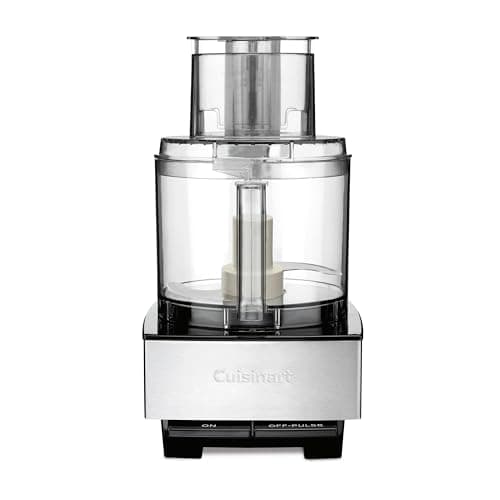
Most full-size kitchens
Cuisinart 14-Cup Food Processor (DFP-14BCNY)
The default full-size processor for a reason: a big, simple, 720-watt workhorse with the shortest parts list to go wrong.
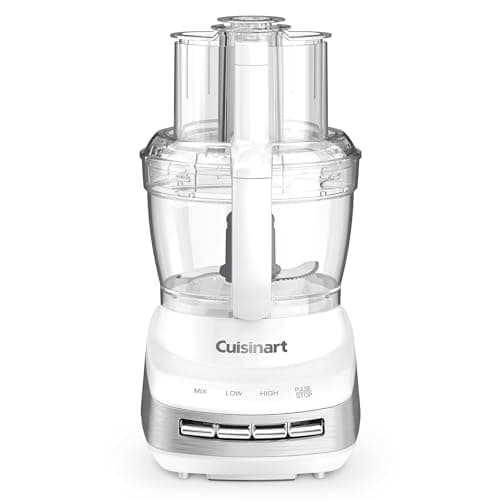
Newer full-size buyers
Cuisinart Core Custom 13-Cup (FP-130)
A modern 13-cup Cuisinart with a SealTight bowl and adjustable slicing — more feature per dollar than the classic DFP-14.
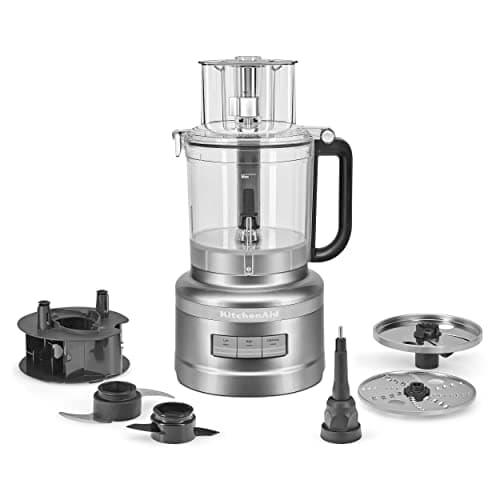
Dicing and prep variety
KitchenAid 13-Cup Food Processor (KFP1318)
A 13-cup KitchenAid with a 3-in-1 feed tube and an included dicing kit — the widest job range in the roundup.
#ad · As an Amazon Associate we earn from qualifying purchases.
Questions
Frequently asked
Can you put food processor parts in the dishwasher?
How do you get the garlic smell out of a food processor bowl?
What is the fastest way to clean a food processor?
Why does my food processor smell even after washing?
Keep reading