HUB 06 · Guides
KitchenAid vs Ninja Food Processor
This is the one brand pairing where the power comparison cannot honestly be run at all: KitchenAid publishes no wattage for its processors, and Ninja publishes only a peak figure. So it comes down to what is in the box — and at the mini size, to how much you want to pay to chop an onion.
We earn a commission if you buy through our links. It does not change the price you pay, and it does not decide our picks — our selection criteria are published in full. How this works.
Choose Ninja if you make dough, want the strongest published motor claim for the money, and a 9-cup bowl is enough. Choose KitchenAid if you want cuts the Ninja cannot make — diced cubes and slice thickness you can change without opening the bowl — and you are willing to wash more parts and accept a brand that publishes no motor figure at all. At the mini size the answer flips almost entirely on price, and we say below who should pay the difference.
The power comparison that cannot be run
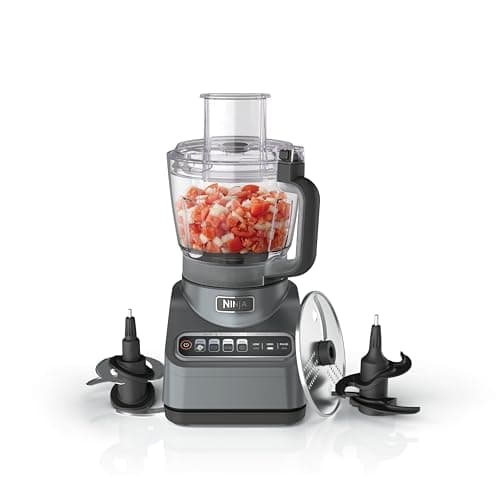
Every food processor comparison on the internet starts with watts, so it is worth saying plainly what happens when you try it with these two brands. Ninja Professional Plus Food Processor (BN601) publishes 1,000 peak watts. KitchenAid publishes no wattage for the KitchenAid 13-Cup Food Processor (KFP1318), none for the KitchenAid 7-Cup Food Processor (KFP0718), and none for the KitchenAid 3.5-Cup Food Chopper (KFC3516) either. There is no KitchenAid number to put next to the Ninja number, and a peak figure would not be comparable to a continuous one even if there were.
That is not a claim that KitchenAid machines are weak. It is a statement about what each company is willing to put in writing, and since this site ranks on published specifications, it is the fact that shapes the whole page. Where a figure is not published we print “not published” rather than converting one from an amperage, a horsepower rating or a review site. The same gap turns up in Cuisinart against KitchenAid, where Cuisinart does publish a continuous wattage and KitchenAid still does not.
Ninja is the more transparent of the two here, with one caveat that matters. A peak watt figure describes the momentary maximum the motor can draw, not what it sustains through a bowl of dough; the continuous figure is lower and Ninja does not publish it. So the honest summary is: Ninja tells you something, KitchenAid tells you nothing, and what Ninja tells you is the flattering half of the story. That is the same point we make about the same machine in Ninja against Cuisinart, where a genuine like-for-like watt comparison is also impossible.
What to compare instead. Bowl size, what is in the box, how many parts you have to wash, and whether the brand sells another size if this one is wrong. All four are published, checkable and far better predictors of whether you will keep using the machine than any watt number either brand prints on the side of the box.
What is actually in the box
This is the real difference between the two brands, and it is a difference of intent. KitchenAid sells cuts. Ninja sells power and dough.
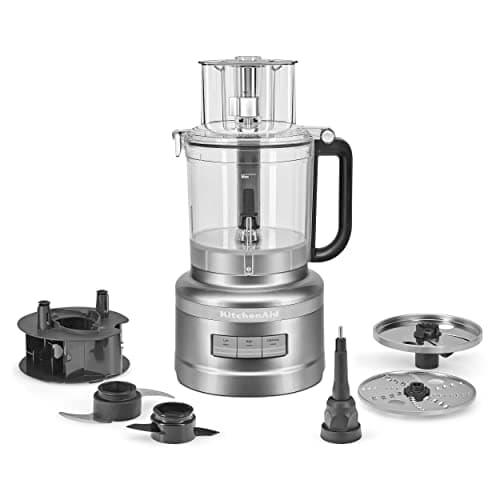
The KitchenAid 13-cup ships with a dicing kit, which makes it one of very few home processors that produces actual cubes rather than mince or slices; an external ExactSlice lever that changes slice thickness while the machine is running; a 3-in-1 feed tube sized for anything from a single carrot to a whole potato; and adjustable slicing and shredding discs. Nothing in the Ninja box does the dicing job, and no home processor does it by accident — without a kit like this, the alternative is a manual push-through dicer.
The Ninja ships a chopping blade, an adjustable slicing and shredding disc and, crucially, a dedicated dough blade— a blunt plastic paddle that folds a dough rather than cutting it, which is why it develops gluten instead of shredding it. Neither KitchenAid processor in our catalog includes one. If bread or pizza dough is a regular job, that single plastic part is worth more than any spec on the page; our food processor for dough guide explains why the blade shape matters more than the motor. Ninja also adds Auto-iQ preset programs, which are pulse patterns run by a timer — useful if you would rather press one button than learn a rhythm, irrelevant if you already pulse by eye.
The full-size comparison
| Factor | KitchenAid 13-Cup Food Processor (KFP1318) | Ninja Professional Plus Food Processor (BN601) |
|---|---|---|
| Work bowl | 13 cups | 9 cups |
| Published motor | Not published | 1,000 peak watts |
| Dicing | Yes — dicing kit included | No |
| Dough blade | Not included | Included |
| Slicing adjustment | External ExactSlice lever, adjustable while running | Adjustable slicing/shredding disc |
| Feed tube | 3-in-1 tube | Standard tube |
| Presets | None — manual control | Auto-iQ preset programs |
| Parts to wash | More — discs, dicing kit, spindles | Bowl, lid, blade, disc |
| Other sizes in our catalog | 7-cup processor and a 3.5-cup chopper | A 2-cup chopper — nothing between |
Size is the thing people get wrong
Thirteen cups against nine sounds like a small gap and is not. Nine cups is a comfortable weeknight machine that fills fast when you are batch cooking; thirteen swallows a whole head of cabbage or a double batch of pastry without stopping to empty it. It is also taller assembled, more likely to live on the counter permanently, and more machine to wash when all you wanted was a handful of parsley chopped. Our food processor size guide works through the bowl-size question properly.
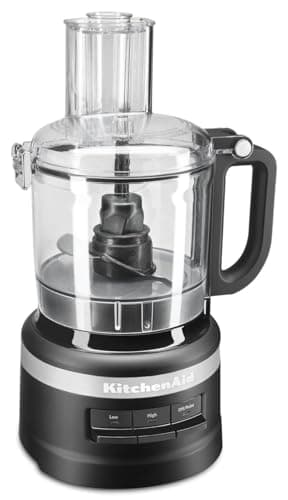
The brands differ in what they offer if the headline size is wrong for you. KitchenAid has a rung below: the KitchenAid 7-Cup Food Processor (KFP0718), a tidy 7-cup machine with a 2-in-1 feed tube and an adjustable slicing and shredding disc, built noticeably more solidly than budget machines twice its capacity. It is the right buy for two to four people who want a processor that stores in a cupboard. What it does not have is a dough blade or a dicing kit, which are the two reasons to buy either of the bigger machines in the first place — so it is a smaller processor, not a cheaper version of the 13-cup.
Ninja, in our catalog, goes from the 9-cup processor straight down to a 2-cup chopper. There is no middle rung. If nine cups is wrong for you in either direction, the choice is between another brand and a different category of tool entirely.
The mini question: chopper against chopper
A large share of people searching for these two brands are not shopping for a full-size processor at all — they want a small electric bowl that minces an onion. Both brands make one, and they are not close in price.
The Ninja Express Chop (NJ110GR) is a 16-ounce (2-cup) bowl with a 200-watt motor and stacked stainless blades, operated by pressing the lid. Bowl, blades and lid are all dishwasher safe. Note that its 200 watts is a plain figure rather than a peak one, which makes it the only number on this page that can be compared with anything. Its limits are real: two cups means batching for a big pot of soup, and there is no pour spout, so wet mixtures drip when you tip the bowl out.
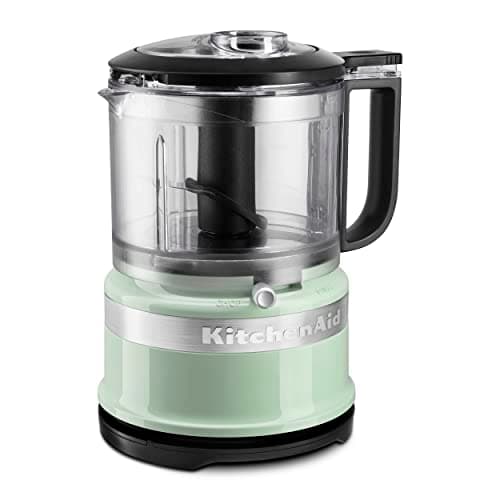
The KitchenAid 3.5-Cup Food Chopper (KFC3516) is the better-built answer at nearly twice the volume: a 3.5-cup bowl, two speeds plus a pulse instead of one button, a locking lid and a drizzle basin in the lid that lets you stream oil in while the blade runs — the feature that makes emulsified dressings, mayonnaise and pesto genuinely easy rather than fiddly. KitchenAid publishes no wattage for it. It also costs meaningfully more than the Ninja, which is exactly why our own catalog entry tells anyone who just wants the cheapest thing that chops an onion to buy the Ninja instead.
The decision rule at this size is short. If you want minced onion, garlic, nuts and herbs for the least money, buy the Ninja. If you make dressings, mayonnaise or pesto and want the drizzle basin and a second speed, buy the KitchenAid and use the extra bowl volume. Our electric chopper roundup ranks both against the rest of the field, and the mini food processor page covers where a small processor beats a chopper outright.
Which one to buy
Buy the Ninja Professional Plus Food Processor (BN601) if you bake, if you want the most motor claim per dollar, or if you are buying your first full-size processor and would rather not pay premium money to find out whether you use it. The honest marks against it: nine cups fills faster than you expect, and the peak-watt headline flatters the machine.
Buy the KitchenAid 13-Cup Food Processor (KFP1318) if dicing or adjustable slicing is something you will genuinely use every week, or if you cook in quantity and the bigger bowl saves you a second pass. The honest marks against it: the dicing kit is fiddly to assemble and clean, there are more parts to store, and KitchenAid will not tell you what the motor is.
Buy the KitchenAid 7-Cup Food Processor (KFP0718) if you want a well-built processor that fits in a cupboard and you do not need dough or dice. And if what you actually need is a small bowl that minces, skip both full-size machines: the Ninja Express Chop (NJ110GR) is the cheap answer and the KitchenAid 3.5-Cup Food Chopper (KFC3516) is the considered one.
If neither brand is settling it for you, the third name in this bracket is worth reading about before you spend: Cuisinart against Breville covers the two brands that publish the most about their motors, which is the axis this particular head-to-head cannot be decided on.
How to read a Ninja spec sheet
Two things on a Ninja listing need translating. Peak watts is the momentary maximum draw, not sustained output, and it is the number Ninja prints largest; treat it as a ceiling rather than a working figure. Auto-iQ is not a sensor — it is a set of timed pulse-and-pause patterns, so it removes the guesswork rather than adding intelligence. Both are real features and neither is a reason on its own to pick the brand.
What is worth weighting heavily is the dough blade, because it is the one part in either box that changes what the machine can do rather than how fast it does it. Food processor blades explained sets out why a blunt paddle develops gluten where an S-blade cuts it apart.
How to read a KitchenAid spec sheet
KitchenAid describes its processors by what they cut, not by how hard they push, so the listing language is about tubes and discs. A 3-in-1 feed tube means three opening widths so you can push a whole tomato or a single carrot without swapping parts. ExactSlice is the external lever that changes slice thickness while the motor runs. The dicing kit is a grid plus a pusher that turns slices into cubes as they leave the disc — the part that makes this brand genuinely different, and also the part that adds the most washing up.
The absence to plan around is the motor figure. If comparing published wattage matters to you, KitchenAid is the wrong brand to shortlist, and that is a legitimate reason to buy elsewhere. Our KitchenAid 13-cup review goes through the machine in full, including where it gives ground.
What neither brand publishes
Neither KitchenAid nor Ninja publishes a continuous wattage, a noise figure, or an assembled footprint for the machines on this page. We are not going to supply those from a review site or a tape measure we did not use. If counter clearance under an upper cabinet is your constraint, the number to look for is the assembled height, and the honest answer is that you will have to ask the retailer or measure the box — the 13-cup machine is the taller of the two.
Warranty terms also vary by model and region and are not stated consistently on either brand’s listings for these machines, so we do not put a warranty column in the table. Check it on the product page before you buy; it is the kind of thing that changes without the listing photo changing.
Parts, cleaning and the machine you actually keep using
The machine that stays on the counter is the one that is quick to reassemble. The Ninja is a bowl, a lid, a blade and a disc. The KitchenAid 13-cup is all of that plus a dicing grid, a pusher and the spindles the discs ride on, and every one of those has to be rinsed before the starch sets. That is not a fault — it is the price of cuts the simpler machine cannot make — but it is the reason a lot of dicing kits get used for a month and then live in a drawer.
Our cleaning guide covers the thirty-second self-clean that keeps either machine usable on a weeknight, and the two places — the lid seam and the drive collar — where food hides on both brands.
Prices, and what “check price” means
Ninja’s machines sit in a lower price bracket than the KitchenAid equivalents at both sizes, which is the single most consistent difference between the brands. We do not print numbers in the copy because they move; the live figure under each pick above comes from Amazon and is dated.
Where a pick shows “check price” rather than a number, our price feed has no current offer for that listing — usually a suppressed buy box rather than a machine that has gone away — and the link still opens the live product page. We would rather show you nothing than an old number you might anchor to.
The hardware
The hardware this guide is about
The products this guide refers to, with prices pulled live from Amazon and dated on every card. Full rankings live in the roundups linked above.
Value and dough
Ninja Professional Plus Food Processor (BN601)
The value pick: a 1,000-peak-watt motor and a dough blade for well under half the price of the premium machines.
Dicing and prep variety
KitchenAid 13-Cup Food Processor (KFP1318)
A 13-cup KitchenAid with a 3-in-1 feed tube and an included dicing kit — the widest job range in the roundup.
Compact everyday prep
KitchenAid 7-Cup Food Processor (KFP0718)
A compact 7-cup KitchenAid with a 2-in-1 feed tube — the tidy middle size, built a step above the budget machines.
Neatly built electric chopper
KitchenAid 3.5-Cup Food Chopper (KFC3516)
A tidy 3.5-cup chopper with two speeds and a drizzle spout — the built-a-bit-nicer electric option.
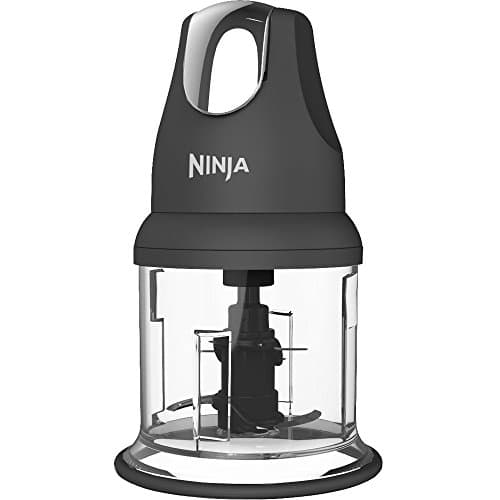
Fast electric chopping
Ninja Express Chop (NJ110GR)
The electric chopper to beat: a 200-watt, one-touch bowl that turns onions and nuts to an even mince in seconds.
#ad · As an Amazon Associate we earn from qualifying purchases.
Questions
Frequently asked
Is KitchenAid or Ninja better for food processors?
How many watts is a KitchenAid food processor?
Is 1,000 peak watts better than a KitchenAid processor?
Which one makes dough?
Which one dices?
Ninja or KitchenAid for a mini chopper?
Keep reading
Related
- Cuisinart vs KitchenAidThe same documentation gap, against a brand that publishes watts.
- Ninja vs CuisinartPeak watts against continuous watts, in full.
- KitchenAid 13-cup reviewThe dicing machine, taken apart.
- Ninja Professional Plus reviewThe value machine, in full.
- Best food processor for doughWhy the blade shape beats the motor.
- Best electric choppersBoth mini bowls, ranked against the field.