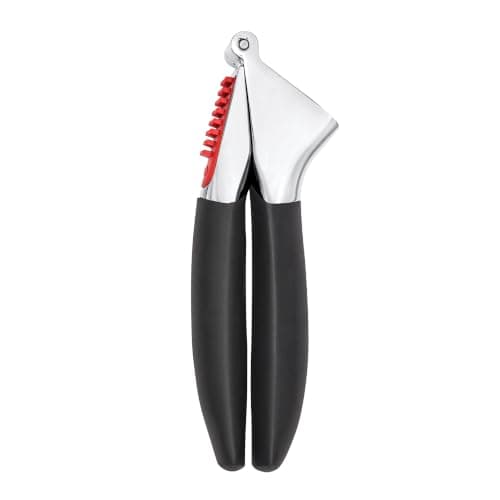
Almost everything that goes wrong with a garlic press is a cleaning problem, not a crushing problem. The clove goes through on the first squeeze; what ruins the tool is the pulp left in thirty small holes, which dries into cement in about twenty minutes. The OXO Good Grips Garlic Pressis the press we rank first because it is the one that answers that problem with a mechanism rather than with advice — the top handle flips over and becomes a comb of pegs that pushes the pulp back out through every hole.
The built-in cleaner is the whole product
This is worth being precise about, because “self-cleaning” on a listing usually means nothing. OXO’s own description is specific: flip the top handle over to push out leftover pulp and skins. The upper handle carries a row of pegs on its back face, pitched to match the hole pattern in the hopper. Fold it back, press it into the chamber, and the pulp is extruded the way it came in. There is no separate brush to find and no extra accessory to lose, because the cleaner is a face of a part you cannot put down without noticing.
Compare that with the alternative at the top of this category. The Kuhn Rikon Epicurean is a better-built press by almost any material standard — stainless throughout, longer handles, more leverage — and it ships with no cleaning tool at all. That is a real difference in daily use, and it is the single reason the OXO outranks it here rather than the other way round.
Die-cast zinc, and what it does and does not promise
OXO states heavy-duty die-cast zinc construction for the body. Die-casting means the load-bearing parts are formed as solid pieces rather than stamped or molded in plastic, and that matters in exactly one place: the hinge. A press fails when the pivot spreads under load and the two halves stop meeting squarely, after which large cloves squash instead of extruding. A cast metal body is the structural answer to that.
What it is not is stainless steel. Zinc alloy is a softer, heavier-feeling, less corrosion-proof metal than the Kuhn Rikon’s stainless, and it is the honest reason this press sits in the budget bracket rather than a reason to prefer it. The listing states the press is dishwasher safe, and we would still rinse it by hand immediately — see the callout below — but that is a garlic habit, not a doubt about the alloy.
The published size is 7 x 2 x 1 inches at 0.8 pounds. That is a genuinely heavy hand tool for its footprint, which is what the “heavy-duty” claim feels like in the hand, and it is also why it takes more drawer space than a bare press. Both of those are in the pros and cons above and neither is a surprise.
Unpeeled cloves: the feature that actually saves time
OXO states the press takes cloves unpeeled, with an efficient hole pattern that pushes the garlic through and leaves the skins behind, and that it presses peeled cloves too. In practice this is the feature that changes how long a recipe takes. Peeling four cloves is the slow part of mincing four cloves; skipping it entirely and lifting a flat disc of skin out of the hopper afterwards is most of the time saving a press offers over a knife.
It also means the press is doing two jobs at once, which is why rinsing it promptly matters more here than on a press you feed peeled garlic: there is skin in the chamber as well as pulp.
The chamber, and the one figure OXO will not give you
OXO describes a large-capacity chamber that crushes multiple garlic cloves at once. That is the claim, and it is the right claim for this category — a one-clove hopper turns a four-clove recipe into four separate squeezes and four separate cleanings.
What OXO does not publish is a number. There is no stated chamber volume, no stated clove count and no stated hole count anywhere in the declared specifications, so we are not going to print one. “Multiple cloves” is what the maker says and “multiple cloves” is what we will repeat. If you are choosing between presses on hopper capacity specifically, no maker in this category publishes a figure you could compare, which is itself worth knowing before you go looking for one.
The handles are an ergonomics claim, and a specific one
OXO states soft, nonslip handles that absorb pressure to reduce strain when squeezing. That is the Good Grips premise applied to the one hand tool where it has the most to do: a press concentrates your whole grip into a short lever, and the pressure lands on the inside of your fingers. A padded handle does not reduce the force required, it spreads it.
For most cooks that is a comfort feature. For anyone with grip or joint limitations it may be the deciding one, and we weigh it that way on the prep tools for arthritis roundup, which sets soft-handled tools against the force each job actually demands.
Rinse it before you cook, not after you eat.This is the entire maintenance story for every press in this category, and the built-in cleaner does not repeal it. Wet pulp pushes out in about five seconds. Pulp that has dried in the holes for an hour needs soaking, and that is how presses end up at the back of a drawer. Flip the handle, push the pulp through, rinse, done — before the pan is off the heat.
The two parts the mechanism costs you
Honesty about the trade: a hinged cleaning handle is one more thing to align. When you wash the press you have to seat the cleaner back into its hinge, and in a dishwasher basket the two halves can sit open and catch other items. The bare-bodied Kuhn Rikon has nothing to align because it has nothing extra.
The second cost is bulk. A press with a folding comb on its top handle is thicker than one without, and in a drawer of flat tools it is the one that stops the drawer closing. If you are fitting a kitchen into very little space that is a real consideration, and we sort the whole drawer on that basis in prep tools for small kitchens.
Who should not buy this press
Three groups, and they are all genuine.
Anyone who crushes garlic in volume and hates presses on principle.That is this product’s own skip line, and it is right. If you are mincing a whole head at a time, a knife and a pinch of salt makes a better paste faster, and an electric chopper beats both for a head at once. A press is a three-clove tool. If it is the outlet you lack rather than the volume, the pull-cord Brieftons minces a bowl of garlic and herbs with no power at all.
Anyone buying a press to hand down. Buy the stainless Kuhn Rikon. Cast zinc with a hinged, soft-faced handle is a tool with a service life; a one-piece stainless press is closer to cutlery. Our garlic press roundup sets the two against each other on exactly that axis.
Anyone who wants the paste, not the mince. A press extrudes garlic in short strands. It does not produce the smooth, emulsified paste a mortar and pestle gives you, and for a dish where garlic is the flavor rather than a background note that difference is noticeable. The mortar roundup covers the tool that does.
What we are not claiming
We have not crushed garlic in a lab, we do not own this press, and nothing on this page is a test result. Every figure above — the die-cast zinc, the flip-over cleaner, the unpeeled-clove claim, the nonslip handles, the dishwasher line, the dimensions and the model number — is OXO’s own declared specification on the listing the buy button points at, read on the date stamped at the top of this page. Where OXO publishes nothing, as with the chamber capacity, this page says so rather than estimating. That is the method, and it is written out in full on how we pick.