Buy the Cuitaxi 8-inch Molcajete, Mexican Lava Rock if guacamole, roasted salsa and anything else you want to mash and serve in the same bowl is the reason you are shopping — the porous lava surface grips soft ingredients in a way smooth stone does not, and at 8 inches across it goes to the table. Buy the Kota Japan Large Black Granite Mortar & Pestle if you want one bowl for everything, and the Fox Run Marble Mortar and Pestle Set (4 in) if dry spices are the job and you want it to live in a drawer. The thing to understand before any of that: a molcajete is not a different category of tool. It is a mortar and pestle, made of a specific stone, in a specific shape, for a specific set of jobs.
Two variables, not two tools. Every mortar on earth varies on the same two axes — what the stone is, and what shape the bowl is. A molcajete sits at one corner: porous vesicular basalt (volcanic rock), wide and shallow, with a matching pestle called a tejolote. A classic spice mortar sits at the opposite corner: dense non-porous stone, small and deep. Everything else is in between. Once you see it as two dials rather than two products, the choice stops being about tradition.
The stone: porous against dense
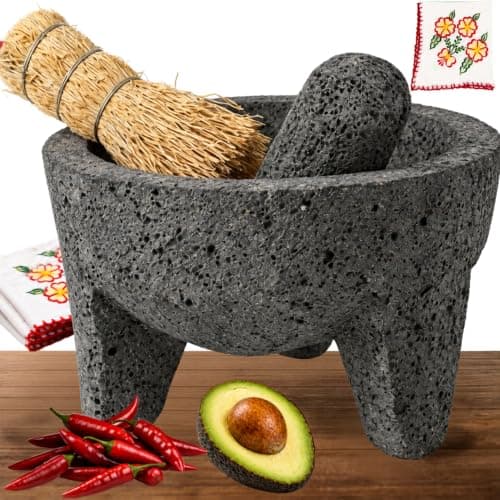
The Cuitáxilisting states its stone precisely — lava rock from the Popocatepetl volcano in Puebla, Mexico, hand-made by artisans. That is unusually specific; most “natural stone” listings say nothing at all. Volcanic rock is full of gas bubbles, which is exactly the point: the surface is a landscape of tiny edges, and soft wet things — avocado, roasted tomato, chilli, garlic — catch on it instead of sliding around a smooth bowl.
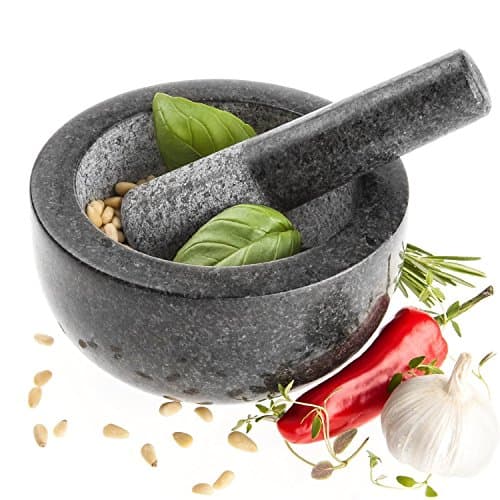
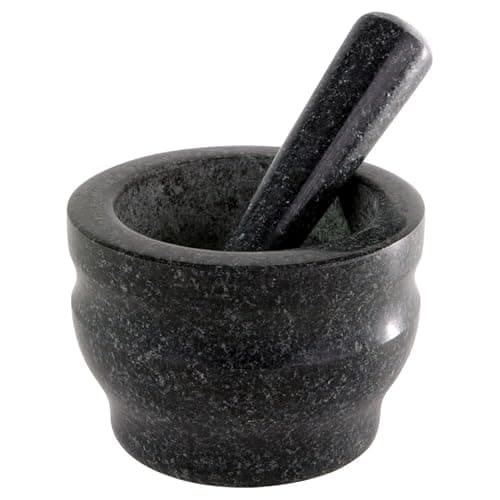
Granite is the opposite material: dense, hard and essentially non-porous once seasoned. In a granite bowl the grinding happens between the pestle face and the wall, which is what you want for something hard and dry like a peppercorn. The Kota Japan set states solid unpolished granite, and Cole & Mason goes one better and states an unpolished pestle tip as well as bowl. Whether granite or marble matters for the stone itself is settled with sourced hardness figures in granite vs marble — the short version is that finish beats stone type.
Porosity has a cost, and the maker says so: a molcajete must be cured before first use or the first few things you make will carry grit, and Cuitáxi sends the method with it. All unpolished stone sheds a little at first; an open-pored volcanic bowl sheds more. The published methods, including this one, are collected in how to season a mortar and pestle.
The shape: wide and open against deep and narrow
A molcajete is a tripod bowl, wide and relatively shallow, usually with a flared rim. That geometry is built for working a volume of soft material with a rocking, pressing motion and then putting the bowl on the table. The catalog’s is 8 inches across and 5 inches high — the widest bowl in our whole mortar lineup.
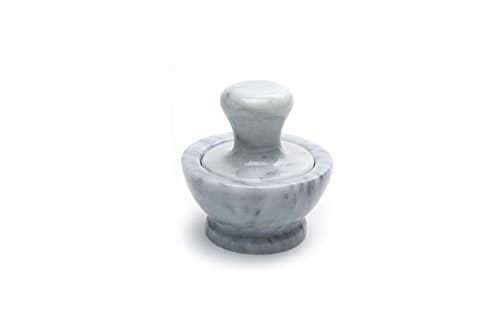
A spice mortar is the inverse: the Kota Japan’s published interior is 3-3/4 inches across and 2-3/4 deep, and the Fox Run is a 4-inch cube of a bowl. Narrow and deep walls mean a dry seed cannot escape sideways from under the pestle. Put a teaspoon of coriander seed in an 8-inch molcajete and you will spend the whole time chasing it around the floor of the bowl. That is not a flaw in the molcajete; it is the wrong bowl for the job, and we rank it out of the best mortar and pestle for spices for exactly this reason.
The published comparison
| Pick | Stone, as stated | Bowl, as stated | Weight | Its real job |
|---|
| Cuitaxi 8-inch Molcajete, Mexican Lava Rock | Lava rock, Popocatepetl volcano, Puebla; hand-made | 8 in diameter, 5 in high | 7.0 to 8.8 lb (hand-made, so a range) | Guacamole, roasted salsa, mash-and-serve |
|---|
| Kota Japan Large Black Granite Mortar & Pestle | Solid unpolished granite | Interior 3-3/4 x 2-3/4 in; 2 cups | 8 lb | One bowl for spices and paste both |
|---|
| Fox Run Marble Mortar and Pestle Set (4 in) | Unpolished rough interior; marble in the title, granite in two bullets | 4 x 4 x 4.25 in | 1.9 lb | Dry spices, in a drawer |
|---|
| Cole & Mason Granite Mortar & Pestle (5.5 in) | Unpolished interior and unpolished pestle tip | 5.9 in bowl diameter; 2 cups in the spec table, 3 in the bullets | 8 lb | Paste and pesto, with the widest granite bowl here |
|---|
The weight column is the one people are surprised by. A hand-made molcajete has a published weight range rather than a figure — 7.0 to 8.8 lb — because no two are the same object. That is a genuine consequence of buying something artisanal and not a listing error. It also means the only mortar here you can lift one-handed is the 1.9 lb marble set.
Which to buy
Guacamole, salsa, and food you want to serve from the bowl: the molcajete. Nothing else in the catalog has a porous surface, and nothing else is 8 inches wide.
Dry spices, a few times a week: the small unpolished marble set. Cheapest, smallest, and the geometry is right.
One bowl for everything: the Kota Japan granite set. 2 cups is enough for a batch of pesto or curry paste, the interior dimensions are published so you can check the shape before buying, and 8 lb of stone does not move while you work.
Pesto specifically, in volume: the Cole & Mason, for the widest granite bowl here — with the caveat that its own listing cannot agree whether it holds 2 cups or 3.
And if the question behind the question is whether to use a machine at all, the honest answer is in mortar and pestle vs food processor: if you buy one tool, buy the processor — but a processor cannot do what crushing does to an oil-bearing seed or leaf.
What we are not claiming
We have not ground anything in any of these four bowls. Every stone, origin, dimension, weight and curing instruction above is the maker’s own published wording on the listing the buy button points at, cited below. Where a listing contradicts itself we record both readings rather than choosing the flattering one. Prices come live from Amazon with the date attached.
Three things people get told that are not published anywhere
“A molcajete seasons itself over time and tastes better.” The curing step is published and real — grinding rice until it comes out white closes the worst of the open pores. The flavour claim beyond that is folklore, and no maker in our catalog makes it. We are not going to make it for them.
“Basalt is harder than granite, so it grinds better.” Nobody publishes a hardness figure for a specific molcajete, and the relevant property here is not hardness but porosity — grip, not toughness. A rough surface of any hard stone grinds; a polished one does not.
“Authentic means it works better.” Provenance is a real thing to want and this listing documents it unusually well. It is not a performance spec. Buy the molcajete for the porous surface, the width and the table presence — all three of which are checkable.
Caring for either one
No soap, ever, on unpolished or porous stone. Rinse with warm water, scrub with coarse salt or dry rice if something sticks, and dry it fully before it goes away.
Expect staining on a molcajete and ignore it. Porous rock takes colour from chilli and tomato; that is not dirt.
Do not put stone in the dishwasher, whatever a listing says. One set in our catalog states both “rinse with warm water and let air dry” and “dishwasher safe” in the same listing, for a stone it also tells you to season. Take the first instruction.