An immersion blender is not the ideal smoothie machine and it is often the sensible one. It costs a fraction of a countertop blender, it washes in fifteen seconds under a running tap, and it takes up a drawer rather than a shelf. What it will not do is crush ice cubes. Every other limitation on this page is manageable; that one is not, and no amount of wattage fixes it.
Why ice is the hard line
A countertop blender crushes ice because a heavy blade spins inside a shaped jar that keeps throwing the contents back down onto it. An immersion blender has a small blade under a guard, in whatever vessel you happen to be holding, with nothing forcing the ice back into the cutting zone. Ice cubes just bounce, and the blade takes the impact.
The workaround is straightforward and it is what every stick-blender smoothie relies on: use frozen fruit instead of ice. Frozen banana, mango, berries and peach all blend readily, chill the drink exactly as ice would, and add body rather than water. If you want it colder still, chill the liquid rather than adding cubes.
What the ranking is based on
Published motor power, because this is one of the few immersion-blender jobs where it genuinely predicts the result. Breaking frozen fruit and fibrous greens down is a sustained load, unlike a pot of cooked soup where the food is already soft.
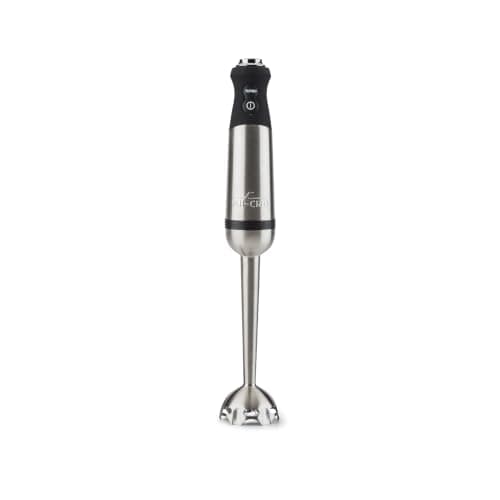
The All-Clad Stainless Steel Immersion Blenderleads at 600 published watts — the strongest figure in our catalog — on a variable-speed all-stainless body. It is also the most expensive here and comes with the fewest attachments, which its own skip line is clear about. Buy it if smoothies and thick purees are the reason you are shopping.
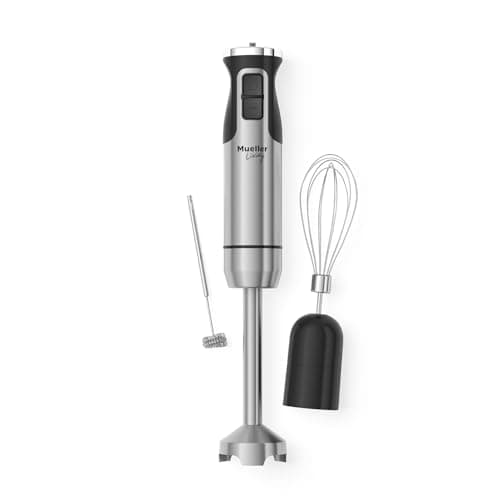
The MuellerLiving Ultra-Stick 500W Immersion Blender is the value answer at 500 published watts with nine speeds plus turbo, for a fraction of the price. The honest caveat is build: it is plastic-heavy next to the metal-bodied sticks, and its longevity is less proven.
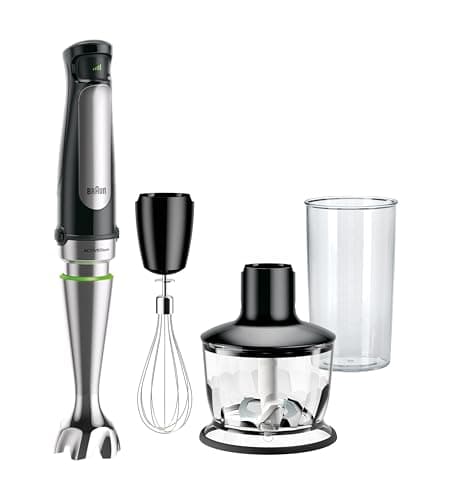
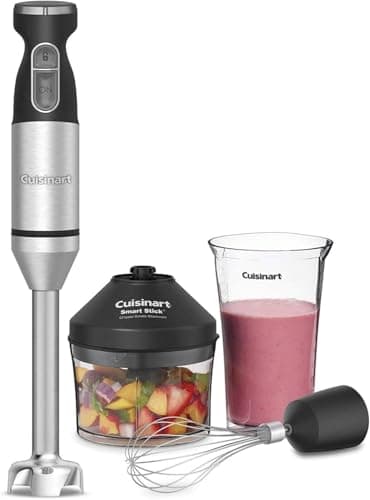
The Braun MultiQuick 7 (MQ7035X) is here for control rather than raw power. Its speed is set by trigger pressure, which is the most usable arrangement on this page for the start-slow-then-increase technique below, and its anti-splash bell matters more than you would think in a narrow beaker. The Cuisinart Smart Stick Variable-Speed (CSB-179) at 300 watts is the sensible middle: enough for frozen berries in a beaker, less happy with a full jar of frozen mango.
The vessel is half the job. A tall, narrow container is what creates a usable vortex; a wide bowl does not, and the mixture just spins away from the blade. Use the beaker that came with the blender, or a wide-mouth jar barely wider than the blade guard. Fill it no more than two-thirds, or you will wear it.
The technique that stops lumps
Liquid goes in first, then soft ingredients, then frozen fruit on top. Put the blender head all the way to the bottom before you switch on — starting it above the surface is how kitchens end up decorated — and run it there for a few seconds to establish a downward pull. Then lift it slowly in small increments, letting the vortex draw the frozen pieces down to meet the blade, and tilt slightly to break suction if it locks onto the base.
Leafy greens are the other lump problem. Kale and spinach are fibrous, and a stick blender will get them small but rarely completely smooth. Blend the greens with the liquid on their own first, before anything frozen goes in, and you get much closer.
How they compare for smoothies
Published motor figures only. Where a manufacturer publishes no wattage we say so rather than converting or estimating one.| Blender | Published motor | Speed control | Best smoothie use |
|---|
| All-Clad Stainless Steel Immersion Blender | 600 W | Variable | Thick, frozen-fruit-heavy blends |
|---|
| MuellerLiving Ultra-Stick 500W Immersion Blender | 500 W | 9 speeds plus turbo | The same job on a budget |
|---|
| Braun MultiQuick 7 (MQ7035X) | Not published | Trigger-pressure variable | Best control and least splatter |
|---|
| Cuisinart Smart Stick Variable-Speed (CSB-179) | 300 W | Variable dial | Berry-and-yogurt style blends |
|---|
When to buy a countertop blender instead
If you make smoothies daily, want them silky rather than merely smooth, use a lot of leafy greens, or genuinely want to crush ice, buy a countertop blender. That is the machine designed for this job, and no stick blender matches it on texture. Our immersion blender vs blender comparison lays out where each one wins in full.
The case for the stick blender is everything around the blending. It cleans in seconds under the tap instead of needing a jar disassembled, it stores in a drawer, and it does a dozen other jobs a blender cannot — which is the argument the uses guide makes. If smoothies are one of several reasons you want one, it is a good buy. If they are the only reason, it is not.