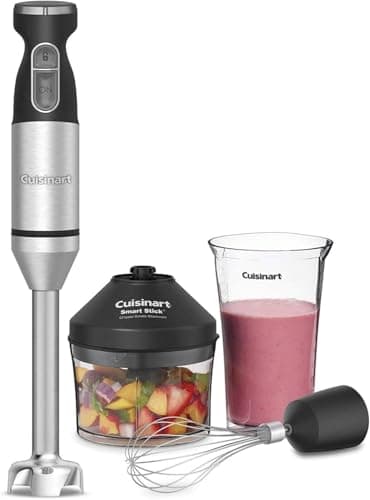
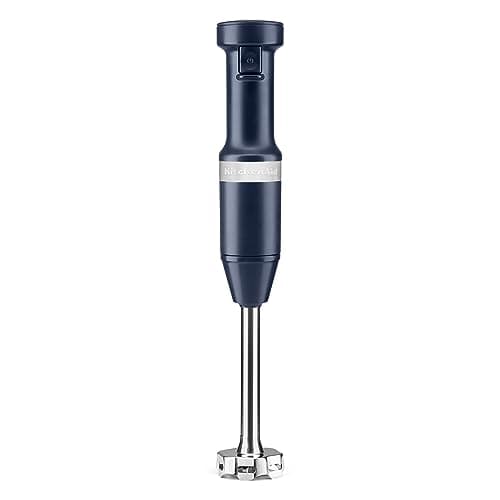
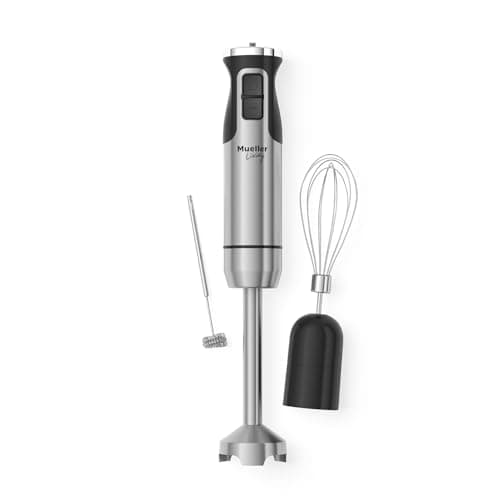
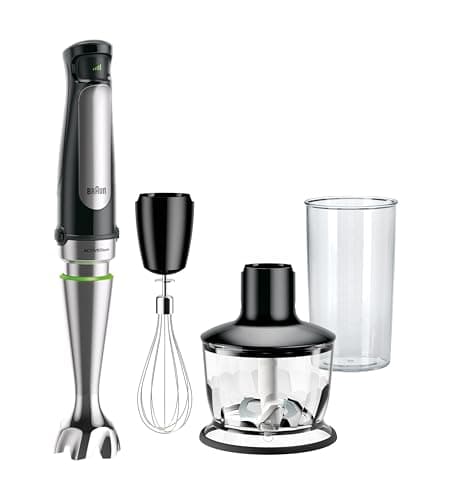
For most people making baby food the best immersion blender is the Braun MultiQuick 7 (MQ7035X), and the reason is the shape of its guard rather than its motor: the anti-splash bell is what keeps hot squash puree inside the pan instead of on the counter, and the chopper bowl that comes in the box is what carries you from smooth purees to lumpier textures later. If the budget is tighter, the Cuisinart Smart Stick Variable-Speed (CSB-179) gives you a variable-speed motor plus the same two attachments for noticeably less, and the MuellerLiving Ultra-Stick 500W Immersion Blender does it for less again. The KitchenAid Variable-Speed Corded Hand Blender (KHBV53) is the one to buy if you batch-cook in a tall pot or in non-stick, because of its 8-inch arm and its removable pan guard.
Why a stick blender suits weaning better than a big machine
Our food processor for baby food page makes the case that a 14-cup work bowl is actively wrong for two tablespoons of carrot, because the food spreads too thin to reach the blade. An immersion blender solves the same problem from the other direction. It does not need a minimum volume spread across a wide bowl — it needs depth. Put a small quantity in a tall, narrow vessel and the blade sits in the middle of it, which is exactly what a beaker or a chopper jug is for.
The second advantage is that there is no transfer. You steam or simmer the vegetable, take the pan off the heat, and blend in the pan. Nothing gets tipped from a hot pan into a plastic bowl, which is the step where people burn themselves and where half the puree ends up on the sides of a blender jar. And the third is the wash: a stick blender at its simplest is one shaft. Compared with a bowl, a lid, a blade and a drive collar twice a day for eight months, that difference is not trivial.
The trade is texture range. A processor with a disc will give you the chunkier, scoop-and-squash textures and the finger-food batons that come later; a stick blender purees and then purees more. That is why the chopper bowl in the box matters so much on this page — it is the attachment that pulses rather than liquefies.
This page is about equipment, not feeding advice. When to start solids, what to start with, and which textures suit which stage are questions for your pediatrician, and we do not answer them here. What we can tell you is which of these machines will still be pleasant to use on day two hundred.
The spec that decides it, and the one nobody publishes
Every immersion blender in our main stick blender ranking is compared on published motor wattage, because on a corded stick that figure predicts what it will push through. For baby food it is close to irrelevant. A steamed carrot, a cooked sweet potato, a softened pear: none of these ask anything of a motor. The 180 watts KitchenAid publishes for the KHBV53 is ample, and the 500 watts on the Mueller buys you nothing here that you will notice.
What is not published by any of the four is a minimum volume — the smallest quantity the blender will actually puree rather than push around. We are not going to invent one. The practical substitute is the vessel: if a blender comes with a beaker or a chopper jug, you have a tall narrow container the head fits into, and small batches work. If it does not, you will be hunting for a measuring cup the right shape, and a wide cereal bowl is the wrong shape.
So the three criteria this page ranks on, in order: does it control splatter, because you are blending hot food; is it safe in the pan you cooked in, because non-stick is what most people steam vegetables in; and how many parts do you wash, because the answer gets multiplied by roughly five hundred.
Splatter is the real difference between these four
One of the four has a bell-shaped guard: Braun calls it anti-splash, and it is the single most-noticed feature on the tool. A flat or open guard lets the vortex break the surface, and hot puree goes up the shaft, up your arm and across the stovetop. A belled guard keeps the circulation under the surface. Blending something at just-off-the-boil temperature with a baby in the next room is precisely the situation where that matters.
The Cuisinart Smart Stick Variable-Speed (CSB-179) does not have one, and we say so both on its card and in the full Smart Stick review: it spatters more than the Braun. That is a real cost, not a technicality. It is also not disqualifying, because the fix is free — blend in a deep vessel, keep the head fully submerged, start on the lowest speed. Our hot-liquid safety guide is the full version of that technique and it is worth ten minutes before the first batch.
The pan you cooked in
Most people steam or simmer weaning vegetables in a small non-stick saucepan, and most people then want to blend in that pan. A bare stainless blade guard on a coated pan is how a coating gets scored. The KitchenAid Variable-Speed Corded Hand Blender (KHBV53) is the only pick here that ships a removable pan guard specifically to protect cookware, which is the reason it is on the page at all despite having the lowest published wattage of the four.
Its other advantage is reach. The 8-inch arm is the longest here, and if you are cooking ahead in a tall pot — a big batch of butternut squash to freeze in portions — that is the difference between blending in the pot and tilting a hot pot toward yourself. What you give up is attachments: KitchenAid bundles fewer of them than Braun does, so the chopper-bowl route to lumpier textures is not included.
Parts, and the dishwashing arithmetic
All four blenders here separate into a motor body and a blending shaft, and on all four the shaft is the only part that has to go into the food. That is the good news, and it is the whole reason a stick blender suits this job. The differences are in what else comes in the box and what you are realistically going to use.
The Braun, the Cuisinart and the Mueller all include a whisk and a chopper. The chopper is genuinely useful for weaning — it is a mini food processor, and pulsing cooked chicken or lentils in it gives you the coarse texture a puree cannot. The whisk is the attachment that will sit in a drawer. The KitchenAid’s box is leaner, which is a point in its favor if you have no cupboard space and a point against it if you wanted the chopper.
One habit worth adopting on day one, for any of them: fill the beaker or the pan with warm soapy water and run the blender in it for five seconds before you wash anything properly. Pureed vegetable dries like glue in the guard, and five seconds beats five minutes with a brush. The same trick is why the thirty-second self-clean works on a processor.
How they compare
Every entry is the maker’s own published claim from the product’s Amazon listing. Where a figure is not published we say so rather than convert or estimate.| Blender | Published motor | Splash-control bell | Pan guard | Chopper in the box |
|---|
| Braun MultiQuick 7 (MQ7035X) | Not published | Yes — anti-splash bell | Not stated | Yes, plus whisk |
|---|
| Cuisinart Smart Stick Variable-Speed (CSB-179) | 300 watts | No | Not stated | Yes, plus whisk |
|---|
| KitchenAid Variable-Speed Corded Hand Blender (KHBV53) | 180 watts | No | Yes — removable | No |
|---|
| MuellerLiving Ultra-Stick 500W Immersion Blender | 500 watts | No | Not stated | Yes, plus whisk |
|---|
Which one to buy
Buy the Braun MultiQuick 7 (MQ7035X) if you want the tidiest tool and you expect to keep using it long after weaning — it is the pick on our main ranking too, so the money is not weaning-specific spending. Buy the Cuisinart Smart Stick Variable-Speed (CSB-179) if you want the same attachment set for less and you are happy to blend in a deep beaker. Buy the MuellerLiving Ultra-Stick 500W Immersion Blender if this is a one-year tool and you would rather spend the difference on freezer trays; it is the value pick on our budget stick blender roundup for the same reasons, and the full Mueller review is blunt about the plastic-heavy build that is the honest reason it is not higher here.
Buy the KitchenAid Variable-Speed Corded Hand Blender (KHBV53) if you batch-cook. A tall pot of squash or a big pan of lentils, blended once and frozen in portions, is a completely different workflow from making one meal at a time, and the long arm plus the pan guard is built for it. If you already own a stick blender and it spatters, the answer is not a new blender — it is a taller vessel and a lower speed.
What to look for in a baby-food blender
A vessel that is taller than it is wide. This is the first thing and most buying guides never mention it. An immersion blender pulls food down into the blade and pushes it out sideways; in a wide bowl the circulation collapses and you get a ring of unblended food around a smooth center. A beaker, a chopper jug or a small deep saucepan fixes it completely. If the blender you are considering comes with neither, budget for a tall measuring cup.
A guard that keeps the vortex under the surface. Bell-shaped guards are the design that does this. Where the maker does not claim one, the technique substitutes for it: submerge fully, start slow, and tilt rather than lift when you want to move the food around.
Variable speed, used at the bottom of the range. Every pick here has it. On thin, hot purees you want the lowest setting that moves the food, not the highest one available. Speed is what throws liquid; it is rarely what makes the texture smoother.
A shaft you can put in the dishwasher. Cuisinart states its stainless shaft is dishwasher safe. Check the manual for whichever you buy, because on some models it is the shaft only and never the motor body — which contains a motor and is not sealed.
Textures, and where the chopper attachment earns its place
Early purees are the easy part; any of these will make a completely smooth one out of a cooked root vegetable. The stage that catches people out is the one after, when the texture is meant to get coarser rather than finer. A stick blender is bad at coarse on purpose — it is a blade spinning in a guard, and it will take a bowl of cooked chicken from shreds to paste in about a second and a half.
The chopper jug is the answer, and it is why the Braun, Cuisinart and Mueller boxes are better value than their price difference suggests. A chopper bowl pulses. You can stop it at coarse. If none of that appeals, a small food processor does the same job with more control — our mini food processor roundup covers those, and the processor versus immersion blender comparison lays out which tool owns which texture.
Batch cooking and freezing
The single biggest time saver in weaning is not the blender, it is cooking once a week rather than once a meal. That changes what you should buy: a bigger pot, a longer arm, and a machine that will blend two pounds of squash without you holding it at an angle. It is the argument for the KitchenAid on this page, and it is also the point at which a full-size food processor starts to make sense instead — see our large food processor roundup if you are cooking for a family at the same time.
Whatever you blend in, do not blend in the freezer tray, and do not put a blender head into something you have already portioned. Blend, then portion.
Safety, plainly
Take the pan off the heat before you blend. Let it stop bubbling. Keep the blade fully submerged before you press the switch and keep it submerged until you let go, because the moment the head breaks the surface at speed is the moment hot puree leaves the pan. Use the lowest speed that works. Never put a hand or a spatula into the vessel while the blender is plugged in.
On non-stick, use a pan guard if the maker supplies one, and if it does not, blend in a beaker rather than in the coated pan. A scored non-stick pan is a pan you have to replace. The full technique, including the reason a half-full pan is safer than a three-quarters-full one, is in our hot-liquid safety guide.