HUB 06 · Guides
Cut-Resistant Glove Levels Explained
Two different standards, two different scales, and both of them use the number 5 to mean different things. Here is what each level is measured in, and the level a mandoline actually calls for.
We earn a commission if you buy through our links. It does not change the price you pay, and it does not decide our picks — our selection criteria are published in full. How this works.
For a mandoline, a grater or a hand-held slicer in a home kitchen, you want ANSI level A4 or A5, or a glove stating EN 388 cut level 5 on the older index. All three gloves we recommend are in that band. Anything above it is industrial equipment you will find clumsy, and anything below it is a comfort glove with a safety-sounding label. The complication — and the reason this page exists — is that two unrelated standards both use the number 5, and they do not mean the same thing.
There are two scales, not one
ANSI/ISEA 105 is the American standard. Its cut-resistance classification runs A1 to A9, and the level is set by how much force — measured in grams of load on a blade drawn across the fabric — is needed to cut through. The published thresholds are:
| ANSI/ISEA 105 level | Grams to cut through | Published descriptor | Typical use |
|---|---|---|---|
| A1 | 200–499 g | Minimal | Light assembly, gardening |
| A2 | 500–999 g | Low | Material handling, packaging |
| A3 | 1,000–1,499 g | Light | Light glass and metal handling |
| A4 | 1,500–2,199 g | Medium | Food prep, light blade work |
| A5 | 2,200–2,999 g | Medium / high | Meat processing, mandoline and grater work |
| A6 | 3,000–3,999 g | High | Heavy glass and metal fabrication |
| A7 | 4,000–4,999 g | Heavy | Industrial blade handling |
| A8 | 5,000–5,999 g | Very high | Heavy industrial |
| A9 | 6,000 g and above | Highest | Specialist industrial |
EN 388 is the European standard, and it reports cut resistance twice. The older coup test spins a circular blade against the fabric and counts cycles until it cuts through, producing an index from 0 to 5— 0 is up to 1.2 cycles, 1 is above 1.2 to 2.5, 2 is above 2.5 to 5.0, 3 is above 5.0 to 10.0, 4 is above 10.0 to 20.0, and 5 is above 20.0 cycles. The 2016 revision adds a letter, A to F, from a straight-blade test reported in newtons, with thresholds at 2, 5, 10, 15, 22 and 30 N respectively.
This is why “Level 5” is ambiguous, and our own three picks prove it. NoCry Cut Resistant Gloves (Food Grade)states EN388:2016 Level 5 and ANSI 105-2016 — the 5 there is the 0-to-5 coup index, not a letter. Dowellife Cut Resistant Gloves (Level 5) states EN388:2003 Level 5 and maps it to EN388:2016 Level C, which is the 10 N band on the letter scale. Mercer Culinary Millennia Level A5 Cut Glove skips the European scales entirely and states ANSI Level A5— 2,200 to 2,999 g. All three are in the right territory for kitchen work, and all three describe it in a different vocabulary. A “Level 5” on a packet is not a number you can compare to another brand’s until you know which scale it came from.
You cannot convert between the two scales
It is tempting to line the scales up and read across, and it does not work. The two standards use different blades, different motions and different units — grams of load over a fixed distance of travel on one side, newtons and blade cycles on the other. A rough sense of overlap exists, which is why gloves in the kitchen band tend to show both a 5 and an A4 or A5, but there is no published conversion factor and anyone offering you one is guessing. If you are comparing two gloves, compare them on the same scale or do not compare them.
Which level a home kitchen actually needs
Mandoline, box grater, rotary grater, hand slicer: A4–A5. This is the band every glove we rank sits in, and it is enough. A mandoline blade is sharp but it is travelling slowly and under your own control; what you are protecting against is a skid across the fabric, which is exactly what this test measures.
Oyster shucking and breaking down proteins with a knife tip: no glove band helps. Cut resistance is not puncture resistance, and that distinction is on the card of every glove on this page. These fabrics resist a blade sliding. A point — a knife tip, a shucker, a fork, a skewer — passes between the fibres rather than cutting them. A glove is the wrong safeguard for that work and an A9 glove is no better at it than an A4.
Powered or serrated blades: no.Mercer states this outright for its own glove — not to be used with moving or serrated blades — and that limit applies to knit gloves generally. A moving blade can catch fabric and pull the hand in. If you own a powered slicer, the guard on the machine is the safety equipment, not the glove.
Above A5: diminishing returns in a kitchen. A6 and up means more or stiffer fibre, usually with steel or glass in the yarn, and the cost is dexterity. The whole point of a kitchen glove is that you can still feel a shrinking potato through it. A glove too clumsy to wear is a glove that sits in the drawer, which protects nothing.
What else to read on the packet
Food grade. An industrial A5 glove is not necessarily made for contact with food. The NoCry pick states food grade and 100% food safe explicitly; that is a separate claim from the cut rating and worth having.
Washing.A glove used on raw chicken needs washing, properly. All three picks are washable and the Mercer publishes machine washable up to 180°F, which is a commercial sanitizing temperature rather than a domestic one.
How many you get. This catches people out: the Mercer is sold as a single glove, not a pair, because in a professional kitchen you glove the hand holding the food. The NoCry is ambidextrous, so a two-pack covers both hands or two cooks.
Nothing at all. If a glove publishes neither an ANSI level nor an EN 388 result, it is making a marketing claim rather than a safety claim, and you have no way to check it. That is the one disqualifier. Our cut-resistant glove roundup ranks the three that do publish, and the mandoline safety guidecovers the habits that matter more than any glove — because the glove is the backstop, not the method.
The hardware
The hardware this guide is about
The products this guide refers to, with prices pulled live from Amazon and dated on every card. Full rankings live in the roundups linked above.
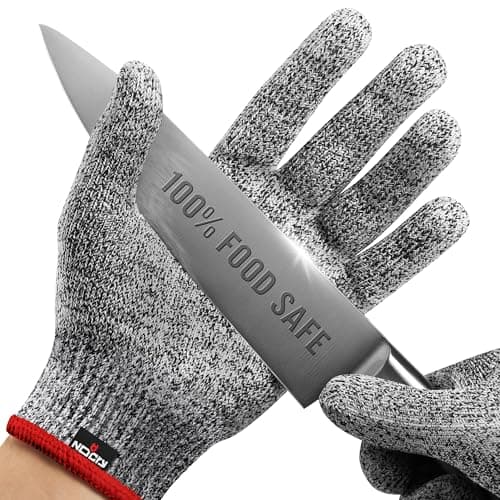
Mandoline and grater work
NoCry Cut Resistant Gloves (Food Grade)
The mandoline glove to buy: EN388 Level 5 fabric, food safe, ambidextrous, and cheap enough that there is no excuse.
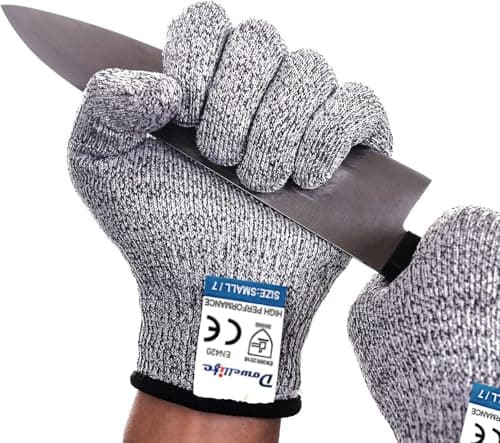
Fit and dexterity
Dowellife Cut Resistant Gloves (Level 5)
The stretchier alternative: HDPE knit blended with elastic nylon, so it fits closer and feels less like a mitten.
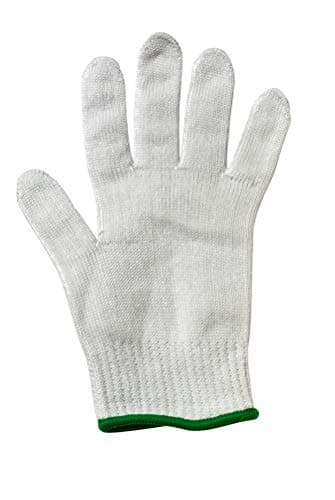
Professional kitchens
Mercer Culinary Millennia Level A5 Cut Glove
The commercial-kitchen glove: stainless-steel-reinforced knit, ANSI A5, color-coded by size, sold singly.
#ad · As an Amazon Associate we earn from qualifying purchases.
Questions
Frequently asked
What does Level 5 cut resistant mean?
What level of cut resistant gloves do I need for a mandoline?
Is A5 better than Level 5?
What is a level 9 cut resistant glove for?
Will a cut-resistant glove stop a knife?
Can you wash cut-resistant gloves?
Keep reading
Related
- The best cut-resistant glovesThe three that publish a rating, ranked.
- Mandoline safety guideThe habits that matter more than the glove.
- The best mandolines and slicersThe tool the glove is for.
- Best mandoline for beginnersStart with the guard, not the blade.
- The best cheese gratersThe other tool with a last inch.
Receipts
Sources
- ANSI/ISEA 105 cut-resistance classification table (A1–A9 thresholds)
- Cut-resistant gloves — ANSI/ISEA 105 gram bands and EN 388:2016 coup index and A–F newton levels
We do not run a testing lab and we do not pretend to. Specifications come from the manufacturer's own published documents and from published standards; prices come from the live Amazon API. Where a figure is not published, the page says “not published” rather than guessing. Read the full method.