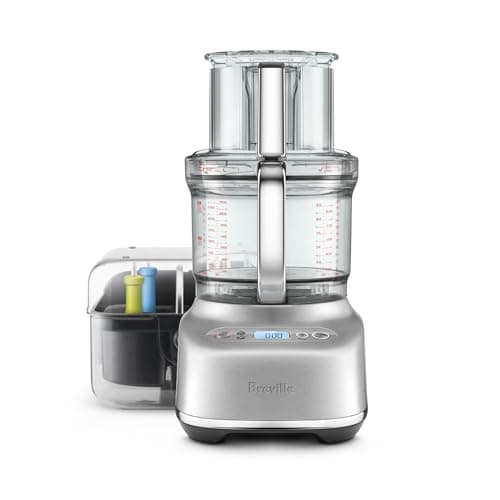
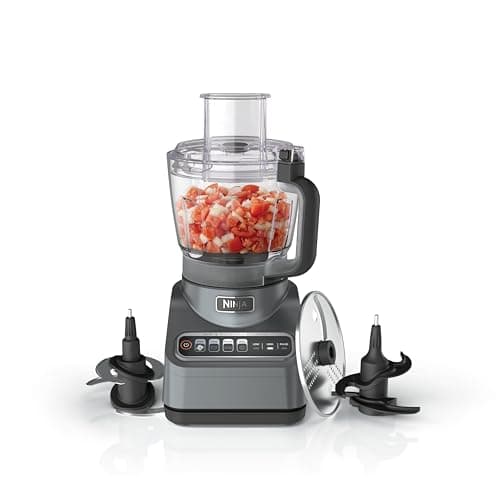
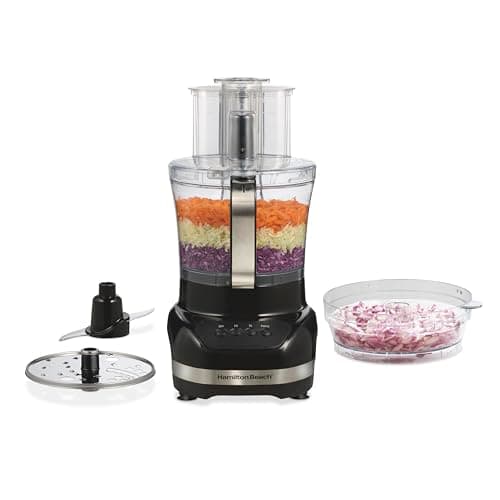
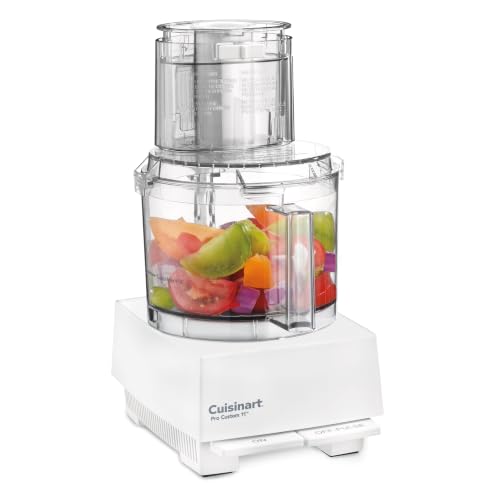
The size-for-size swap is the Cuisinart Pro Custom 11-Cup Food Processor (DLC-8SY): eleven cups, a published 625-watt motor, an extra-large feed tube with two pushers, and a chopping/mixing/ dough blade named in its own accessory list. If you want to beat KitchenAid at the thing it is actually best at — setting a slice thickness from outside the bowl — the Breville Sous Chef 16 (BFP810) is the machine that does it, with a 24-position dial and a millimeter range Breville prints in its own instruction book. The Ninja Professional Plus Food Processor (BN601) matches the power for far less, and the budget pick is the Hamilton Beach Big Mouth Duo Plus 12-Cup.
Prices above come live from Amazon with the date they were last checked. Where we have no verified live price we show none rather than printing a stale figure — which is also why the KitchenAid machines are discussed here rather than ranked.
What KitchenAid publishes, and is genuinely known for
A substitution page that does not state the original’s strengths first is a sales pitch. So, from KitchenAid’s own listings and nothing else:
It dices. The 13-cup KFP1318 ships with a dicing kit, and it is one of the very few domestic processors that cuts a cube at all— the rest of this category slices and shreds and leaves cubes to a manual grid chopper. If you bought a KitchenAid for the dicing kit, read the next section carefully, because this is the thing you cannot simply swap.
The thickness lever is on the outside. ExactSlice is an external lever that adjusts the slicing disc without opening the bowl or swapping a disc. Changing thickness mid-job, with food already in the bowl, is a genuine convenience and most machines at any price cannot do it.
The feed tube is a 3-in-1. It takes a single carrot, a handful of vegetables or a whole potato through three different openings, which cuts the pre-cutting that makes processors feel like more work than they save.
And the compact machine does not feel compact. The 7-cup KFP0718 carries an adjustable slicing disc despite its footprint, and it is noticeably more solid than the budget 8-cup machines it competes with on price.
One thing KitchenAid does not publish at all: wattage. It headlines no motor figure on these machines, which means they cannot be compared with a Cuisinart or a Ninja on power even badly, and it is why no running-cost arithmetic appears on our KitchenAid pages. We would rather say that than estimate it. Our KitchenAid review goes through the machines themselves in detail.
The ranking, and what each one answers
1. Cuisinart Pro Custom 11-Cup Food Processor (DLC-8SY) — the straight swap.Eleven cups is the same class of machine as the 13-cup KitchenAid for household purposes, and Cuisinart publishes what KitchenAid does not: 625 watts, stated. Its accessory list names a chopping/mixing/dough blade — which, notably, the 14-cup DFP-14BCNY’s list does not — and the extra-large feed tube ships with both a small and a large pusher, so whole fruit and vegetables go in without pre-cutting. The honest costs: it does not dice, and its slicing disc is fixed rather than adjustable, so changing thickness means a different disc rather than a lever. What you gain beyond specification is Cuisinart’s parts continuity — bowls and discs for these model lines stay buyable for years, which is the argument our Cuisinart alternatives page makes in reverse.
2. Breville Sous Chef 16 (BFP810) — the machine that beats it on its own ground. KitchenAid’s best feature is external thickness control; Breville does the same thing with more resolution and publishes the numbers. Sixteen cups, a stated 1,450-watt motor — the strongest figure in our catalog — and a 24-position dial covering 0.3 to 8.0 mm, a range printed in Breville’s own instruction book rather than inferred. The wide feed chute takes a whole tomato or potato. It will push through nut butter and stiff dough without complaint. The cost is blunt: it is by a wide margin the most expensive machine we rank, and it still does not dice. Full detail in our Breville review.
3. Ninja Professional Plus Food Processor (BN601) — the power-per-dollar answer. If what you wanted from a KitchenAid was a machine that handles dough and does not bog down, the Ninja gets you there for substantially less: a dedicated dough blade in the box, Auto-iQ preset programs, and a headline figure of 1,000 peak watts. That word matters and we repeat it every time: peak is a momentary maximum, the continuous figure is lower and unpublished, so a 1,000-peak-watt Ninja and a 625-watt Cuisinart are not 375 watts apart in any meaningful sense. It does not dice and it does not have an external lever. Our Ninja alternatives page covers the same brand from the other side, and KitchenAid vs Ninja is the head-to-head.
4. Hamilton Beach Big Mouth Duo Plus 12-Cup — the budget pick.Two bowls for the price of one — 12 cups for batches, 4 cups for small chopping jobs, and they nest for storage, which is the closest thing here to KitchenAid’s 3-in-1 flexibility argument. Hamilton Beach publishes a 500-watt motor, which is a figure most machines at this money never state, and the Big Mouth chute is listed to take whole tomatoes, potatoes and onions. What you give up: no dough blade, no adjustable slicing, and a build that is plainly built to a price. It is the pick if the KitchenAid you were looking at was the compact 7-cup and the appeal was value rather than the dicing kit.
Two things you give up by leaving KitchenAid, named rather than softened. First, dicing. Not one of the four machines above cuts a cube, because almost nothing in this category does — if the dicing kit is the reason you were buying, the honest answer is to keep the KitchenAid or to buy a manual grid chopper alongside a cheaper processor, and our best dicers page ranks those. Second, the external thickness lever: only the Breville replaces it, and the Breville costs several times what a KitchenAid does. Everything else here means opening the bowl and swapping a disc.
Matching the swap to your reason
- You wanted the 13-cup for family batches. Buy the Cuisinart 11-cup, or the 14-cup if you genuinely fill a bowl that size. Our large processor ranking covers the class.
- You wanted the 7-cup compact. Buy the Hamilton Beach for value or look at the mini rankingsif the bowl was the point — and under $200 for the middle of the market.
- You wanted the slicing control.Only Breville matches it. Second best is a mandoline alongside a cheaper machine, which is also the cheapest path to a thinner cut than any processor manages — see mandoline vs food processor.
- You wanted the dicing. There is no swap. Pair any machine here with a grid chopper, which produces more even cubes than a processor dicing kit does anyway.
- You wanted the brand because you own the mixer.That is a real reason and we are not going to argue you out of it — but nothing is shared between a KitchenAid stand mixer and a KitchenAid processor except the badge: no bowls, no blades, no discs. Processor vs stand mixer covers what the mixer already does for you.
Nothing here disparages KitchenAid
Every claim about KitchenAid on this page is from its own listings: the dicing kit, the ExactSlice lever, the 3-in-1 feed tube, the adjustable disc on the compact machine, and the absence of a published wattage. We have not invented a reliability figure for it, and we have not implied one for any machine above it. The reason this page exists is that “KitchenAid food processor alternative” is a real search with a real motive — usually price, occasionally availability — and the useful answer names what you lose as precisely as what you gain. If after reading this you would rather have the original, our KitchenAid review is the page to read next, and Cuisinart vs KitchenAid is the direct comparison with this page’s top pick.