For most people the right tool is the Zyliss Easy Twist Apple Corer: it is the only pick here that removes the core and leaves the fruit in one piece, which is what a baked apple, a stuffed apple or a cored-and-sliced-by-hand apple actually needs. It is also the cheapest tool on the page, so the top pick and the budget pick are the same thing — unusual enough that it is worth saying plainly rather than inventing a reason to rank something dearer first. If you want the core out and the apple in wedges in one press, buy the Zyliss Apple Divider. If you are peeling and coring apples by the bagful for pie, the Johnny Apple Peeler (VKP1010) is a different class of tool and the only one here that will save you an afternoon.
Every price in the table above is read live from Amazon with the date it was last checked. Where there is no verified live price we show none rather than printing a stale figure.
Coring and wedging are not the same job
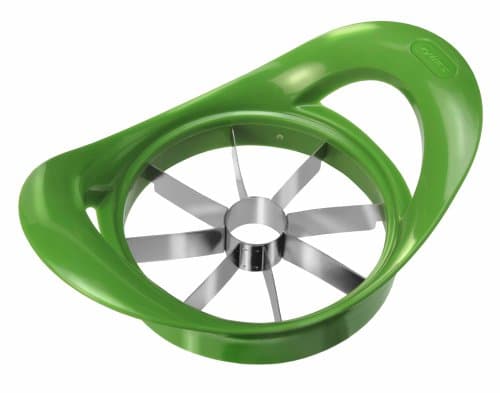
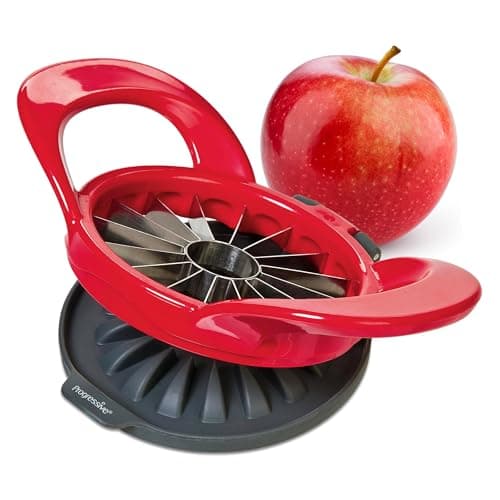
This is the whole reason this page exists separately from our apple slicer ranking. A wedger is a ring of blades radiating from a central hole: you press it down through the apple and it cuts eight or sixteen pieces while punching the core out at the same time. It is a brilliant tool and it is useless the moment you need the apple to stay whole, because the apple does not stay whole — that is its entire mechanism.
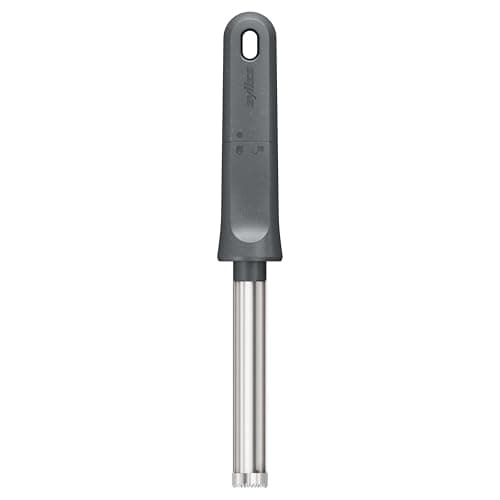
A corer is a tube. It goes down the axis of the fruit, cuts a cylinder around the seeds and stem, and brings it out. What is left is an apple with a hole through it. That is the shape you need for a baked apple, for stuffing with butter and sugar, for apple rings, and for any recipe where the fruit is cooked before it is cut.
Three of the four picks here do both jobs at once in different proportions. Exactly one does only the coring, and that is why it leads.
The one measurement that decides whether a tool fits your apples
For any wedger, the number that matters is the blade diameter, and most makers do not publish it. Zyliss does: the Divider states a 3.75-inch stainless blade assembly. That is a medium ring. A large Honeycrisp or a big Gala will overhang it, and when the fruit overhangs the ring the core is not fully caught — you get wedges with seeds still in them and a wobbly press that can slip.
PrepWorks publishes an overall footprint for its 16-slice tool but no cutting diameter at all, so whether it clears a very large apple is unknown before it arrives. If your apples are routinely the size of a softball, the twist corer sidesteps the problem entirely: nothing has to fit a ring, so any size of apple works.
Measure one apple before you buy a wedger. Take the widest apple in the bowl and put a ruler across it. If it is wider than 3.75 inches, a medium ring will overhang and you should buy a corer and a knife, or the extra-large wedger ranked on our apple slicer page, which publishes 4.52 inches of cutting diameter.
How we ranked these four
- What comes out of the fruit.A whole cored apple, eight wedges, sixteen thin slices and a peeled spiral are four different outputs. We ranked on which of them is hardest to get any other way — and a whole cored apple is the one a knife cannot give you neatly.
- Published figures over adjectives.Zyliss states a blade diameter and a blade thickness on the Divider. Johnny states the body material, the blade material, the adjustment and a five-year warranty. Those are checkable. “Razor sharp stainless steel” is not.
- What happens to your fingers. A ring of blades living loose in a drawer is the real hazard in this category. The PrepWorks tool ships with an attached cover, which answers both the drawer problem and the pushing-wedges-back-out problem at once.
- Whether the maker admits a limit. Zyliss says the Divider is dishwasher safe and then recommends hand washing to maintain sharpness, which is a contradiction you have to resolve yourself. We would rather a listing say that than say nothing.
- No invented durability claims. None of these four publishes a blade steel grade. We do not score them as though one did.
Which one, for which kitchen
Buy the Zyliss Easy Twist Apple Corer if the apple has to survive. Twist, and the body slides to eject the core, so you are not digging a plug out of a tube with a fingertip. It works on any size of fruit because nothing has to fit a ring. Two honest limits: it does not slice, so if what you wanted was wedges this is the wrong purchase and no amount of twisting changes that; and Zyliss publishes no barrel diameter, so how much flesh comes out with the core is something you discover on the first apple.
Buy the Zyliss Apple Dividerif you want eight substantial wedges and the core gone in one motion. It is the only tool here that publishes the two numbers a wedger buyer needs — 3.75 inches across, with a stated 0.75-inch blade thickness — and the blades are riveted, which is the joint that fails first on cheap wedgers. Its limits are the ring size on large apples, the real downward force eight blades need through a dense apple, and no cover to push the wedges back out.
Buy the PrepWorks 16-Slice Apple Slicer and Corer if the apples are for children, for dipping or for a tart. Sixteen thin slices is a genuinely different cut from eight fat wedges, and the attached cover is the best safety answer on the page. Accept that sixteen thin blades need more force through a dense apple than eight do, that twice the cut surface browns twice as fast, and that no cutting diameter is published.
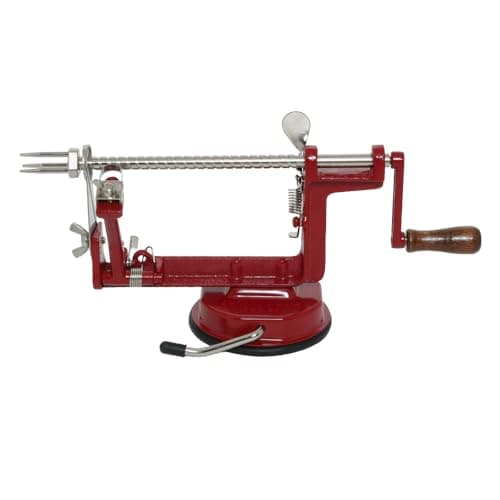
Buy the Johnny Apple Peeler (VKP1010)if you process apples in volume. One crank peels, cores and slices in a single pass, the peel depth adjusts so you are not throwing away a third of each apple, and the cast-iron body carries a five-year warranty — the longest cover here by a distance. The constraints are real: the suction base needs a smooth, non-porous counter and will not hold on textured granite or tile grout, it stores like a small appliance rather than a gadget, and it spiral-cuts, so you get rings and not wedges.
What none of these tools will do
They will not stop the apple browning. Cut surface plus air equals oxidation, and the only real answers are lemon juice, cold water or eating it sooner — which is one more argument for the twist corer, since an apple with a hole in it has far less exposed flesh than sixteen slices do.
They will not core a pear reliably unless the listing says so. PrepWorks states its tool works on soft cored fruit such as pears; the others do not make that claim, and a pear is softer, more tapered and more likely to collapse under a ring of blades than an apple is.
And they will not help with the rest of the apple job. If you want thin even slices for a tart rather than wedges, that is a mandoline question and our beginner mandoline guide is the right starting point. If the apples are destined for sauce, the tool that earns its place is a food mill, which separates skins and seeds and makes coring optional in the first place.