HUB 06 · Guides
How to Sharpen a Mandoline Blade
The honest answer is that you replace it rather than sharpen it — and before you do either, check that the problem is actually the blade. Four of the five causes of a mandoline that stopped cutting are not the edge.
We earn a commission if you buy through our links. It does not change the price you pay, and it does not decide our picks — our selection criteria are published in full. How this works.
Do not sharpen it. Replace the blade if your mandoline sells one, and replace the mandoline if it does not— and before either, check that the blade is actually the problem, because usually it is not. Not one of the mandolines we rank publishes a sharpening procedure, and that is not an oversight: a mandoline blade is a thin, hardened, single-bevel strip fixed into a frame, and the two things sharpening requires — access to the edge and a consistent angle against it — are exactly what the frame prevents.
Check these five things first
A mandoline that has “gone blunt” is usually a mandoline being used slightly wrong. Work through this list before you touch the edge, because four of the five are free to fix.
- The thickness setting has drifted. Dials and screw-set plates move. The OXO Good Grips Chef's Mandoline Slicer 2.0 has 21 settings on a dial and the Benriner Super Slicer (Japanese Mandoline)uses a screw-set thickness dial — either can be nudged in a cupboard. If it is set near zero the blade barely protrudes, and a blade that is not standing proud of the bed cannot cut whatever its edge is like.
- You are pushing instead of stroking. A mandoline cuts on a long, even stroke with the food moving at a steady speed. Short scrubbing motions and vertical pressure make it feel blunt even when it is new.
- The food is wrong for the setting. Soft tomato on a thin setting, or a watery cucumber, will tear rather than slice no matter how sharp the blade is. Firm and cold slices; soft and warm smears.
- There is dried food in the blade slot. Starch sets like glue under the blade and in the runway. It reduces the effective blade height and drags on everything passing over it. This is the single most common cause and it is fixed with a brush.
- The blade is in backwards or the wrong insert is fitted.On any multi-insert slicer — the Mueller Austria Multi-Blade Adjustable Mandolinepublishes five interchangeable stainless blades, the Benriner three julienne blades plus a flat one — a julienne insert in place of the flat blade will behave like a dull slicer because it is not trying to make a slice at all.
Why sharpening a mandoline blade goes wrong
A kitchen knife is sharpened by holding its edge at a fixed angle against an abrasive and taking metal off both sides until they meet. Three things about a mandoline blade break that.
It is fixed in a frame. On most Western mandolines the blade is riveted or captured in the body, so you cannot present it to a stone at all. You can drag a stone or a rod across it in situ, but you cannot hold a consistent angle while doing so, and an inconsistent angle is how an edge gets rounded over rather than sharpened.
It is a single bevel, and it is thin.A mandoline blade is ground on one face only, with the other face flat, and the whole blade is barely thicker than a razor’s. There is very little metal to remove before the geometry changes, and once the bevel angle is wrong the slicer tears instead of cutting — a worse outcome than the dullness you started with.
Honing a blade you cannot see is dangerous. This is the part that should decide it. A mandoline is already the most common source of serious lacerations in a home kitchen; working a stone along a captured blade with your fingers an inch away, in a frame designed to keep your hand off that edge, is not a job worth doing to save ten dollars. Read the mandoline safety guide and wear a cut-resistant glove if you go anywhere near it.
The real reason to buy a Japanese mandoline: the blade is a spare part. Benriner blades are stocked individually by foodservice suppliers — a 3 mm coarse replacement blade, for example, lists at well under ten dollars and is sold explicitly to “replace your old, lost, or worn out mandoline blade”. That is the whole answer to this question. A slicer whose cutting edge is a consumable you can buy for the price of two coffees does not need sharpening, and it does not need throwing away either. It is also why the Benriner Super Slicer (Japanese Mandoline) is described on our pages as a near-indestructible design that lasts for years.
So what do you actually do?
Clean it properly first.A stiff brush under running water, into the blade slot and along the runway, immediately after use. Never in a sink of soapy water where the blade is invisible. Most “blunt” mandolines come back to life here.
Then check for a replacement blade.Search the model name plus “replacement blade”. Japanese slicers and foodservice models generally have them; consumer plastic-framed ones generally do not. This is a buying decision disguised as a maintenance one.
If no spare exists, replace the slicer and treat the cost as what it was. A value mandoline is a consumable. Our own card for the Mueller Austria Multi-Blade Adjustable Mandolinesays it plainly: the blades are sharp but dull faster than the premium slicers, and the frame flexes a little under hard pressure. That is the deal at that price, and it is a fair one if you slice occasionally. If you slice several times a week, buy once — the OXO or the Benriner — and let the blade be a part you can buy rather than a reason to shop again.
Do not put it in the dishwasher to “clean it up”. Detergent and a long hot cycle are hard on a thin hardened edge, and a loose blade in a dishwasher basket is a hazard for whoever unloads it. Hand wash, dry, store closed.
Keeping the edge you have
Three habits do more for a mandoline blade than any sharpening attempt. Wash and dry it immediately, because acid and salt left on a thin edge pit it. Store it closed, or in its own slot rather than loose in a drawer where the edge knocks against other steel — the OXO Good Grips Chef's Mandoline Slicer 2.0 folds and the OXO Good Grips Hand-Held Mandoline Slicer is slim enough to have a dedicated drawer spot. And never run anything through it that is not food: a stray rubber band or a plastic tie on a bunch of herbs will nick an edge in one pass and that nick shows on every slice afterwards.
If you are at the point of deciding between repairing and replacing, our mandoline and slicer hub ranks the field, and Japanese mandolines covers the design whose blades are genuinely serviceable.
The hardware
The hardware this guide is about
The products this guide refers to, with prices pulled live from Amazon and dated on every card. Full rankings live in the roundups linked above.
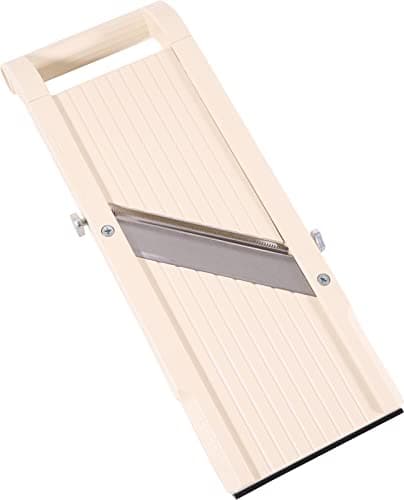
Sharpest slices
Benriner Super Slicer (Japanese Mandoline)
The professional's mandoline: a wide Japanese slicer whose razor-sharp blades chefs quietly rely on.
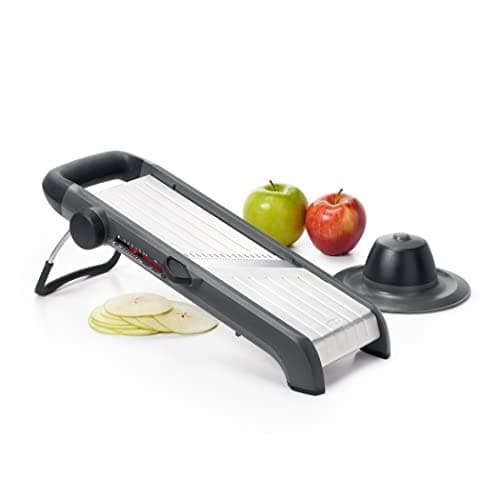
Most home cooks
OXO Good Grips Chef's Mandoline Slicer 2.0
The mandoline to buy: a solid, foldable slicer with a runway of thickness settings and a genuinely usable hand guard.
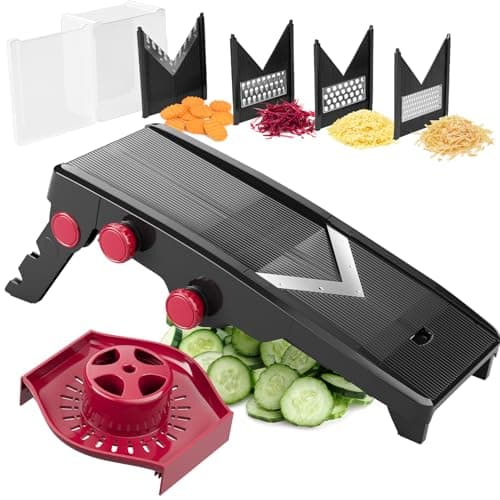
Value and versatility
Mueller Austria Multi-Blade Adjustable Mandoline
The value mandoline: five blade inserts and an adjustable dial for about a third of the premium price.
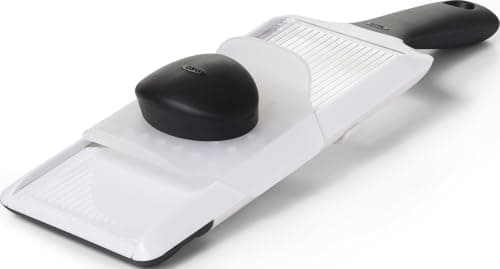
Small jobs, easy storage
OXO Good Grips Hand-Held Mandoline Slicer
The drawer-friendly slicer: a flat handheld mandoline with adjustable thickness for quick, small jobs.
#ad · As an Amazon Associate we earn from qualifying purchases.
Questions
Frequently asked
Can you sharpen a mandoline blade?
Why is my mandoline not cutting?
Can you buy replacement mandoline blades?
Can you put a mandoline in the dishwasher?
How long should a mandoline blade last?
Keep reading
Related
- The best mandolines and slicersThe whole field, safety weighted.
- Japanese mandolinesThe design whose blades are spare parts.
- Mandoline safety guideBefore you go near the blade.
- Benriner Super Slicer reviewThe professional's slicer, in full.
- The best cut-resistant glovesWear one for cleaning, not just slicing.
Receipts
Sources
We do not run a testing lab and we do not pretend to. Specifications come from the manufacturer's own published documents and from published standards; prices come from the live Amazon API. Where a figure is not published, the page says “not published” rather than guessing. Read the full method.