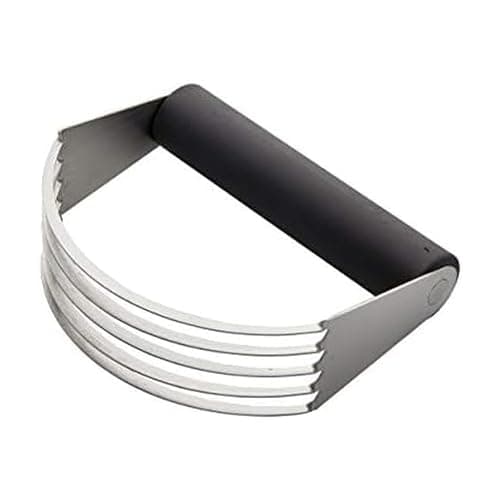
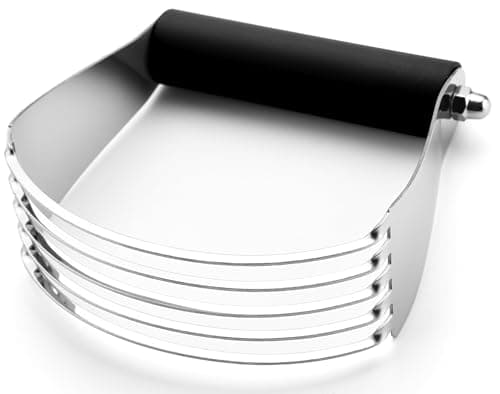
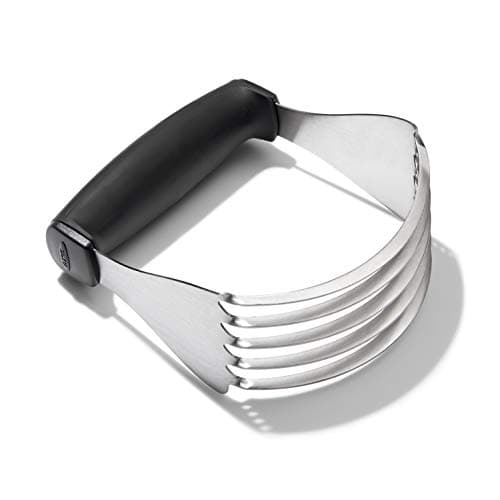
Buy the OXO Good Grips Dough Blender With Blades. It is the blade type, not the wire type, and on butter straight out of the fridge — which is the only temperature pie crust wants — rigid blades cut and flexible wires do not. Its handle is the broadest here, which matters more than it sounds like it should when you are leaning on a tool for two solid minutes. If you would rather have a lifetime warranty than the best cutting action, the KitchenAid Gourmet Pastry Blender is a wire tool that names its steel and covers itself for life for less money.
Blades or wires is the whole decision. A pastry blender exists to cut cold fat into flour, leaving pea-sized lumps of butter intact so they melt in the oven and steam the layers apart. A rigid blade shears a cold cube. A curved wire, which is what most of this category ships, flexes against one — it works beautifully once the butter has softened, and it smears rather than cuts when the butter is hard. The colder you work, the more you want blades.
The four things that actually separate these tools
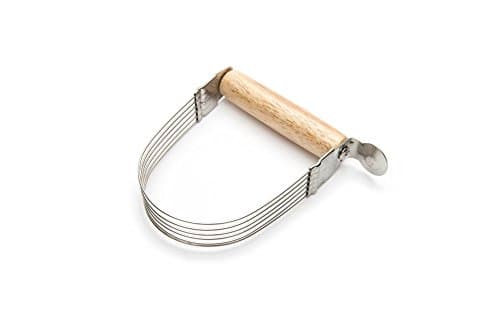
1. Rigid blades or flexible wires. OXO, Spring Chef and Norpro are blade or solid-steel tools. KitchenAid states “curved, yet flexible tempered 420 stainless steel wires”; Fox Run states plain “stainless steel wires”; Zulay sits in between, describing “5 thick stainless steel wire blades”. Flexible is a virtue when you are rubbing softened butter into a crumble and a liability when you are cutting a cold stick for pie.
2. What the handle is made of. You press down with most of your upper body weight, repeatedly, through whatever the handle is. Four of the six are cushioned — OXO’s broad non-slip grip, KitchenAid’s TPE, Spring Chef’s and Zulay’s thick rubber. Norpro’s is rolled bare metal and Fox Run’s is wood. Spring Chef and Zulay both name arthritis specifically in their listings, which is an unusually direct thing for a maker to say and worth knowing if that is you.
3. Whether it goes in the dishwasher. Butter-and-flour paste sets like grout between blades. Four of these are dishwasher safe; Norpro recommends hand washing, and Fox Run says hand wash and dry completely, which a wooden handle genuinely requires. That is a real daily difference, not a footnote.
4. Whether the maker tells you anything measurable at all. This is the honest finding of the whole page: no maker here publishes a steel gauge, a wire diameter or a blade length. Zulay is the only one that states a count (five). Norpro and Fox Run are the only two that state a size. Everyone else describes the tool and leaves the numbers out, so we print what they say and nothing more.
The six, best cutting action first
1. The best cut on cold butter — OXO Good Grips Dough Blender With Blades
OXO states plainly that the stainless steel blades “easily cut butter and shortening into dry ingredients”, and the broad, soft, non-slip handle “absorbs pressure”. That is the right pair of claims for this tool. Rigid blades do not care how cold the butter is, and the handle is where every bit of force you apply gets transmitted into your palm. It is dishwasher safe, which matters because butter-flour paste wedges between rigid blades more stubbornly than it does between wires.
The honest limits: OXO publishes no blade count, no blade length and no steel grade, so you are buying a described tool rather than a specified one. And the thing rigid blades are worst at is clearing themselves — expect to scrape the gaps once per batch with a butter knife.
2. The buy-once pick — KitchenAid Gourmet Pastry Blender
This is the only listing in the category that names a steel specification: tempered 420 stainless steel, curved and flexible, on a TPE soft-grip handle. It is dishwasher safe and it carries a one-year hassle-free replacement plus a lifetime limited warranty, on a tool that costs less than a bag of good flour. If a pastry blender is a thing you buy once and keep in a drawer for twenty years, this is the sensible purchase.
The trade-off is stated by KitchenAid itself. “Flexible” wires are the exact property you do not want against a hard stick of butter — they ride around it. Cube your butter and let it sit for five minutes and this tool is lovely; attack a cold brick with it and you will be there a while. It also has nothing to clear paste from between the wires.
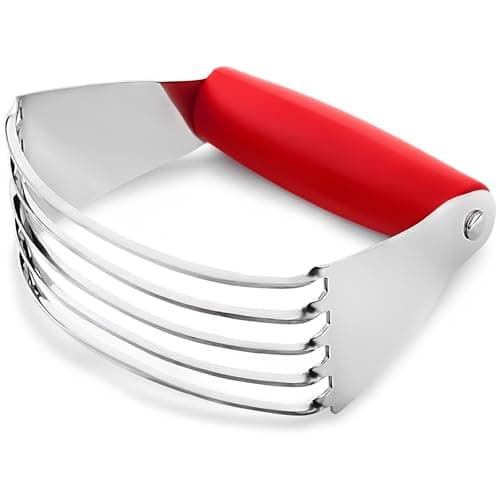
3. The double-batch tool — Spring Chef Large Dough Blender
A wide head on a thick, cushioned rubber handle, with rigid metal blades that Spring Chef says are “twice as thick as some others”. A wider head clears more of the bowl per press, which is a real advantage when you are doing a double crust or a big batch of biscuits, and the handle is the one most explicitly built for sore hands. It is dishwasher safe and it is the cheapest full-size blade tool here.
We are not going to pretend the headline claim means anything, though. “Twice as thick as some others” names no gauge and no competitor, so there is nothing to check it against. And a wide head is awkward in a narrow bowl, which is where most people actually make crumble topping.
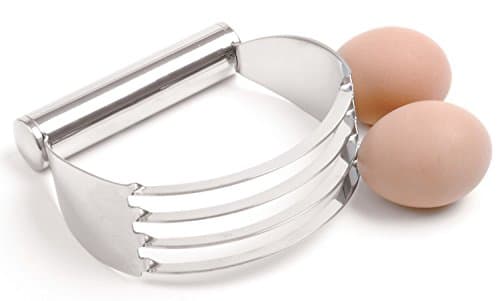
4. The one that publishes a size — Norpro Deluxe Pastry Blender
Norpro states the dimensions — 5 x 5 x 2 inches — which sounds trivial until you have ordered a pastry blender that turned out to be wider than your mixing bowl. It is heavy-duty commercial-quality stainless steel throughout, with a thick rolled handle that Norpro states suits right- or left-handed use, and nothing on it can perish: no rubber to split, no wood to swell.
Two real drawbacks. Norpro recommends hand washing, so it is out of the dishwasher. And a bare rolled metal handle, however well rolled, concentrates pressure into your palm in a way a cushioned grip does not — this is the least forgiving pick here on a long session. Stock on this listing also comes and goes, so check it is available before you build a baking day around it.
5. The only one that counts its blades — Zulay Kitchen Professional Dough Blender
Zulay states five thick stainless steel wire blades, bolted rather than crimped, on an anti-slip rubber grip. The count is a small thing that no one else in this category offers, and bolted construction addresses the exact failure mode of cheap pastry blenders, which is the head working loose from the handle. It is dishwasher safe and it costs less than a pie dish.
Zulay also says the handle is “a perfect fit for small to medium-sized hands”. Read that as written: large hands will find it cramped. “Wire blades” is its own category of description, sitting somewhere between OXO’s rigid blades and KitchenAid’s flexible wires, so expect some give on very hard butter.
6. The traditional one, and the cheapest — Fox Run Wire Pastry Blender (58544)
Stainless wires, a wooden handle, a thumb rest, 5 x 4 x 1.25 inches, and a price lower than anything else on this page. This is the pastry blender your grandmother had, and for softened butter in a crumble topping or a scone dough it genuinely is pleasant to use — the thumb rest gives you a second contact point and more control than a bare bar does.
It is last because of what it cannot do. Wires bend against fridge-hard butter, so you have to let the butter sit out, which is the opposite of what a pie crust wants. Fox Run says hand wash and dry completely, and that is not optional advice for a wooden handle. At this price the wires are also the part that eventually splays out of line.
What each one publishes
| Pick | Cutting element | Handle | Published size | Dishwasher |
|---|
| OXO Good Grips Dough Blender With Blades | Stainless steel blades | Broad soft non-slip | Not published | Yes |
|---|
| KitchenAid Gourmet Pastry Blender | Curved flexible tempered 420 stainless wires | TPE soft grip | Not published | Yes |
|---|
| Spring Chef Large Dough Blender | Stainless steel blades | Large thick rubber | Not published | Yes |
|---|
| Norpro Deluxe Pastry Blender | Commercial-grade stainless steel | Thick rolled metal | 5 x 5 x 2 in | No — hand wash recommended |
|---|
| Zulay Kitchen Professional Dough Blender | 5 thick stainless wire blades | Anti-slip thick rubber | Not published | Yes |
|---|
| Fox Run Wire Pastry Blender (58544) | Stainless steel wires | Wood, with a thumb rest | 5 x 4 x 1.25 in | No — hand wash and dry |
|---|
Four of six publish no size at all and none publishes a steel gauge or a wire diameter. We are not going to invent those numbers, so the column says what the maker said.
Why cold butter is the whole point
Flaky pastry is a physical trick, not a chemical one. You want discrete lumps of solid fat sitting in the flour when the dough goes into a hot oven. Each lump melts, the water in it turns to steam, and the steam pushes the dough apart into a layer. Melt the butter early — by warming it in your hands, by over-mixing, or by smearing it with a tool that cannot cut it — and the fat coats the flour instead of sitting in it. You get a short, sandy, uniform crust rather than a layered one. It is not ruined; it is just a different thing.
That is why every serious pie recipe says to keep everything cold, and it is why the blade-versus-wire split is the real story of this category. A tool that bends around cold butter forces you to warm the butter up to use it, which defeats the purpose of using it.
When you should use a food processor instead
Honestly: often. A food processor fitted with the standard chopping blade cuts cold butter into flour faster and more evenly than any hand tool, because the blade is driven rather than pressed and the butter has no time to warm up. If you already own one, pulse it — six to eight one-second pulses, no continuous running — and you are done before a hand tool has finished the first pass. The best food processors for dough ranks the machines on exactly that job.
A pastry blender still earns a drawer slot for three reasons. It gives you total control over how far you take the cut, and a processor goes from pea-sized to paste in about two pulses. It washes in ten seconds instead of three parts. And it works for a single batch of scones without dragging a 14-cup machine onto the counter. A stand mixer with a paddle is the third option and the worst of the three for pastry — it is a mixer, not a cutter, and the comparison is laid out in food processor vs stand mixer.
Technique that fixes most pastry-blender complaints
Cube the butter first. Half-inch cubes, straight from the fridge. No pastry blender cuts a whole stick efficiently, and trying is where most people conclude their tool is useless.
Press and rock, do not saw. Push straight down to the bottom of the bowl, rock the tool slightly to release, lift. Sawing sideways smears fat along the bowl wall.
Clear the blades every thirty seconds. A head packed with paste stops cutting and starts pressing. Run a butter knife through the gaps. Rigid-blade tools need this more often than wire ones, which is the main thing wires are better at.
Stop at pea-sized, not at even. A mixture with some pieces the size of peas and some the size of oats makes a better crust than a perfectly uniform one. If it looks like damp sand, you have gone too far.
Chill the bowl in summer. Ten minutes in the freezer before you start buys you several minutes of working time, which is the cheapest upgrade available to anyone making pastry in a warm kitchen.
And since the crust is only half of a pie: if you are peeling and slicing the filling by hand, the best apple slicers and corers covers the wedgers and the crank peelers that turn a bag of apples into a tray of filling.
Where this page stops
This page ranks the hand tool. It does not rank machines — food processors for dough does that, and the potato masher roundup covers the other tool people reach for when they cannot find a pastry blender, which works for mashing and is wrong for cutting. A bench scraper, which often gets sold in a set with a dough blender, is a different job again: it divides and lifts dough, it does not cut fat into flour. Shaping the dough once the fat is cut into it is a separate tool with its own published figures — the best rolling pins ranks the tapered, handled, steel and marble pins on barrel length, diameter and mass.
Which one should you buy?
You make pie with cold butter. Buy the OXO. Rigid blades, broad handle, dishwasher. This is the default recommendation and the reason it is ranked first.
You want to buy once and never think about it again. Buy the KitchenAid. Lifetime limited warranty, named steel, cheap. Accept that you will cube and rest your butter for five minutes.
You bake in double batches, or your hands hurt. Buy the Spring Chef. The widest head and the most cushioning, and the listing addresses sore hands directly. See also our prep tools for arthritic hands, which applies the same grip logic across the whole kitchen.
You want metal that will outlive you, and you hand wash anyway. Buy the Norpro. It is the only one that tells you its dimensions, and there is nothing on it to degrade.
You have small hands, or you want a count before you commit. Buy the Zulay. Five stated blades, bolted, dishwasher safe, and the handle is sized for you rather than against you.
You make crumble and scones, not pie. Buy the Fox Run. Softened butter is what a wire tool is for, and this is the cheapest honest version of it.
What a pastry blender costs, and what that buys
This is a budget category end to end: the whole field here sits in single figures to the high teens, and the most expensive pick is still cheaper than the pie dish you will bake in. That changes how to think about the purchase. You are not trading money for performance so much as trading it for handle comfort, warranty and whether the thing goes in the dishwasher. Spending more does not get you a measurably better cut, because no maker in the category publishes a measurement to compare.
The one place money does buy something concrete is warranty. KitchenAid is the only pick with a lifetime limited warranty attached, and it is not the most expensive tool here.
What we are not claiming
We have not tested these six on butter or on anything else. Every blade description, wire description, handle material, steel grade, dimension, warranty and care instruction above is the manufacturer’s own published wording on the listing the buy button points at, cited below — including the absences, which we have named rather than filled in: no blade counts except Zulay’s, no steel gauges, no wire diameters, and no head widths. The physics of steam-leavened pastry is kitchen science you can verify in any baking reference, not a bake-off we ran. Prices come live from Amazon with the date attached.