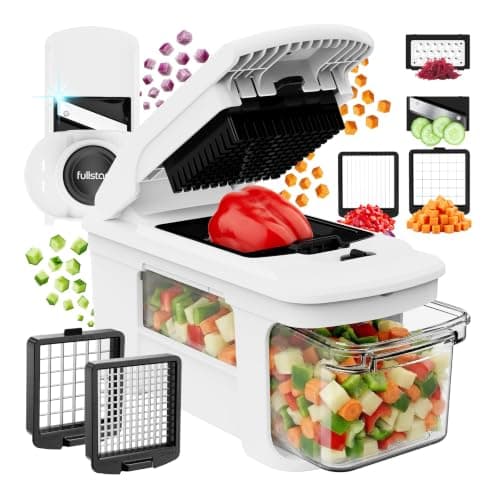
For meal prep, buy the Fullstar Pro XL Vegetable Chopper & Mandoline. It is the only pick here that answers both halves of the job in one tool: it presses vegetables into an even cube, which is the cut that holds its shape in a box, and the cubes fall straight into a 1.8 L container with a lid that goes into the fridge as it is. If your week is built on roasting trays, grain bowls, stews and chilli, that is the whole purchase. The other four picks below exist because meal prep is not one job — a sauce base, a week of aromatics and a kitchen with no free outlet each have a different answer.
The container is the product. Every chopper on this page cuts acceptably. What separates them for prep is what happens in the ninety seconds after the cut: whether the output lands in a lidded box or in a bowl you then have to decant, and whether the shape you made weeps into the bottom of that box by Wednesday. A bladed chopper gives you a fine, slightly uneven mince with a lot of cut surface; a push-dicer gives you a cube with comparatively little. Cut surface is where moisture leaves, so the cube is the shape that keeps.
What meal prep actually asks of a chopper
Three demands, in the order they bite. Volume without stopping — four days of vegetables for two people is several litres of output, so a 2-cup bowl means eight or ten emptying cycles and a 1.8 L catcher means two or three. A shape that stores — an even dice stacks in a box and reheats evenly; a mince compacts and releases water. A wash you will actually do at the end — prep day ends with you tired, and the tool you resent washing is the tool that stops getting used. Those three, not wattage, are what the ranking below is ordered on.
Nothing here is a substitute for a full-size machine if your prep runs to shredding five pounds of cabbage or slicing a sack of potatoes. That is a disc-and-feed-tube job, and the best food processor for slicing is where it belongs. A chopper is for the dice, the mince and the aromatics.
The five, and the prep job each one owns
1. Even cubes into a lidded box
The Fullstarpresses food through a fixed grid, so every cube is the size of the grid rather than the size of your attention span. Its published blade set is four in 420J stainless — a fine dicer, a medium dicer, a 2 mm slicer and a grater — and for prep the medium dicer is the one you will leave fitted. The reason it leads is underneath: a 1.8 L catch container with a lid, on an 8-cup XL body. Onion, pepper, courgette and carrot go in, cubes come out, the lid goes on, the box goes in the fridge. The honest cost is force: a raw carrot or sweet potato takes a real shove, which is the one reason to buy something else.
2. More than one shape in the same session
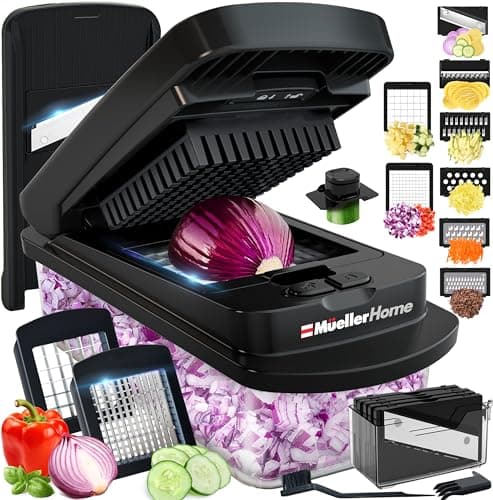
The Mueller Pro-Series 10-in-1 Vegetable Chopper publishes eight interchangeable stainless blades against the Fullstar’s four, covering dice, slice, julienne and grate, into a 1.2 L container. If your week includes slaw and a gratin as well as a stew, that is a genuine advantage — one tool, one wash, four cuts. The trade is a smaller catcher and eight small parts to store and keep track of, and if you honestly only ever dice, you will never touch six of them.
3. Sauce bases and marinades by the batch
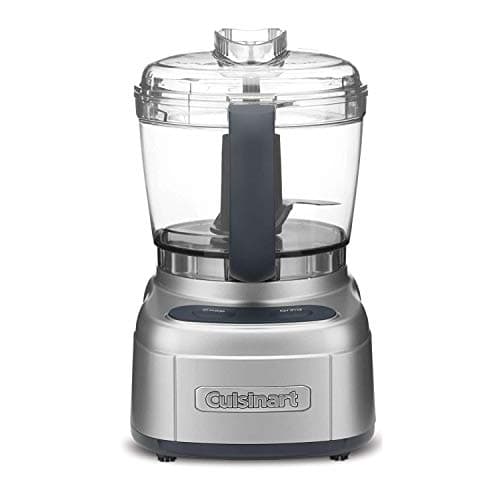
Prep is not only solids. The Cuisinart Elemental 4-Cup Chopper/Grinder (ECH-4SV) has a 4-cup work bowl with a handle, separate chop and grind touchpads and an auto-reversing blade, and every removable part is dishwasher safe. That is the pick for a week’s sofrito, a jar of salsa, a curry paste or a marinade — wet mixtures where pulp is the point and a cube would be wrong. It is the only pick here with a dedicated grind function, which also makes it the one to buy if your prep includes spice blends. What it does not have is a lidded catch box, so you decant.
4. A week of aromatics in two-cup lots
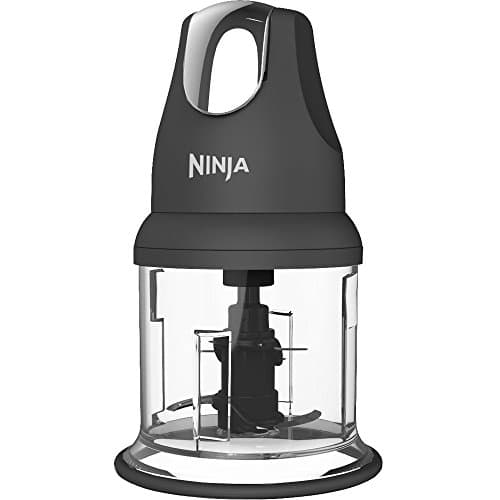
The Ninja Express Chop (NJ110GR) is a 16 oz bowl on a 200-watt motor with stacked blades, and for prep it has one job it does better than anything else here: the aromatics station. Garlic, ginger, chilli and onion, two or three one-second pulses each, into small pots or an ice-cube tray for the freezer. Bowl, blades and lid all go in the dishwasher, which is why it gets used on a Sunday evening. It has no pour spout, so a wet mince drips on the way out — tip it over the sink the first time.
5. No outlet, no noise
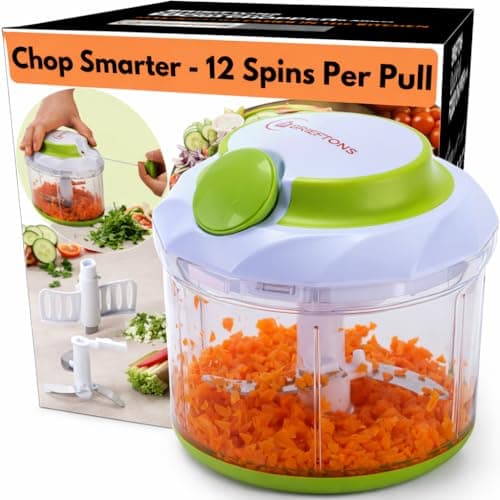
The Brieftons QuickPull Manual Food Chopper (4-Cup) is a 4-cup bowl driven by a pull cord spinning stacked stainless blades. It is the biggest manual bowl on the page and it needs no socket, which matters more than it sounds like it should: prep day is when every outlet and every square foot of counter is already taken. You control texture by pull count, so the first session or two is calibration, and the cord is a wear part. Blades are removable and it is a hand wash.
What each one publishes
| Pick | Mechanism | Published capacity | Lands in | Best prep job |
|---|
| Fullstar Pro XL Vegetable Chopper & Mandoline | Hand press through a fixed grid | 1.8 L container, 8-cup XL body | Lidded catch container | Even cubes for trays, bowls and stews |
|---|
| Mueller Pro-Series 10-in-1 Vegetable Chopper | Hand press, 8 blade inserts | 1.2 L container | Catch container | Dice plus slice, julienne and grate |
|---|
| Cuisinart Elemental 4-Cup Chopper/Grinder (ECH-4SV) | Powered blade, auto-reversing | 4-cup work bowl | Work bowl — decant | Sauce bases, salsa, spice grinding |
|---|
| Ninja Express Chop (NJ110GR) | Powered stacked blades, 200 W | 16 oz (2 cups) | Work bowl — decant | Aromatics in small lots |
|---|
| Brieftons QuickPull Manual Food Chopper (4-Cup) | Pull-cord drive, stacked blades | 4 cups | Work bowl — decant | Volume mincing with no outlet |
|---|
The vegetables to prep, and the ones to cut on the day
A chopper does not change food science. Onion, carrot, celery, pepper, cabbage, swede and most brassicas cut on Sunday and cook on Thursday without complaint. Courgette, cucumber and mushroom shed water as soon as they are cut, so dice those into the box they will be cooked from, or cut them on the day. Potato oxidises; keep diced potato under cold water and use it quickly. Tomato is its own problem, which is why it has a page of its own. Leafy herbs are a day-of job in every kitchen — the mince is the point of failure, not the storage.
Recipe practice generally puts cut, raw, firm vegetables at three to four days refrigerated in a sealed box. We are repeating the common convention there, not a number we measured, and the honest version is: cut it, seal it, and judge it with your nose on day four.
Why this is not the dicer page or the hub
The best vegetable dicers ranks push-dicers against each other on the quality of the cube, and the chopper hub ranks the whole field on the cut it makes. This page asks a narrower question — which of them survives a four-day storage job — and the answer re-orders the field, because the lidded container and the shape that keeps matter more here than blade sharpness does. That boundary is deliberate and stated on all three pages.
Four habits that beat any upgrade
Cut dry, store dry. Wash and dry vegetables before they go through the grid, not after. Water carried into the box is the single biggest cause of prep going slimy, and no tool fixes it.
Rinse the grid before you cook, not after you eat. Ten seconds under a tap while the food is still wet, against ten minutes of picking at dried-on onion later. The full method is in how to clean a vegetable chopper.
Fill boxes by meal, not by vegetable. A box of mirepoix beats three boxes of onion, carrot and celery: one container to wash, one thing to tip into the pan, and you are not re-measuring on a weeknight.
Freeze the aromatics. Minced garlic, ginger and chilli freeze in a tray and drop straight into a hot pan. That converts the one cut that spoils fastest into the one with the longest shelf life.
What we are not claiming
We have not tested these five tools, on a prep session or on anything else. Every capacity, blade count, container volume, motor figure and care instruction above is the manufacturer’s own published wording, cited below; the ranking is a mechanism argument about containers and cut shapes that you can check against those same listings. The storage guidance is general kitchen practice, not a measured shelf-life study. Prices come live from Amazon with the date attached.