HUB 06 · Guides
How to Season a Mortar and Pestle
A new unpolished stone mortar sheds grit. Seasoning is the ten-minute job that knocks the loose dust off the grinding surface — and two of the makers we rank publish their own method for it.
We earn a commission if you buy through our links. It does not change the price you pay, and it does not decide our picks — our selection criteria are published in full. How this works.
Season a new stone mortar before you use it: grind a handful of uncooked white rice to powder, tip it out, and repeat until the powder comes out white instead of grey. Then grind a little garlic with coarse salt, rinse with water and no soap, and air dry. That is the whole job, it takes about ten minutes, and skipping it is why the first three things people make in a new mortar taste faintly of rock.
Why an unpolished mortar needs this at all
A mortar grinds because its inside is deliberately rough. That roughness is not a finish applied to the stone; it is the stone, left unpolished, with the tooling marks still on it. A fresh surface like that holds a quantity of loose dust and tiny unattached grains — the debris of its own manufacture — sitting in the pores waiting to come out.
Rinsing does not remove it, because water runs over the pores rather than into them. What removes it is abrasion from something hard, dry and expendable. Rice is the traditional choice for a sensible reason: it is hard enough to knock the loose grains free, it turns to flour so you can see what you are dragging out, and it is cheap enough to throw three batches away without flinching.
You can tell when you are done by colour. The first batch of rice flour will come out visibly grey or speckled with stone dust. Keep going and it gets paler. When a batch comes out plain white, the surface is clean. Most granite sets take two to four rounds; a porous lava-rock molcajete can take rather more.
The makers’ own instructions
This is one of the rare cases where you do not have to take a website’s word for the method, because some of the manufacturers publish it themselves.
Cole & Mason Granite Mortar & Pestle (5 in) states its seasoning routine on the product listing: season before use with white rice, garlic, cumin, salt and pepper. That is the fullest published method of any set we rank, and it is worth noting what the second half of it is for — the aromatics are not cleaning the bowl, they are seasoning it in the other sense, leaving the stone smelling of food rather than of nothing.
Cuitaxi 8-inch Molcajete, Mexican Lava Rock goes further and makes curing a condition of use: its listing states the molcajete must be cured before first use and that the maker sends the method with it. Lava rock from the Popocatépetl volcano is far more porous than granite, so there is more loose material to displace. If you buy a molcajete and skip this, you will taste it.
Kota Japan Large Black Granite Mortar & Pestle ships seasoning instructions in the box rather than printing them on the listing. ChefSofi Granite Mortar and Pestle Set (2 cups)states unpolished granite and a 500 ml bowl but tells you nothing about preparing it — which is a real gap, because an unpolished stone set that arrives with no instruction is exactly the one most likely to be used straight out of the packaging.
Step by step
- Wash the new mortar and pestle in warm water. No soap, no detergent. You are rinsing off packaging dust, not cleaning it.
- Dry it completely. Rice needs a dry bowl to abrade properly; in a damp one it turns to paste and polishes rather than scours.
- Grind a small handful of uncooked white rice to flour.Press and turn the pestle rather than pounding. Work the flour up the walls as well as the base — the walls are where you actually crush things.
- Tip it out and look at the colour. Grey or gritty means repeat. Plain white means move on.
- Repeat until the flour comes out white. Two to four rounds for granite, more for lava rock or very coarse stone.
- Grind a few cloves of garlic with a teaspoon of coarse saltto a paste, and smear it round the bowl. Cumin and black pepper if you are following the Cole & Mason method. Leave it a few minutes.
- Rinse with warm water and no soap. Air dry completely before putting it away.
Never use soap on a seasoned mortar, and never put one away damp.Porous stone absorbs detergent, and detergent then comes back out into the next thing you grind — which is both unpleasant and the one failure that is genuinely hard to undo. Water, a stiff brush and, for a stubborn residue, a little coarse salt ground dry are all you need. Store it dry and uncovered; a stone bowl put away wet is how a mortar develops a smell.
Do you need to re-season it later?
Not as a routine. Seasoning is a one-time preparation, not maintenance, and a mortar in regular use stays conditioned by what you grind in it. There are three honest exceptions. If you have ground something aggressively aromatic — a lot of chilli, cumin or fenugreek — and the next thing you make picks it up, grind a batch of rice to strip it. If the mortar has sat unused for a year, give it a rice round before you trust it. And if someone has washed it with soap, rice is also the fix.
A polishedmortar is the one case where none of this helps. If the interior is smooth and shiny, seasoning will not make it grind, because there is nothing for the ingredients to catch on — it is a decorative bowl. This is the single most common disappointment in the category and it is why every mortar we rank states unpolished stone on its own listing. Our mortar and pestle roundup is built around that one spec, and granite vs marble covers which stone to start from.
If you are still deciding whether a mortar is the right tool at all — rather than a machine — mortar and pestle vs food processor settles that one on mechanism: a pestle crushes and releases oils, a blade cuts and does not.
What to look for if you have not bought one yet
An explicit “unpolished” claim.This is the only specification that predicts whether a mortar grinds, and it is the only one worth refusing to buy without. Every set we rank states it. “Natural stone” next to a glossy photograph is not the same claim.
An unpolished pestle tip as well as bowl. A polished pestle in a rough bowl still slides, and almost no maker mentions the pestle at all. The Cole & Mason Granite Mortar & Pestle (5 in)is the one listing we have found that states both surfaces are unpolished — and it is also the one that publishes its seasoning method, which is probably not a coincidence.
Whether a seasoning instruction comes with it. Two of the four sets here publish or ship one. A maker who tells you the tool needs preparing before use is a maker who understands what they have sold you.
Interior dimensions, not just a cup figure. A capacity tells you what the bowl holds; the interior width and depth tell you whether you can swing a pestle without wearing the contents. Only the Kota Japan Large Black Granite Mortar & Pestlepublishes them — interior bowl 3-3/4 by 2-3/4 inches, 2 cups, 8 lb — which is why it is our first pick.
Weight, honestly assessed. Stone works because it stays put, and the sets here run from about 4 lb to nearly 9 lb. A heavy mortar is a better tool and a worse houseguest: at 7 to 8 lb it lives on the counter or in a low cupboard, never in a drawer and never on a high shelf.
Ignore conflicting care claims in favour of the stricter one.The Kota listing says both “rinse with warm water and let air dry” and “dishwasher safe” for a stone you are also told to season. Those instructions cannot all be right. Hand rinse, no soap, air dry — that is the one that is consistent with how the tool works.
The hardware
The hardware this guide is about
The products this guide refers to, with prices pulled live from Amazon and dated on every card. Full rankings live in the roundups linked above.
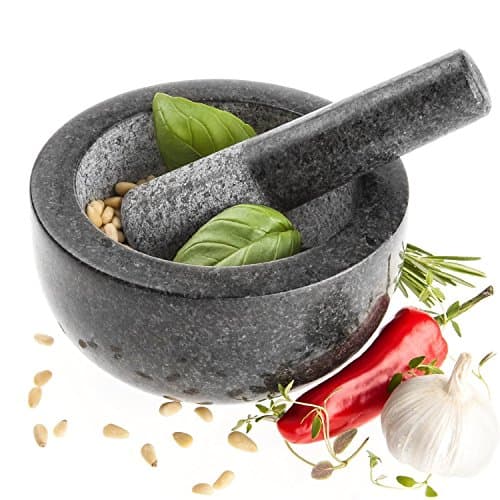
Most kitchens
Kota Japan Large Black Granite Mortar & Pestle
The set that publishes the number nobody else does: the interior bowl size, in unpolished granite, so you know what actually fits before it arrives.
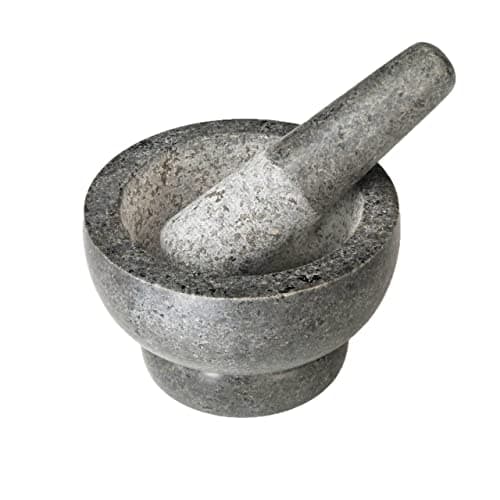
Spices and small batches
Cole & Mason Granite Mortar & Pestle (5 in)
The only listing here that says the pestle tip is unpolished as well as the bowl — which is the half of the equation most makers leave out.
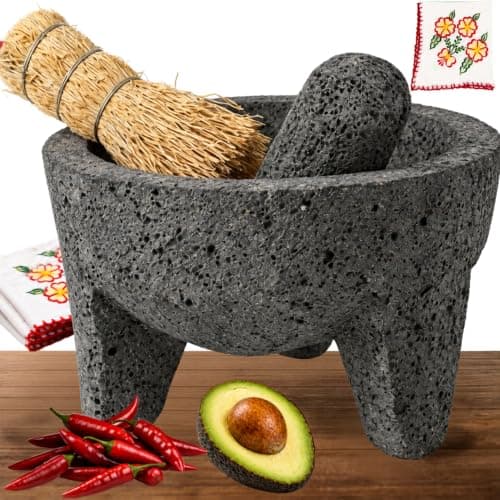
Guacamole and salsa
Cuitaxi 8-inch Molcajete, Mexican Lava Rock
The specialist: a hand-made 8-inch lava-rock molcajete from Puebla, which is the traditional tool for guacamole and roasted salsa rather than a general spice grinder.
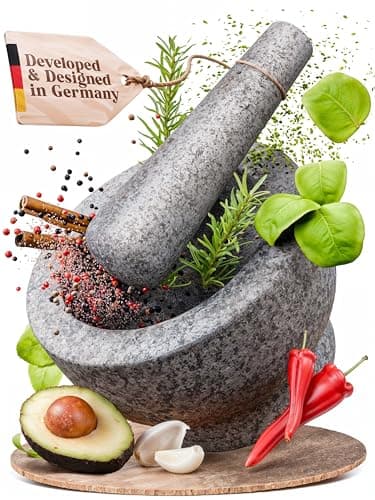
A first granite mortar
ChefSofi Granite Mortar and Pestle Set (2 cups)
The same unpolished granite and the same 2-cup bowl as our top pick, for a little less — bought on the stone rather than on the spec sheet.
#ad · As an Amazon Associate we earn from qualifying purchases.
Questions
Frequently asked
Do you have to season a mortar and pestle?
What do you season a mortar and pestle with?
How do you season a marble mortar and pestle?
How do you clean a mortar and pestle?
How long does seasoning take?
My mortar still will not grind anything. Now what?
Keep reading
Related
- The best mortars and pestlesFive ranked on the unpolished claim.
- Granite vs marbleWhich stone, and why it is not close.
- Mortar and pestle vs food processorCrushing versus cutting, job by job.
- Best food processor for pestoThe machine answer to the same dish.
- The best manual prep toolsThe rest of the drawer.