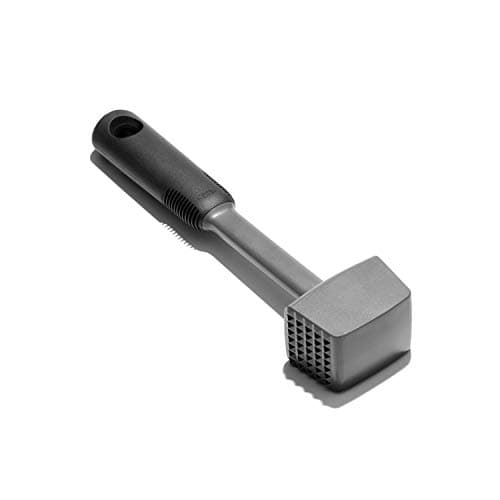
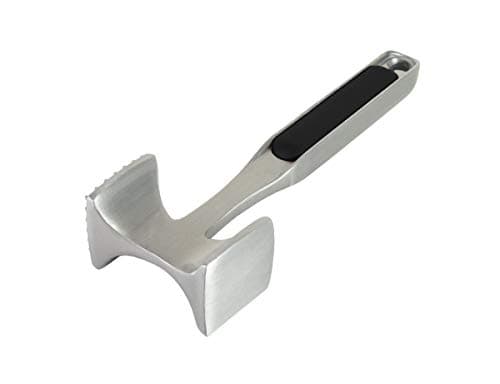
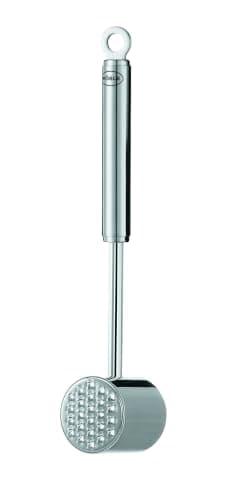
If you are buying one mallet and keeping it, buy the Rösle Stainless Steel Heavy Weight Meat Tenderizer Mallet (12820): a single piece of 18/10 stainless steel with nothing to delaminate, a riveted face rather than sharp pyramid teeth, and a maker that states the weight is evenly distributed — which is the difference between a head that lands flat and one that lands on a corner. For most kitchens the OXO Good Grips Meat Tenderizer is the better buy, because it is the only mallet here that says what each of its two faces is for and it is dishwasher safe. The budget pick is the KitchenAid Gourmet Multi-Sided Meat Tenderizer— the cheapest mallet in this group that still states what it is made of.
Every price in the table above is read live from Amazon with the date it was last checked. Where we have no verified live price we show none, so a blank price means “check” rather than a figure that has gone stale.
A mallet does not do what a blade tool does. Pounding thins a cutlet and bruises the fibers apart along the way. A bladed or needle tool cuts connective tissue in place and leaves the shape of the cut alone. They are not competing answers to one question, and if what you actually want is a thick steak made tender without being flattened, the tool you want is on our meat tenderizer ranking and examined in detail in the Jaccard review.
The specification nobody publishes
A mallet works by mass. You raise a weight, you drop it, and the energy that arrives at the meat is the product of that weight and how fast it is moving. Which means head weight is the single most useful number a mallet could publish, and not one of the three picks on this page publishes it. Rösle calls its mallet “heavy weight” in the product name and never states a figure. OXO describes its head as angle and weight optimized without naming either. KitchenAid says nothing about mass at all.
We will not invent the number, so this page ranks on what the makers do state: the material the head is made of, which is a proxy for density; the face design, which decides what the mass does when it lands; and the cleaning instruction, which on a tool used exclusively on raw meat is not a minor detail. If you see a mallet review quoting a weight in ounces, check whether the maker published it or the reviewer put it on a scale — both are legitimate, but only one of them is reproducible from a document.
Material is the one honest stand-in for mass
Three materials, three different tools.
Solid stainless steel.The Rösle is 18/10 stainless all the way through. There is no core, no cladding and no joint, which removes the failure mode that kills most mallets: a head that works loose from its handle after a few hundred swings. Steel is also dense, so a given head size carries more mass than the same shape in aluminum. The cost of that is zero give — a hard swing on a delicate fish fillet will tear it rather than thin it, and you have to let the tool do the work.
Plastic over a steel core. The OXO is impact-resistant ABS wrapped around a solid steel core, which OXO states plainly. That is a design decision rather than a cost cut: the mass is still metal, but the surface that touches raw poultry is a sealed polymer, which is easier to get properly clean than a riveted steel face. It will not outlive the Rösle, and OXO does not pretend otherwise.
Aluminum.The KitchenAid is the lightest head here, which is a genuine advantage on a tray of chicken cutlets — you can work one-handed for twenty minutes without your wrist complaining. It is also the softest metal of the three, so the textured face will round off over years of hard use where the Rösle’s rivets will not, and a light head means more swings for the same result on a thick piece of beef.
The two faces, and which one you actually use
Every mallet on this page is double-sided, and the two sides are not interchangeable.
- The smooth face flattens.This is the side you want for a chicken breast you are butterflying into a schnitzel, for a pork cutlet, or for anything that needs to be an even thickness so it cooks through at the same moment all the way across. It spreads force over a wide area and does not break the surface. OXO is the only maker here that explicitly says its smooth face is sized to flatten quickly — most listings say “double-sided” and leave you to guess.
- The textured face breaks fibers. Pyramid teeth, as on the OXO and the KitchenAid, bite into the surface and push muscle fibers apart. Rivets, as on the Rösle, do the same thing with a blunter profile: they bruise rather than pierce, which matters on a thin cutlet where pyramid teeth can shred the surface into something that falls apart in the pan.
If your cooking is mostly schnitzel, chicken paillard and pounded cutlets, the smooth face is the side you will wear out and the riveted Rösle is the gentler tool. If you are working on cheaper braising cuts, the pyramid faces do more per swing.
Cleaning is a specification, not an afterthought
A meat mallet is one of the only tools in a kitchen whose entire working surface meets raw poultry every time it is used, and the three picks here give three different answers to what happens next.
The OXO is dishwasher safe, which on this tool is the strongest practical argument on the page. The Rösle is also stated dishwasher safe, and being a single piece of stainless with no seams it has nowhere for anything to hide. The KitchenAid is hand wash only, and KitchenAid goes further: rinse and dry immediately. That is the most demanding care instruction here, on the tool most likely to be bought by someone who wanted the cheap option, and it is the main reason it is ranked third rather than second.
Which one, for which kitchen
Buy the Rösle Stainless Steel Heavy Weight Meat Tenderizer Mallet (12820)if you want to buy once. One piece of 18/10 stainless, a riveted tenderizing face that is kinder to thin cutlets than pyramid teeth, a stated even weight distribution and a dishwasher instruction. The honest cost is price: it is several times what the KitchenAid costs for a job the KitchenAid also does, and the “heavy weight” claim in its own name is unverifiable because Rösle never publishes a figure.
Buy the OXO Good Grips Meat Tenderizer if you want the most useful mallet rather than the most durable one. It is the only pick that documents what each face is for, it states its construction, and it goes in the dishwasher. What you are accepting is that a plastic body over a steel core is a wear item in a way that solid steel is not, and that OXO publishes no weight for a tool whose whole function is mass.
Buy the KitchenAid Gourmet Multi-Sided Meat Tenderizer— the budget pick — if you pound cutlets a few times a year and the tool will live in a drawer in between. It is the cheapest mallet here that states its material, it is light enough to use one-handed, and it has a hang hole so it does not have to share space with anything. Accept the hand wash, and do not buy it if your usual job is a thick chuck steak.
What a mallet will not fix
Pounding makes meat thinner and slightly more tender. It does not turn a tough cut into a tender one — collagen needs time and moisture, not impact, which is why a chuck roast wants a braise and not a mallet. It will not help with a steak you intend to cook rare, because thinning it removes your margin for error entirely. And it is not a substitute for grinding: if what you want is mince, a mallet gets you nowhere and the machines that do the job are on our meat grinder ranking and the under-$200 grinder band.
One technique note that matters more than which mallet you buy: put the cutlet between two sheets of parchment or inside a bag before you start. It keeps the surface intact, it keeps the splatter off your backsplash, and it lets you use the smooth face with real force without tearing the meat.