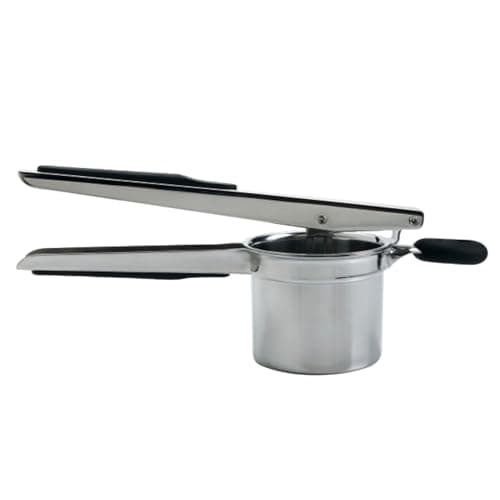
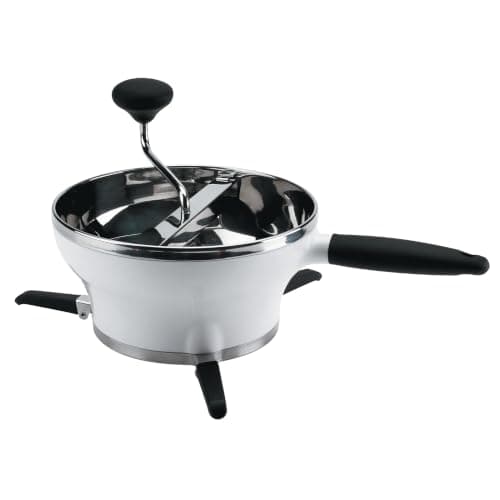
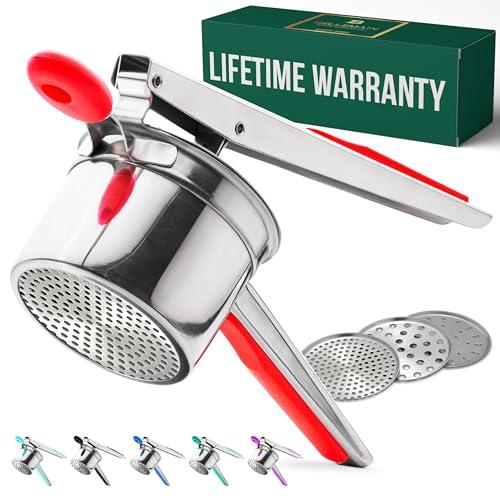
The Bellemain Stainless Steel Potato Ricer (15 oz, 3 discs) is the ricer to buy if you want texture choice and a bigger hopper for less money: Bellemain publishes three interchangeable ricing discs, a 15-ounce chamber and a polished 18/10 stainless body, and it lands under the OXO Good Grips Stainless Steel Potato Ricer, which is the tool we rank first overall. The reason the OXO still wins that ranking is not the plate — it is the frame and the handles. If what you actually want is a crank and interchangeable discs for sauce as well as potato, the OXO Good Grips Food Mill is the different machine at the end of this page, and the cheapest of the three here is the Bellemain itself.
Prices above are read live from Amazon with the date they were last checked. We print no figure we cannot verify, so a blank price means check rather than a stale number. We have not tested this ricer in a lab and we do not claim to have; everything below is either the manufacturer’s own published specification, cited on the product card, or a mechanical consequence of it.
What a ricer is for, in one paragraph
A ricer is a hopper, a perforated plate and a lever. Cooked potato goes in, you squeeze, and it is extruded through the holes once, in one direction, and never worked again. That single pass is the reason riced mash is light rather than sticky: the usual explanation is that repeated crushing and folding ruptures more starch cells and frees more starch, and extrusion does the shaping in one movement and then stops. The full argument against a masher is elsewhere; the thing to hold on to is that every ricer does this, and the differences between them are therefore about the hopper, the plate and your hand.
The three discs are the actual reason to buy it
This is the one specification that separates the Bellemain from everything else in our catalog. The OXO we rank first has a single fine plate, which is a deliberate choice: one plate means nothing to swap, nothing to lose and nothing to store. Bellemain ships three interchangeable discs, all included, which gives you something no single-plate ricer can — a choice of output from the same tool.
What that is worth depends entirely on what you cook:
- A fine disc is classic mash and the one you want for anything that has to be silky or piped.
- A medium or coarse discleaves the strands thicker, which is what you want when the potato is going into something rather than onto a plate — potato cakes, fritters, a topping that is supposed to look rustic.
- Coarse also moves faster, because bigger holes mean less resistance per squeeze, which matters on a large batch.
If you only ever make smooth mash, the discs are three things to keep in a drawer and the OXO is the better buy. Bellemain’s own listing is the basis for the claim and we have not invented a thickness for any of the three plates, because Bellemain does not publish one.
Fifteen ounces, and why hopper size is a real spec
Bellemain publishes a 15-ounce chamber. A ricer is loaded by hand, one scoop at a time, and a bigger chamber means fewer refills for the same pot: for a holiday batch that is the difference between five loads and eight. It also means more potato under the lever at once, which is where the handles come in.
Where the OXO still wins, stated plainly
Two things, both of them in the OXO’s published description rather than in a review somewhere.
The frame rests on the pot.The OXO hooks over the rim, which means you are not holding the whole loaded assembly in mid-air while you squeeze — you can rice one-handed. On the Bellemain you support the tool and squeeze it at the same time. With a full 15-ounce hopper of hot potato, that is the single biggest practical difference between these two tools, and it is why the OXO leads our ricer ranking and has its own review.
The handles need less force. The Bellemain takes a firmer squeeze. For most hands and an ordinary pot that is a non-issue; for anyone with grip pain it is the whole decision, and our prep tools for arthritis page exists for exactly that reader.
Everything else is close. Both are stainless; the Bellemain states 18/10 and a polished finish. Both rinse clean, and both are easiest to clean in the thirty seconds after use rather than the thirty minutes after dinner, which is true of every ricer ever made.
Who should buy it
Buy the Bellemainif you want texture choice, if you rice in volume, or if the price gap matters — it is the ricer in our catalog that sits inside the sub-$25 prep tool band, which makes it the cheapest route to a real extruded mash. Accept the firmer squeeze and three discs to keep track of.
Buy the OXO instead if you make classic smooth mash and nothing else, if you want to work one-handed over the pot, or if hand force is a consideration. One plate, softer handles, a frame that does the holding.
Buy the food mill insteadif potato is only half the job. A mill is the same extrusion mechanism on a crank, with discs of its own, and it leaves skins and seeds behind on the plate — so it makes tomato sauce and applesauce as well as mash. It costs more and stores like a small appliance; the trade is laid out on our food mill ranking and in mill vs ricer vs masher.
What it will not do
It will not rice raw anything. A ricer presses cooked food through a plate; raw cauliflower florets fracture and jam rather than extrude, which is a mistake common enough that we gave it its own page at ricer for cauliflower. It will not replace a masher for a quick rustic mash in the pan you cooked in. And it will not fix waxy potatoes: variety and cooking method decide more of the outcome than the tool does — a floury potato, cooked through, riced hot, is most of the way to good mash before the tool is chosen at all.
If none of the three tools here appeals, our ricer alternativespage ranks what takes over the work, and names the two substitutions — a food processor and an immersion blender — that fail outright.