HUB 06 · Guides
Food Mill vs Ricer vs Masher
Three tools that all push cooked food through holes, and one question that separates them completely — whether anything has to be left behind.
We earn a commission if you buy through our links. It does not change the price you pay, and it does not decide our picks — our selection criteria are published in full. How this works.
Use a food millwhen something has to be left behind — tomato skins, apple peel, raspberry seeds. Use a ricer when the food is already peeled and you want it fluffy and lump-free. Use a masher for everything else, in the pot, with nothing to load. All three push cooked food through holes; only one of them separates as it goes.
The question that decides it: skins and seeds
A mill has a crank-driven blade that sweeps food across a perforated disc, and a scraper that pushes the puree through while whatever will not fit — skin, seed, core, fibre — stays in the hopper. That is a separating action, and no ricer or masher does it. It is why a mill is the traditional tool for passata, apple sauce and berry coulis: you cook the fruit whole, mill it, and throw the skins away at the end instead of peeling at the start.
A ricer does not separate, it extrudes. Cooked food goes into a hopper and out through a perforated plate in one pass. Nothing is removed except what physically cannot fit, which is why cooks who rice unpeeled potatoes lift the skin out of the hopper between loads. A masher separates nothing at all: it crushes from above, repeatedly, in the pan.
If you have ever wondered why your blender-made tomato sauce tastes bitter and looks pink rather than red, this is the answer — a blade chops skins and seeds into the sauce instead of taking them out. A mill is the tool that fixes it.
What each does to the texture
Cooked potato is a mass of cells full of swollen starch. Separate them gently and you get fluffy mash; rupture them and the starch leaks out as glue. That single fact ranks the three tools for mash: a ricer is gentlest (one pass, no repeat working), a mill is close behind on its fine disc, and a masher is the most variable because the result depends on how long you keep going. We go deeper into that in potato ricer vs masher.
Where the mill pulls ahead is choice. OXO ships three stainless discs — fine, medium and coarse — changed with a spring-loaded lever, so the same tool gives a silky apple sauce and a rustic vegetable soup base. A ricer typically has one plate; the OXO has a single fine disc, which is exactly why the multi-disc Bellemain exists as an alternative in the ricer roundup.
Batch size, and the pot you are working over
This is the practical detail that decides which one you reach for on a Sunday. OXO publishes about 2.3 quarts of capacity for its mill, with three non-slip legs that sit across bowls and pots up to 11 inches across, and legs that fold for storage. That is a tool built to work over a big pot in volume.
A ricer works in hopper-sized loads, so a large pot of potatoes is a rhythm of refills — fast once you have it, but a rhythm. The OXO ricer’s advantage here is the non-slip knob that holds it in place over the bowl or pot, so you are not supporting the whole assembly in mid-air while you squeeze. A masher has no batch size at all: it works in the pan the potatoes cooked in, which is also why it is the only one of the three that adds no washing-up.
Side by side
| Factor | Food mill | Potato ricer | Masher |
|---|---|---|---|
| Removes skins and seeds | Yes — the whole point | Only what will not fit | No |
| Texture control | Three discs, fine to coarse | One pass, one texture | However long you keep going |
| Best at | Tomato sauce, apple sauce, coulis | Mash and gnocchi | Everything else, in the pot |
| Risk of gluey mash | Low | Very low | Moderate, rises with over-working |
| Works over the pot | Legs straddle pots to 11 in | Rests on the rim | Works in the pan itself |
| Parts to wash | Most — body, disc, blade, scraper | Hopper and plate | One tool |
| Storage | Bulky, legs fold | Bulky | Slim, hangs on a rail |
If you are only buying one
Buy the masher first. It is the cheapest, the smallest, the easiest to wash, and it is the only one of the three that handles beans, avocado, swede, squash and banana as happily as potato. Our pick is the KitchenAid Gourmet Stainless Steel Wire Masher, because it is the only masher in the masher roundupthat publishes its wire gauge — 4.5 mm, which is what stops a head splaying under a full pot.
Buy the ricer second, and only if mash is a point of pride or you make gnocchi. The OXO Good Grips Stainless Steel Potato Ricer is the one we recommend, reviewed in full in our OXO ricer review.
Buy the food millwhen you start cooking with whole tomatoes, apples or berries in quantity — at that point it stops being a luxury and starts saving you an hour of peeling. The OXO Good Grips Food Mill leads the food mill roundup on its three discs and its pot-straddling legs.
The one tool that is wrong for all three jobs.A food processor, blender or stick blender ruptures effectively every starch cell within seconds, and turns potato into wallpaper paste that cannot be recovered. It also chops skins and seeds into your sauce rather than removing them. This is the single most common mistake in this corner of the kitchen — see what a food processor can and cannot do.
Can one tool replace another?
A mill replaces a ricer for potato, comfortably — the fine disc gives a very similar result, and you get the skin separation for free. It does not replace a masher, because a mill cannot work in the pan and is far too much washing-up for a weeknight.
A ricer does not replace a mill: it will not take skins and seeds out of a sauce, and it is the wrong shape for anything loose and wet. And a masher replaces neither for smooth results, though it happily replaces both for anything where texture is welcome. If you own a masher and a mill you have the field covered; a ricer is the specialist you add when mash matters most.
If the mill is the one you land on, the technique is what decides whether you enjoy owning it, and it is rarely explained anywhere: how to use a food mill covers which disc to fit, the back-crank that clears a jam instead of bending a disc, and the uncored, unpeeled tomato method that is the whole argument for the tool.
The hardware
The hardware this guide is about
The products this guide refers to, with prices pulled live from Amazon and dated on every card. Full rankings live in the roundups linked above.
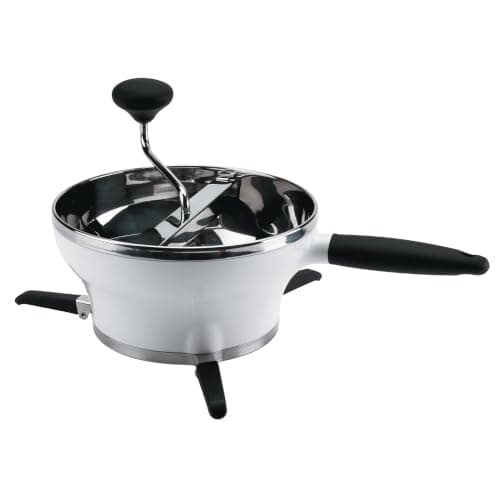
Sauces and purees
OXO Good Grips Food Mill
The food mill to buy: three discs, a stable pot-straddling design and comfy handles for smooth sauces and purees.
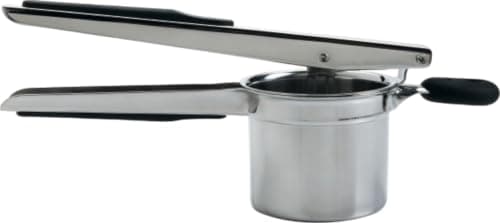
Most kitchens
OXO Good Grips Stainless Steel Potato Ricer
The ricer to buy: comfortable handles, a big hopper and a hook that rests it on any pot for lump-free mash.
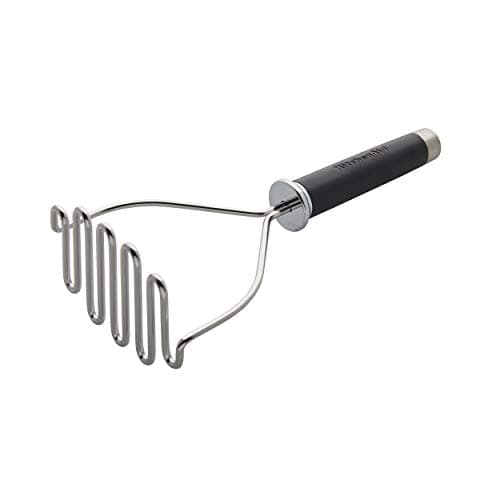
Most kitchens
KitchenAid Gourmet Stainless Steel Wire Masher
The only masher here that publishes a wire gauge, on a wide head and a weighted handle — and it costs less than the obvious alternative.
#ad · As an Amazon Associate we earn from qualifying purchases.
Questions
Frequently asked
Is a food mill better than a potato ricer?
Can a food mill make mashed potato?
Do I need all three?
What is the difference between a food mill and a food processor?
Which is easiest to clean?
Keep reading