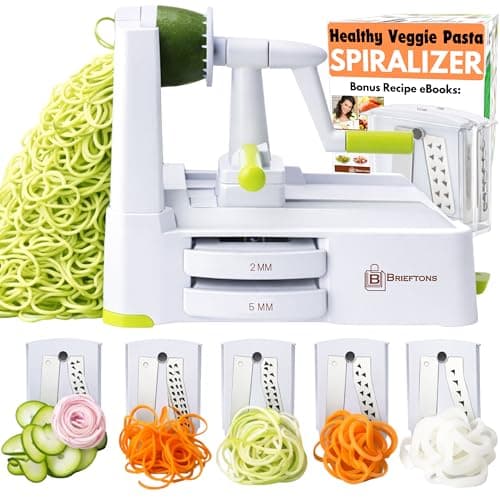
The Brieftons 5-Blade Vegetable Spiralizer is the spiralizer to buy if you are going to use one regularly: five labeled blades from 2 mm angel hair to a flat ribbon, and an oversized suction pad with a locking lever that holds the base to the counter while you crank a raw beet. Both of those are the difference between a tool you keep and a tool that ends up in the back of a cupboard.
Tabletop or handheld: pick this first
A tabletop spiralizer clamps or suctions to the counter, holds the vegetable between a crank and a blade plate, and you turn a handle. Your hands stay away from the blade, hard produce is manageable because the machine takes the force, and the spirals come out long and even. The cost is footprint: it is a real object that has to live somewhere.
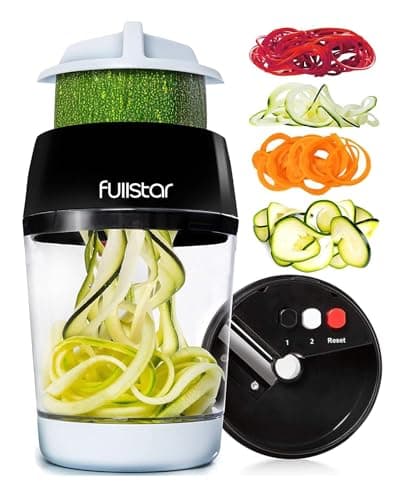
A handheld spiralizer like the Fullstar 4-in-1 Handheld Vegetable Spiralizer is a cone you twist the vegetable into by hand. It stores in a drawer, costs a fraction as much, and is completely adequate for a courgette twice a month. It is also tiring past two or three vegetables and leaves a larger unusable stub. For occasional use that is a fair trade; for weekly meal prep it is not.
The one-line rule.Spiralizing weekly, or working with sweet potato and beet? Buy a tabletop — the Brieftons or the OXO. Making zoodles now and then from soft courgette? The handheld Fullstar does it for pocket money and disappears into a drawer.
What the counter surface decides
This is the specification nobody checks and everyone should. Suction-mounted spiralizers — including the Brieftons — need a hard, flat, non-porous surface: granite, quartz, sealed marble, tile or glass. On butcher block, unsealed wood, textured laminate or a grouted tile line, the pad will not seal and the whole design collapses; you end up holding the machine with one hand and cranking with the other, which is both awkward and less safe.
If your counters are wooden or textured, either plan to work on a large glass chopping board or choose a handheld. It is worth knowing before you buy rather than after.
What each one does best
The Brieftons 5-Blade Vegetable Spiralizerhas the widest cut range here — 2 mm angel hair, 3 mm spaghetti, 5 mm fettuccine, 5.5 mm pappardelle and a flat ribbon slicer, each labeled by millimeter so you are not guessing which insert is which. The blades are Japanese 420-grade stainless and there is a locking blade caddy so nothing sharp is loose in a drawer. It needs firm produce at least an inch and a half across, so celery, thin carrots and eggplant are out.
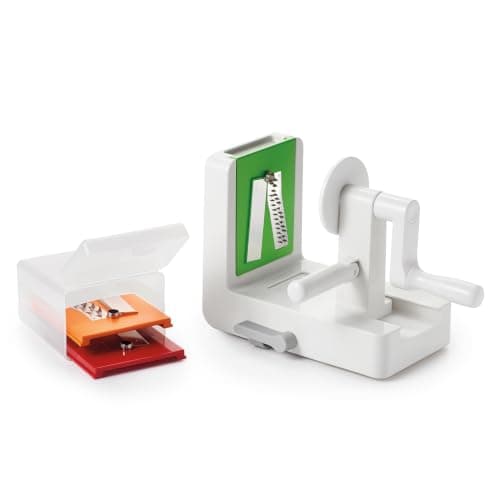
The OXO Good Grips 3-Blade Tabletop Spiralizer is the tidier tabletop unit: three blades covering spaghetti, fettuccine and ribbon cuts, a suction base, and blades that store inside the body rather than in a separate caddy. Fewer cut options than the Brieftons, less to keep track of. And the Fullstar 4-in-1 Handheld Vegetable Spiralizeris the drawer answer — four cuts, a built-in catch container with a lid so spiralized courgette goes straight to the fridge, and a multi-pronged finger guard for the last inch.
Getting good noodles
- Trim both ends flat.A square end seats properly against the crank plate and the vegetable turns instead of slipping. Most “it just shredded it” complaints come from a rounded end.
- Choose straight, fat vegetables. A curved courgette spirals into short fragments. Straight and at least an inch and a half thick is what these tools want.
- Do not cook zoodles long. Sixty to ninety seconds in a hot pan is plenty; beyond that they release water and go limp. Salting and draining them for ten minutes first removes a surprising amount of that water.
- Wash immediately, with a brush. Spiralizer blades are fine-toothed and hold vegetable fiber. All three of these come apart; the Brieftons is top-rack dishwasher safe.
A spiralizer is also the least versatile of the three tools that make vegetable strands, and it is worth knowing that before you give it counter space — julienne peeler vs mandoline vs spiralizer compares all three on cut shape, volume and waste, and is honest that a noodle is the one thing the other two cannot make.
How we picked
Tools we claim to have lab-tested: 0
Every site in this category tells you they ran twenty machines through a lab. We have not, and we say so. Here is what we do instead: read the manufacturer's manual and spec sheet, record the published bowl capacity, motor rating, blade and disc counts and materials, cross-check the warranty against the manufacturer's own warranty document, and cite all of it so you can check the work. Prices come live from Amazon's API and disappear rather than go stale.
The scores above are judgments from that documented research — not test results. The full rubric, including what disqualifies a product, is published in full.