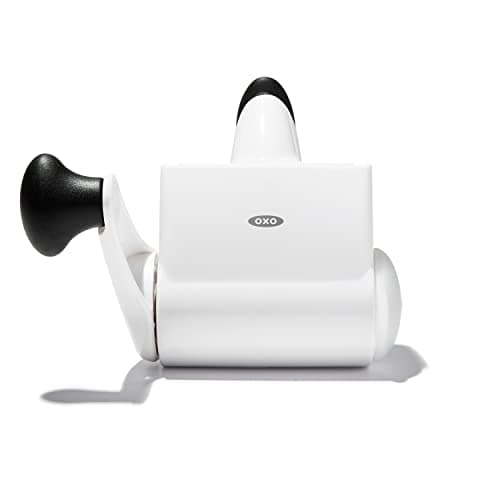
The OXO Good Grips Rotary Cheese Grateris the rotary grater to buy for most kitchens, and the deciding feature is not the drum — it is the cap. It seals, so the half a block of parmesan you grated goes straight back in the fridge in the tool you grated it with. On a gadget that lives or dies by how little friction it adds, that is worth more than another millimeter of drum.
One step up from this page: if what you typed was “best cheese grater” rather than the name of a mechanism, our cheese grater pagesorts all four — box, rotary drum, fine rasp and dual-surface handheld — by the cheese you actually buy, then sends you back to the roundup for whichever one wins.
What a rotary grater is for
A rotary grater holds cheese in a small hopper, presses it against a perforated drum with a spring-loaded lid, and you turn a crank. Your fingers never approach the cutting surface, and the last stub of a block gets used instead of being thrown out because it is too small to hold safely against a box grater. Those two things — safety and yield — are the whole argument, and they are strongest exactly where box graters are weakest: hard, expensive cheese.
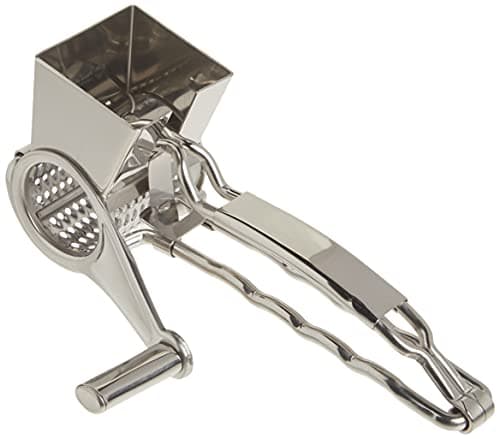
It is also the only grater that works comfortably at the table. Grating parmesan directly over someone’s plate is a rotary’s natural habitat, which is why the Cuisipro Foodservice Rotary Graterexists in all-stainless foodservice form — it is a tool designed to be handed to a guest.
The honest caveat. A rotary does one texture on one class of food. Soft cheese gums the drum, vegetables mostly will not fit the hopper, and there is no zesting or slicing surface. If you grate more than hard cheese, a box grateris more versatile and usually cheaper — buy the rotary as a specialist, not a replacement.
What separates the three
The OXO Good Grips Rotary Cheese Grater is the most practical: a large barrel so you reload less often, a medium drum that suits hard cheese, chocolate and nuts, and the silicone-sealed cap that turns it into a storage container. An adjustable window lets you pour a measured amount rather than tipping the whole lot onto a plate.
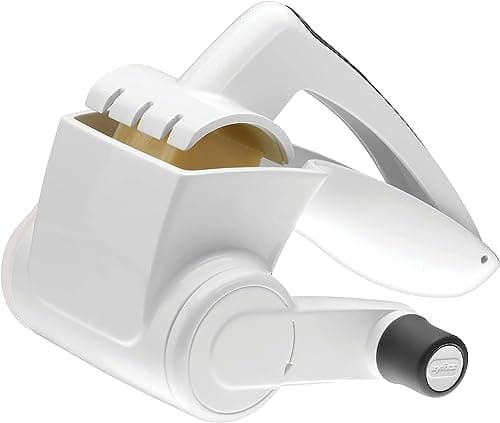
The Zyliss Classic Rotary Cheese Grater is the classic, and the one with a credential: it is NSF restaurant certified and dishwasher safe. It grates hard cheese and nuts quickly and comfortably, and its smaller drum means more reloading on a big job. The Cuisipro Foodservice Rotary Grateris the tableside piece — all stainless, dishwasher safe, foodservice-grade build — and you pay for the material and the finish rather than for a better grate. It is also the least widely stocked of the three, so availability comes and goes.
Getting a good result out of one
- Cold cheese only. Room-temperature cheese smears rather than shreds and will clog the drum. Fifteen minutes in the fridge before grating fixes almost every complaint about rotary graters.
- Cut to fit, do not force. Trim the block to a piece the hopper accepts comfortably. Jamming an oversized wedge in is how the crank handle gets broken.
- Wash it straight away. Dried cheese in a drum is genuinely unpleasant to clear. All three of these are dishwasher safe; use that.
- Do not try soft cheese.Mozzarella and cheddar at room temperature will paste up the drum. Hard, dry cheeses — parmesan, pecorino, aged gouda — are what a rotary is built for.
How we picked
Tools we claim to have lab-tested: 0
Every site in this category tells you they ran twenty machines through a lab. We have not, and we say so. Here is what we do instead: read the manufacturer's manual and spec sheet, record the published bowl capacity, motor rating, blade and disc counts and materials, cross-check the warranty against the manufacturer's own warranty document, and cite all of it so you can check the work. Prices come live from Amazon's API and disappear rather than go stale.
The scores above are judgments from that documented research — not test results. The full rubric, including what disqualifies a product, is published in full.