HUB 06 · Guides
Cuisinart vs KitchenAid Food Processor
Two very different design philosophies at the same price. One publishes its motor and keeps the parts count low; the other adds cuts the first cannot make. Here is the split.
We earn a commission if you buy through our links. It does not change the price you pay, and it does not decide our picks — our selection criteria are published in full. How this works.
Choose Cuisinart if you want a straightforward machine with the fewest parts and a published motor figure you can compare. Choose KitchenAidif you want the widest range of cuts — particularly dicing, which Cuisinart’s mainstream machines do not do — and are comfortable with a brand that publishes less about its motors.
What each brand actually documents
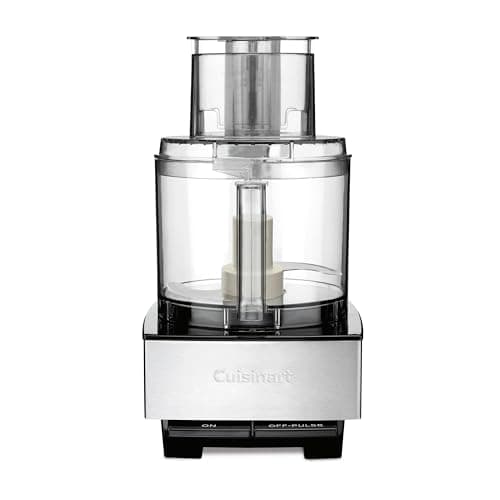
This matters more than it sounds. Cuisinart publishes wattage across its range: 720 watts for the Cuisinart 14-Cup Food Processor (DFP-14BCNY), 550 for the Core Custom 13-cup, 350 for the Elemental 8-cup. That gives you something to compare and something to hold them to.
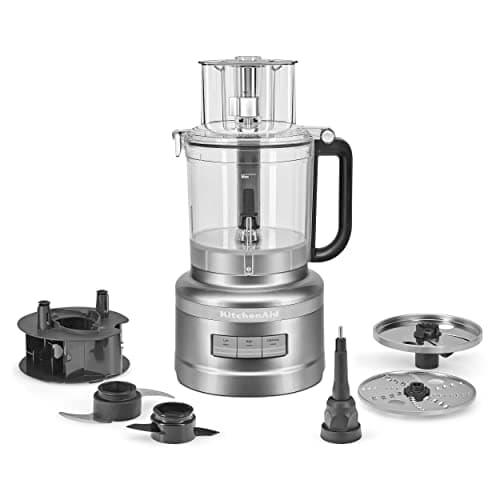
KitchenAid, on the KitchenAid 13-Cup Food Processor (KFP1318), publishes no motor wattage at all. That is not a claim that the machine is weak — it is a statement about what the manufacturer is willing to put in writing, and since this site ranks on published specifications, it is a real gap. Where a figure is not published we print “not published” rather than converting one from somewhere else.
The comparison table
| Factor | Cuisinart 14-Cup Food Processor (DFP-14BCNY) | KitchenAid 13-Cup Food Processor (KFP1318) |
|---|---|---|
| Work bowl | 14 cups | 13 cups |
| Published motor | 720 W | Not published |
| Dicing | No | Yes — dicing kit included |
| Slicing adjustment | Fixed disc | External adjustable lever |
| Feed tube | Standard wide tube | 3-in-1 ExactSlice tube |
| Parts to wash | Three | More — discs, dicing kit, spindles |
The case for Cuisinart
Simplicity, and the fact that it survives contact with real life. A bowl, a lid and a blade is a machine you will reassemble willingly at 7pm on a weeknight; a machine with a dicing grid, three discs and two spindles is one you will use for the first month. The DFP-14 has been in production long enough that its design has been sanded down by decades of complaints, and the 720-watt motor handles dough and hard cheese without drama. Our full review covers where it gives ground.
The case for KitchenAid
Cuts the Cuisinart cannot make. The dicing kit is the headline: a processor that produces actual cubes rather than mince or slices, which otherwise requires a separate push-dicer. The external slicing lever lets you change thickness while the machine is running, which is genuinely useful when you are part-way through a bag of potatoes and want them a shade thinner. And the 3-in-1 feed tube handles a whole tomato and a single carrot without swapping anything.
The rule.If your prep is chopping, slicing, shredding and dough, buy the Cuisinart — it does those with the least friction and tells you what its motor is. If dicing or adjustable slicing is something you will genuinely use, buy the KitchenAid and accept the extra parts.
Two things that are not differences
Capacity. Thirteen against fourteen cups is not a meaningful gap; both are full-size machines and both are taller than most under-cabinet gaps when assembled. See our size guide for what those numbers really mean in use.
Running cost. Neither costs anything to run. Even the documented 720-watt motor, at a generous assumption of daily use, is a rounding error on an electricity bill. Wattage on a food processor is a capability figure, not an operating cost.
What each brand’s smaller machines look like
The brands diverge more at the small end than at the large one, and it is worth knowing before you commit to an ecosystem. Cuisinart fields a genuinely wide range of small machines: the 3-cup Cuisinart Mini-Prep Plus (DLC-2ABC) with its reversible sharp-and-blunt blade, the 5-cup Cuisinart 5-Cup Chop & Shred Food Processor (FP-5) that still carries a shredding disc, and an 8-cup Elemental at a published 350 watts. Whatever size you decide you need, there is a Cuisinart at it, built to the same plain philosophy.
KitchenAid’s small end is oriented differently — toward well-made choppers such as the 3.5-cup KFC3516 with two speeds and a drizzle basin, and a 7-cup compact processor, rather than toward a broad ladder of processor sizes. If you like the brand and want a small machine, you are choosing from a shorter list. Our mini food processor roundupranks both brands’ small machines against each other.
Which one to buy if you are also buying for someone else
Two practical points that come up constantly and are rarely written down. First, if the machine is a gift or is going into a shared kitchen, fewer parts wins — a three-component machine gets used by everyone, while a machine with a dicing grid and three discs gets used by the one person who learned it. Second, if the recipient bakes, check for a dough blade rather than a motor figure; neither of the two machines compared here includes one, which is covered in the best food processor for dough.
And if you have not settled on a full-size machine at all, the third contender worth reading about is Ninja, which undercuts both on price while publishing a peak wattage and shipping a dough blade — the comparison is in Ninja vs Cuisinart. If it is the KitchenAid you are weighing against it, KitchenAid vs Ninja takes that pair on directly — and it is the one head-to-head where no motor figure can be compared at all, because only one of the two brands publishes one.
The hardware
The hardware this guide is about
The products this guide refers to, with prices pulled live from Amazon and dated on every card. Full rankings live in the roundups linked above.
Most full-size kitchens
Cuisinart 14-Cup Food Processor (DFP-14BCNY)
The default full-size processor for a reason: a big, simple, 720-watt workhorse with the shortest parts list to go wrong.
Dicing and prep variety
KitchenAid 13-Cup Food Processor (KFP1318)
A 13-cup KitchenAid with a 3-in-1 feed tube and an included dicing kit — the widest job range in the roundup.
#ad · As an Amazon Associate we earn from qualifying purchases.
Questions
Frequently asked
Is Cuisinart or KitchenAid better for food processors?
Does the KitchenAid food processor really dice?
Why does KitchenAid not publish wattage?
Which is easier to clean?
Keep reading