HUB 06 · Guides
How to Use a Food Mill
A food mill is a sieve with a crank. It purees and strains in the same motion, which is why tomato sauce made with one tastes different from tomato sauce made with a blender — and why no amount of horsepower substitutes for it.
We earn a commission if you buy through our links. It does not change the price you pay, and it does not decide our picks — our selection criteria are published in full. How this works.
A food mill is the only tool in a domestic kitchen that purees and strains in one action. A blender pulverizes everything you put in it, skins and seeds included; a sieve strains but does not puree; a mill does both, because a curved blade drags soft food against a perforated disc and leaves everything too tough to go through sitting on top. That is the whole reason to own one, and it is why tomato sauce is the job that justifies the purchase.
Setting it up
- Choose the disc and fit it before anything else. On a three-disc mill the disc drops into the bottom of the hopper and the blade assembly sits on top of it, held by a spring. Getting this order wrong is the single most common reason a mill will not crank.
- Straddle the pot or bowl. A mill has legs or a hook designed to sit across the rim of a vessel. Use a vessel narrow enough that the legs span it properly — a mill perched on a too-wide bowl will tip when you push down on the crank, and you will be holding it with the hand you needed for the food.
- Fill it no more than two-thirds. The blade needs room to move food around. An overfilled hopper spills over the rim as soon as you start cranking.
- Crank forward steadily, then back a half turn. Forward does the work; the back-crank lifts the blade, releases the pressure and clears the disc. Alternating the two is the technique, and it is what separates people who like food mills from people who find them hard work.
- Scrape the underside of the disc when you are done. A surprising amount of the finest puree clings there, and a spatula recovers it in seconds.
If it jams, do not force it. Back-crank a full turn to lift the blade, then go forward again. A mill that will not turn usually has a piece of skin or a stem wedged under the blade, or it has been loaded with something fibrous that was never going to go through. Forcing it bends discs.
Which disc for which job
Most mills ship three discs and most people use one. The difference is real and worth learning.
The fine disc is for smooth purees where texture would be a fault: tomato passata, apple sauce, baby food, raspberry or blackberry puree where you want the seeds gone completely. It is also the disc that takes the most effort to crank through.
The medium disc is the general-purpose one and where to start. Tomato sauce, vegetable soups, potato puree, most fruit. If you only ever use one disc, this is it.
The coarse disc is for anything that should still have body: a chunky tomato sauce, a rustic vegetable soup, a mash you want to feel. It is also the fastest to crank, so it is the one to use when you are doing a lot.
Tomatoes, which is the reason to own one
Cook the tomatoes first — halved, in a pan, until they collapse, ten to twenty minutes depending on how ripe and how many. Do not peel them, do not seed them, do not core them beyond pulling off anything green. That is the entire point: the mill removes the skins and the seeds for you, and it removes them after they have given their flavor to the sauce rather than before.
Then mill straight into a clean pan. What goes through is sauce; what stays behind is a dry mat of skin and seed you tip in the compost. The texture is different from blended sauce and so is the taste, because a blender chops seeds into the sauce and tomato seeds are bitter.
This is the job that makes a mill worth its cupboard space if you cook tomatoes in any quantity — a glut from a garden, a case from a market, a batch to freeze. Our food mill roundup covers the two we would buy, and our full review of the OXO goes through its three discs and its pot-straddling legs in detail.
Apples, berries and other fruit
Apple sauce is the second-best argument for a mill. Quarter the apples, core them roughly, and cook them down with a splash of water — no peeling. Mill on medium and the skins stay behind. The sauce takes some color from the skins, which is why mill-made apple sauce is pink when the apples were red, and that is a feature.
Berries go through raw or barely cooked. Raspberries, blackberries and currants are the classic case: a fine disc takes every seed out and leaves a smooth puree for a coulis or a sorbet. Nothing else does this without a sieve and a lot of pushing.
Stone fruit needs pitting first — a mill will not remove a peach stone and will be damaged trying. Cook, pit, mill.
Potatoes, and the gluey question
A mill makes excellent mashed potato, and it does it for the same reason a ricer does: it presses cooked potato through holes once, rather than beating it. Beating potato develops the starch and that is what makes mash gluey — which is why a food processor is the wrong tool for mash and always will be, however powerful it is.
Between a mill and a ricer for this specific job, the ricer is simpler, cheaper and has fewer parts to wash, and our ricer roundup recommends one for anyone whose main goal is mash. The mill wins if you also want to leave the skins behind, because you can boil potatoes in their skins and mill them straight — more flavor, no peeling. Our mill versus ricer versus masher comparison works the whole decision through, and the spine of it is one question: are there skins or seeds you want removed?
What a food mill is wrong for
Anything raw and firm. A mill does not cut. Raw carrot, raw potato and raw apple will not go through, and pushing harder bends the disc. Cook it first, always.
Anything fibrous. Celery strings, tough greens and pineapple core wrap around the blade. The mill will jam, and the jam is not the mill’s fault.
Emulsions and anything that needs speed. Mayonnaise, pesto, hummus, nut butter: all of these need a blade at speed and a mill has neither. That is what a food processor is for, and our hummus page and nut butter page cover those jobs properly.
Cauliflower rice. People ask, because a mill looks like it should. It does not — and neither does a ricer, which is a mistake common enough that we wrote a whole page correcting it.
What to look for in a food mill
Three discs, not one. A single-disc mill is a one-texture tool, and the disc it comes with is rarely the one you want for the job in front of you. Both mills we rank publish three.
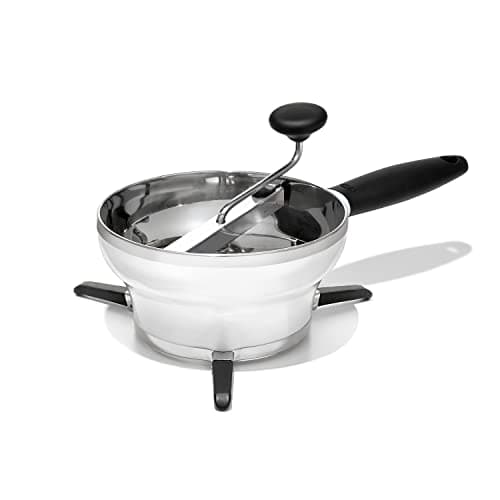
Legs or a hook that straddle a pot properly. Stability is the difference between a pleasant job and a two-handed wrestling match. The OXO states wide legs and a hook designed to sit across a pot or bowl, and that is the feature to look for.
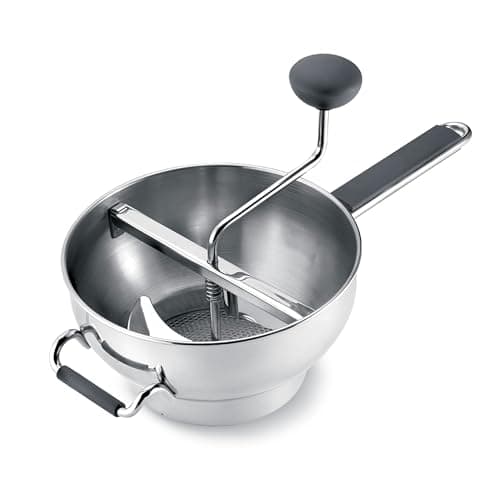
A handle you can grip while pushing down. You are applying force with one hand and holding the mill still with the other. A cushioned crank and grip is worth more here than it sounds, which is why the OXO’s soft non-slip handle is a genuine advantage over the all-metal Cuisipro for a home cook doing a few batches.
Stainless, if you mill tomatoes. Acidic food and cheap metal do not mix. Both picks in our roundup are stainless, and it is the specification not to compromise on.
Take-apart construction. Everything about a mill’s cleaning depends on how easily the blade, spring and disc come off. Check that before you buy, because the underside of a disc is where puree hides.
Which of the two we rank
The OXO Good Grips Food Mill is the pick for almost everyone: three discs, the pot-straddling design, soft handles, and a price that suits someone who mills a few times a year. Its honest costs are on its card — it is bulky to store and there are more parts to wash than a ricer.
The Cuisipro Deluxe Food Mill is the heavy-duty alternative: all stainless, three grinding discs, fold-down legs. It is the one to buy if you process a seasonal glut every year and want a tool that will outlive you. Its costs are equally plain: noticeably more money, and a metal handle with none of the OXO’s cushioning, which you feel after the fifth pan of tomatoes.
If you are choosing between a mill and something else entirely, the ricer is the cheaper, simpler tool for mash alone, and the masher is the cheapest and the most forgiving. The mill is the one that does the job neither can: separating skins and seeds while it purees.
Cleaning it
Rinse it immediately, before anything dries. Tomato pulp and apple sauce set hard on a perforated disc and become genuinely difficult to remove an hour later, which is the main complaint people have about mills and is almost entirely a timing problem.
Take it apart — blade, spring, disc, hopper — and rinse each piece under running water, brushing the underside of the disc where the fine puree collects. A dish brush or an old toothbrush does what a sponge cannot. Check your manual before putting any of it in a dishwasher; some mills are dishwasher safe and some are not, and a spring is a part you do not want to lose to a bottom rack.
Dry the disc before it goes away. Perforated stainless holds water in every hole, and a mill put away damp is a mill with marks on it next season.
The hardware
The hardware this guide is about
The products this guide refers to, with prices pulled live from Amazon and dated on every card. Full rankings live in the roundups linked above.
Sauces and purees
OXO Good Grips Food Mill
The food mill to buy: three discs, a stable pot-straddling design and comfy handles for smooth sauces and purees.
Frequent, serious use
Cuisipro Deluxe Food Mill
The heavy-duty mill: an all-stainless Cuisipro with fold-down legs and three discs, built for years of sauce-making.
Most kitchens
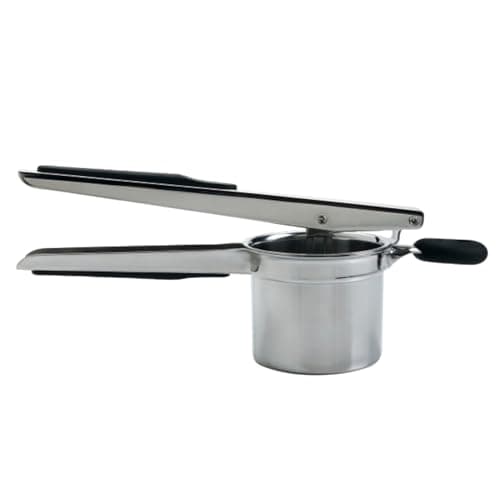
OXO Good Grips Stainless Steel Potato Ricer
The ricer to buy: comfortable handles, a big hopper and a hook that rests it on any pot for lump-free mash.
#ad · As an Amazon Associate we earn from qualifying purchases.
Questions
Frequently asked
What does a food mill do that a blender cannot?
Do you have to peel tomatoes before using a food mill?
Which food mill disc should you use?
Why is my food mill jamming?
Is a food mill better than a potato ricer for mash?
Can you use a food mill on raw fruit or vegetables?
Keep reading
Related
- Best food millsThe two we would buy, and who each suits.
- OXO Good Grips food mill reviewThree discs and the pot-straddling design, in full.
- Food mill vs ricer vs masherOne question decides it: are there skins or seeds?
- How to rice cauliflowerThe job neither a mill nor a ricer can do.
- Best potato ricersThe simpler tool, if mash is the whole goal.
- Best food processor for salsaWhere a blade beats a sieve.