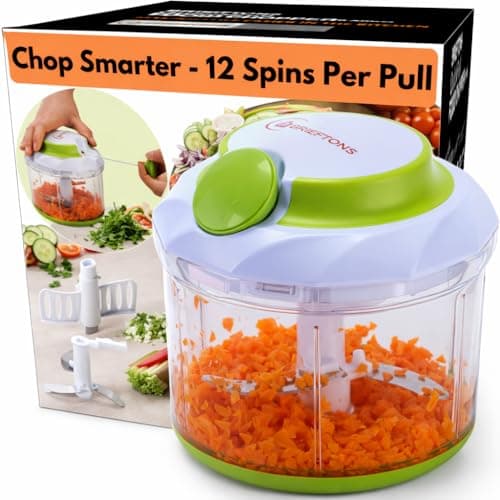
Searches for a “spin chopper” or a “chopper machine” are usually looking for this specific thing: a bowl with blades in it that you drive by hand, with no motor and no plug. The Brieftons QuickPull Manual Food Chopper (4-Cup) is that tool, and it occupies a slot nothing else on this site fills. Every other way to mincefood here needs electricity; every other way to prep food by hand — a push-dicer, a mandoline, a knife — produces cubes or slices rather than a mince. This is the one cordless tool that makes a mince.
The published number that makes this tool rankable
Brieftons publishes something almost nothing in this category does: about five pulls give a coarse chop and ten pulls a fine mince. That one sentence is the whole argument for a manual bladed chopper, and it is worth unpacking why.
A bladed chopper — electric or manual — does not cut to a size. It hits food repeatedly until the pieces are small, so texture is a function of how many times the blade passed through. On an electric chopper you control that with pulse count and a certain amount of guessing, because a motor completes a pulse faster than you can judge it. On a pull-cord chopper each pull is a discrete, countable event you can feel, and Brieftons tells you roughly what each count buys. Five pulls for salsa and a chopped salad where the pieces should be visible; ten for a curry base, a pesto or baby food where they should not be.
That is a genuinely useful spec, and it is also the honest frame for this product’s main weakness, which is in its own cons: you are the motor, so the texture is yours to get wrong. The first onion you do will probably be unevenly chopped. The published counts shorten that learning curve rather than removing it.
Three blades and two sweeper arms — the sweepers are the interesting part
Brieftons describes a cutting rotator with three sharp stainless steel leaves and two sweeper arms, stating that the sweepers pull food down and chop it evenly across the bowl.
The sweepers address the characteristic failure of every bowl chopper, which is stratification: the blade spins in the middle, food climbs the wall, and you end up with paste at the bottom and untouched chunks around the rim. An electric chopper solves it by making you stop, open the lid and scrape the sides down. Arms that sweep the wall on each rotation are the mechanical answer, and on a tool where every rotation costs you a pull, not having to open the lid twice is worth more than it would be on a machine.
Three blades rather than one also means three cuts per revolution, which is how a hand-driven tool gets to a usable number of cuts in five pulls.
The safety contrast nobody draws in this category
Brieftons states that the blades stay concealed inside the bowl during use, so nothing sharp is exposed while you pull. On this site that is a meaningful claim, because the manual alternative is the opposite.
A push-down dicer — the Fullstar or the Mueller— works by pressing food through a stationary grid, and that grid is a field of exposed blades you then have to clean with your fingers near it. It is the reason the dicer roundup tells you to buy a glove the dicers do not include. A sealed bowl with the blades underneath the lid has none of that exposure during use, and the blade assembly lifts out as a unit for washing.
So the honest ranking is: this is the safest manual chopping tool we cover, and it is also the one that cannot produce an even cube. Those two facts are the same fact — a spinning blade in a closed bowl is safe and imprecise; a fixed grid is precise and exposed. Which you want is decided by the cut, and electric vs manual choppers works that fork through in full.
Tear-free onions is a sealed-lid claim, not a magic one
Brieftons says the tool chops onions tear-free because the lid stays sealed. That is a mechanism, and it is a fair one: what makes you cry is the volatile compound the cut onion releases, and a closed bowl keeps most of it in the bowl instead of in the air in front of your face. It is the same logic as any lidded chopper, and it is a real advantage over a board and a knife.
It is not an absolute. You still have to open the lid at the end, and the first breath over an open bowl of freshly minced onion is exactly as sharp as you would expect. If onions are the reason you are shopping, how to chop onions without crying covers what actually works and what is folklore, and the onion chopper roundup ranks the tools on that one job.
The mixer attachment: a second tool in the same box
The listing states an included mixer attachment that swaps in to whisk, mix and blend batters, dressings and dips. This is the part most buyers do not notice they are getting.
In practice it turns the same bowl and cord into a hand-driven whisk, which is genuinely useful for a vinaigrette, a small batch of pancake batter or a dip where you want emulsion rather than cutting. It is not a replacement for a stick blender and its whisk, which has a motor and a much wider range, but it means the drawer space this tool occupies covers two jobs.
Size, storage and what the published dimensions mean
The bowl is 4 cups / 950 ml, and Brieftons states that every part comes apart and nests inside the bowl, with published outer dimensions of 5.51 x 5.51 x 5.51 inches at about 0.86 pounds.
Two things follow. First, 4 cups is a bigger bowl than most mini electric choppers offer, which is one of this product’s published pros — a full batch of salsa goes in one go rather than two. Second, a tool that collapses into its own bowl and weighs under a pound with no electronics is the one you can put in a camper, a holiday rental or a box of kit for a kitchen you do not live in. Brieftons leans on that case explicitly, and it is the strongest argument for owning this alongside rather than instead of an electric chopper. The body is stated to be BPA-free, food-safe plastic with an anti-skid base and a soft-grip lid.
What the cord costs you
This is the real limitation and it deserves to be stated plainly rather than buried. The pull cord is a wear part. It is a length of cord under repeated tension, and on any tool of this design it is the component that eventually frays or parts — which on a sealed hand tool is not a user-serviceable repair. That is in the product’s cons above and it is the honest ceiling on how long this thing lasts.
The flip side is the one Brieftons makes and we think is fair: there is no motor to burn out and no power cord to fail. An electric chopper has a different failure mode, not a better one. But if you chop in volume every day, repeated hard pulls get tiring and you will wear the cord faster — which is this product’s own skip line, and it points you at the electric chopper roundup.
Cleaning is the quiet win here. Brieftons states the blades and bowl are top-rack dishwasher safeand that the components separate completely. That is a real contrast with a dicing grid, where the whole maintenance problem is food lodged in dozens of small square cells — see how to clean a vegetable chopper. A blade assembly that lifts out in one piece and goes in the dishwasher is the easiest cleanup of any chopping tool on this site.
Who should buy something else
Anyone who wants even cubes.This is a mincing tool. It cannot dice, and no number of pulls will make it. If the pieces are visible in the finished dish and you want them square, buy a push-dicer — the dicer roundup covers the two worth having and Fullstar vs Mueller settles which.
Anyone chopping large volumes daily. The product says so itself. Pull count is effort, and effort scales with volume in a way a motor does not.
Anyone with grip, wrist or shoulder limitations.A hard pull is a sharp, one-armed load. It is a different demand from a push-dicer’s downward press but it is still a demand, and prep tools for arthritis sorts the whole drawer on exactly that question. An electric chopper asks nothing of your hands but a button.
Anyone whose actual job is two cloves of garlic.This bowl is 4 cups; garlic for one dinner does not reach the blades properly in it, and you will be chasing cloves around a wide bowl for ten pulls. A press crushes them in one squeeze with the skins still on — see the OXO garlic press review. Herbs, onions and nuts are what this bowl is actually sized for.
Anyone who needs a true food processor. No bowl chopper slices, shreds or makes dough. That is a different machine, and food processor vs chopper is the page for that decision.
What we are not claiming
We have not pulled this cord, we do not own this chopper, and nothing above is a test result — including the pull counts, which are Brieftons’ published figures and not ours. Every fact on this page — the three blades and two sweeper arms, the five-and-ten pull guidance, the concealed-blade claim, the sealed-lid onion claim, the included mixer attachment, the 4-cup / 950 ml bowl, the nesting storage, the anti-skid base, the BPA-free body, the top-rack dishwasher line and the published dimensions and weight — is the maker’s own declared specification on the listing the buy button points at, read on the date stamped at the top of this page. Where the listing publishes nothing, this page prints nothing: there is no stated warranty term and no stated cord life, so we have given you neither. The method is on how we pick.