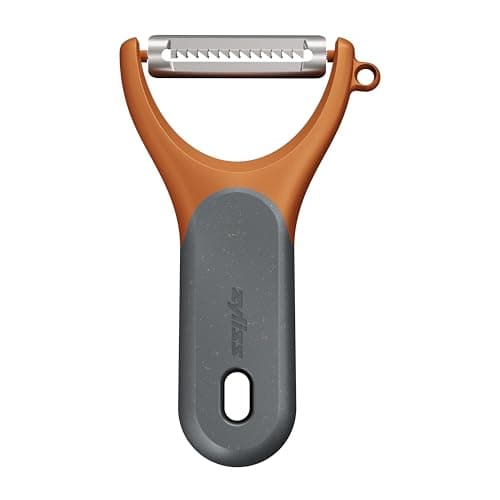
For most kitchens the best julienne peeler is the Zyliss Julienne Y Peeler: it is the cheapest of these five that ships with a blade cover, and on a tool whose teeth are the most finger-hostile edge in the drawer, the cover is the feature that matters. If you are left-handed, the Kuhn Rikon Family Y Julienne Peeleris the same cover-and-eye-remover package with one addition — Kuhn Rikon states outright that it works in either hand. And if you want one tool for decades rather than a few years, the Rösle Stainless Steel Julienne Peeler publishes more about how it is built than every other pick here combined, at several times the price.
What a julienne peeler actually does
It is a peeler whose edge has been turned into a comb. A row of small vertical teeth sits in front of, or forms part of, the blade: as you pull it down a carrot the teeth score parallel channels into the surface and the blade lifts the scored layer off, so what comes away is not a ribbon of peel but a handful of thin, square-edged strips. It is the same mechanism as the julienne disc on a food processor, which we take apart in food processor blades explained, shrunk down to something that lives in a drawer.
Two things follow from that, and they decide whether this is the right tool for you. The width of each strip is fixed by the spacing of the teeth, so a julienne peeler makes one size of matchstick and nothing else. And the lengthof each strip is the length of your stroke, which means a julienne peeler makes short strips — ideal for slaw, spring rolls, a stir-fry or a garnish, and useless for long vegetable noodles, which are a spiralizer’s job.
The spec nobody publishes
Here is the awkward truth about this category: not one of the five makers on this page states how wide its strips are. There is no published tooth pitch, no “2 mm julienne”, no matchstick dimension of any kind — which means the single number that would let you compare them cannot be compared on paper. We are not going to invent one, and you should be wary of any listing that suddenly does without saying where the figure came from.
In practice, all five cut what a cook would call a fine julienne: thin enough to disappear into a slaw, too thin for a crudité stick. If you want thicker batons, a julienne peeler is the wrong tool entirely; a mandoline with a julienne blade gives you a choice of widths, and the mandoline roundup says which ones carry them. What the makers here do publish is enough to choose between them, and it is not the headline spec anyone expects.
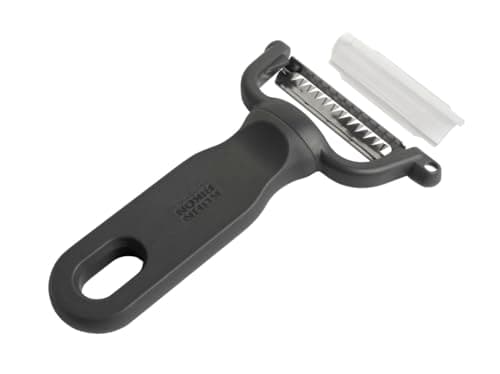
Buy the cover. A plain peeler blade is recessed and hard to cut yourself on. Julienne teeth are exposed, sharp on their points, and sit at exactly the height a hand reaches into a drawer. They also catch dishcloths, snag the tines of every other utensil and dull themselves against them. A blade cover solves all of that for the price of a bit of plastic, and only two of these five include one.
The three things makers do state
Whether a cover is in the box. Zyliss includes a safety cover; Kuhn Rikon includes a blade guard and says it protects the edge as well as your fingers. OXO, Rösle and Deiss list none. That single line on the listing is the most useful thing to read.
What the blade is. Everyone says stainless steel, which on its own tells you almost nothing. Two makers go further. Zyliss states an extra-hardened steel blade, a claim about keeping an edge. Rösle states 18/10 stainless, a claim about corrosion resistance and the grade of the steel. Neither is the same claim, and both are more than the others make.
Whose hand it fits, and how many jobs it does.Kuhn Rikon states right- and left-handed use; Rösle states the round handle works in either hand; OXO says its Y shape works with every grip. Deiss goes the other way and puts a julienne edge and a plain peeling edge on the same head, which makes it two tools in one handle — a genuine convenience and, as we will get to, a genuine compromise.
The five peelers
The Zyliss Julienne Y Peeleris the pick because it gets the order of priorities right at the lowest price. It ships with a safety cover, states an extra-hardened stainless blade rather than just “stainless”, and builds in an eye cutter so one tool handles the whole potato. The Y shape is the fast one for pulling down the length of a carrot or a zucchini. The honest marks against it: Zyliss says it is dishwasher safe and in the same breath recommends hand washing to keep it sharp — follow the second instruction — and the listing does not say which hand it suits.
The Kuhn Rikon Family Y Julienne Peeleris the one to buy if handedness is a question you have learned to ask. It has the same package as the Zyliss — blade guard, integrated eye remover, stainless julienne blade — plus a recessed non-slip grip that Kuhn Rikon states works for right- and left-handed users. Kuhn Rikon is a peeler specialist; its carbon steel Y-peeler three-pack is already on our vegetable peeler page. What you give up: the listing makes no dishwasher claim either way, and it costs a little more than the Zyliss for what is, on paper, the same kit plus one sentence.
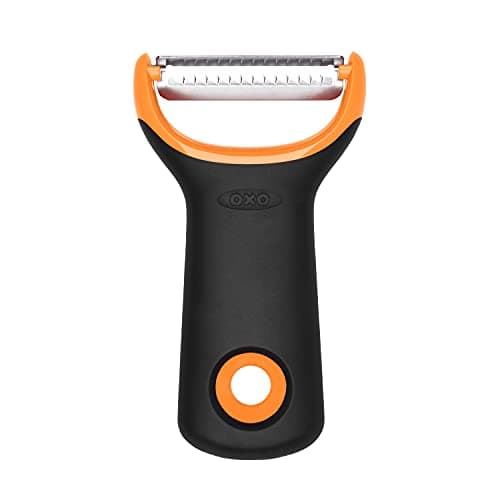
The OXO Good Grips Julienne Prep Peeleris the comfortable, low-maintenance default from the brand most people already have a peeler from. It has the familiar Good Grips non-slip handle, OXO says the compact Y shape works with every grip, and it is dishwasher safe without the hand-wash caveat — which matters on a tool whose teeth trap vegetable fiber. The cost of all that comfort is safety in storage: there is no blade cover listed, so the teeth go into the drawer bare, and there is no eye remover either.
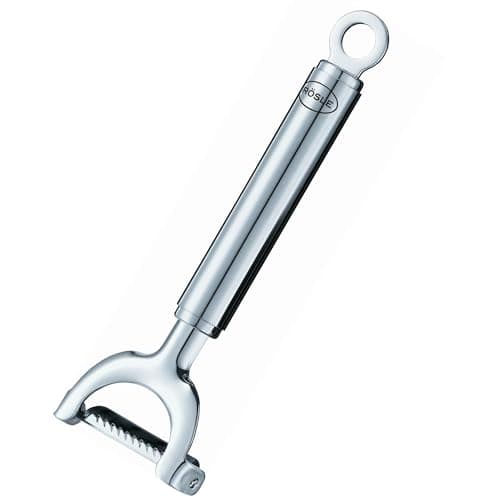
The Rösle Stainless Steel Julienne Peeleris the buy-once tool, and the only one here whose maker explains how it is built. Rösle states 18/10 stainless steel, a round handle that works in either hand, and a handle filled with epoxy at both ends — which seals it against water getting in and anchors the head, the joint where cheap peelers loosen and fail. It is a straight peeler rather than a Y, 6.7 inches long, and it costs several times what the Y peelers do. Rösle lists no cover and makes no dishwasher claim, so it is a tool you wash by hand and store with some care, for a very long time.
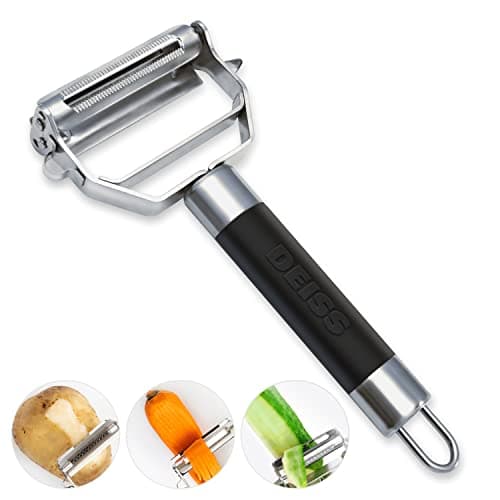
The Deiss PRO Dual Julienne & Vegetable Peeleris the cheapest set of julienne teeth on this page and the only listing that publishes a warranty at all — a lifetime one. It puts a julienne edge and a plain peeling edge on the same Y head, it is dishwasher safe, and it hangs from a loop in the handle. Two honest cautions. Deiss sells it as a zoodle maker, and a julienne peeler makes strips the length of your stroke, not noodles; if noodles are the goal, buy a spiralizer. And a double-edged head with no cover is two exposed edges in a drawer rather than one.
Y or straight?
Four of these five are Y peelers, where the blade runs across the handle like a razor. That is the faster shape for julienne, because you pull straight down the length of a long vegetable and every stroke produces a full-length strip. The Rösle is a straight peeler, with the blade in line with the handle, which gives more control on round or awkward shapes and suits cooks who hold a peeler like a knife. If you already own and like one shape of ordinary peeler, buy the same shape in julienne; the motion transfers exactly.
How they compare
Every entry below is the maker’s own published claim from the product’s Amazon listing. Strip width is not in the table because no maker here publishes it.| Peeler | Shape | Blade cover | Blade claim | Handedness stated | Dishwasher |
|---|
| Zyliss Julienne Y Peeler | Y | Yes | Extra-hardened stainless | No | Yes; hand wash recommended |
|---|
| Kuhn Rikon Family Y Julienne Peeler | Y | Yes | Stainless | Right and left | Not stated |
|---|
| OXO Good Grips Julienne Prep Peeler | Y | No | Stainless, won’t rust | “Every grip” | Yes |
|---|
| Rösle Stainless Steel Julienne Peeler | Straight | No | 18/10 stainless | Left or right | Not stated |
|---|
| Deiss PRO Dual Julienne & Vegetable Peeler | Y, two edges | No | Stainless, won’t rust | No | Yes |
|---|
Which one to buy
Buy the Zyliss Julienne Y Peeler if you want the sensible answer: a cover, a hardened blade and an eye cutter for the least money. Buy the Kuhn Rikon Family Y Julienne Peeler if you are left-handed and want that stated rather than discovered. Buy the OXO Good Grips Julienne Prep Peeler if it will live in the dishwasher and you can store it somewhere its bare teeth will not meet a hand.
Buy the Rösle Stainless Steel Julienne Peeler if you would rather pay once for a tool you will still be using in twenty years. And buy the Deiss PRO Dual Julienne & Vegetable Peelerif you want one tool for peeling and julienne both, for the least money on the page — as long as you are not buying it for noodles.
A peeler is only one of the ways to get the cut, and for several vegetables it is the wrong one. Our guide to julienning vegetables sets out the plank-stack-strip knife method, which vegetables suit a peeler, which need a mandoline blade, and which are a knife job however many gadgets you own.
How to julienne without losing a knuckle
Lay the vegetable flat on a board rather than holding it in the air, and pull the peeler away from you, down its length, in long even strokes. Keep your holding hand at the far end, behind the direction of travel. The strips come away cleanly and pile up on the board rather than in your palm.
Stop well before your fingers. The last inch of a carrot is where every julienne injury happens, because the vegetable gets short and the instinct is to keep going. Do not. Turn it, julienne another face, and when it is too small to hold safely, the stub goes into a stock or gets finished with a knife. It is the same rule as the hand guard on a mandoline, for the same reason.
What it cuts well, and what it does not
Firm, straight vegetables are the whole point: carrot, cucumber, zucchini, daikon, beet, potato, firm apple. Cucumber and zucchini julienne best if you work down one side until you reach the seeds, then turn and work the next, and stop at the watery core.
It struggles with anything soft, round or fibrous. A ripe tomato tears rather than strips, a pepper’s curved wall defeats a straight comb of teeth, and stringy celery clogs the teeth in a stroke or two. Those are knife jobs.
Cleaning the teeth
Rinse it the moment you finish. Vegetable fiber dries into the gaps between the teeth and sets like glue, and a tool you left in the sink through dinner takes a brush to clear. Run water along the teeth, in the direction they point, rather than wiping across them — wiping across is how a sponge gets shredded and how a finger gets cut.
Even where a maker says dishwasher safe, a quick rinse first does the tool a favor, and the makers that recommend hand washing do so to protect the edge. Dry it before it goes back in the drawer, and put the cover on if you have one.
When you need a different tool
A julienne peeler is the cheapest way to matchstick one or two vegetables, and it stops being the right answer the moment the job gets bigger. For a full tray of julienned vegetables, a mandoline with a julienne blade is several times faster and gives you a choice of widths. For long vegetable noodles, you want a spiralizer. For shredded carrot for a slaw in bulk, a food processor’s shredding disc does in seconds what a peeler does in minutes, even though the cut is rougher. And for a garnish on one plate, a sharp knife and five minutes remain the tool with nothing to clean.