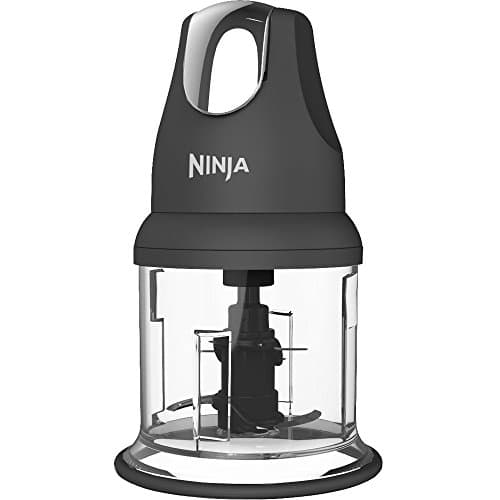
If your hands hurt, the most useful tool in this list is the one with a motor: the Ninja Express Chop (NJ110GR) replaces the grip, the pinch and the repetitive wrist rotation of chopping with a flat palm pressed down on a lid. After that the ranking is about leverage and gearing rather than brand — the Kuhn Rikon Epicurean Garlic Press for the hardest routine squeeze in a kitchen, the Chef'n FreshForce Citrus Juicer because its gears do the work your hand would otherwise do, and the OXO Good Grips Swivel Peeler because a fat cushioned handle needs less pinch force than a thin hard one.
The number nobody publishes
We went looking for a grip-force figure on every tool in our catalog. There is not one. No manufacturer here states how many pounds of force its press, peeler, squeezer or pair of shears requires, and none states a maximum, either. That is an honest hole in the published record and we are not going to fill it with a number from a review site or a guess of our own.
What makers do publish is the mechanism, and mechanism is the thing that decides whether a job is painful. A geared press multiplies your force. A long handle multiplies it further. A motor removes it. A wide, soft handle spreads the load across the palm instead of concentrating it in the finger joints. A non-slip base means one hand can stop holding the bowl. Those are all stated claims, checkable on the listing, and they are what this page ranks on.
So the order of criteria here is: does a motor do it, then does a lever or a gear do it, then does the handle spread the load, then can you use it with one hand. Price comes last, because the cheapest tool in a category is very often the one that needs the most force.
We are not a medical site and this is not medical advice. Occupational therapists do this properly — they assess your grip, your range of motion and your specific diagnosis, and they recommend accordingly. What this page can do is tell you which published mechanisms remove hand force, and which popular kitchen gadgets demand a lot of it.
Leverage: the cheapest thing you can buy
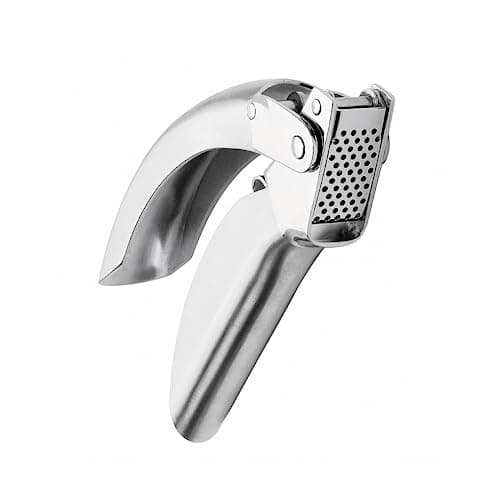
A garlic press is the hardest routine squeeze in a domestic kitchen. It is a small hinge with a hard clove behind it, and it asks for a sustained, forceful close at exactly the grip angle that hurts. It is also the job with the biggest published difference between tools. The Kuhn Rikon Epicurean Garlic Press is described by its maker as a long-handled, high-leverage design, and long handles are simple physics: the further your hand is from the hinge, the less force it takes to close it.
The alternative we rank first for most cooks is the OXO, and it is an honest second here too — soft, wide handles and a built-in cleaner, for a lot less money. The reason the Kuhn Rikon wins on this page and not on that one is that this page is ranking on force, and on force the longer lever wins. Our full review of the Kuhn Rikon covers what else you get for the price.
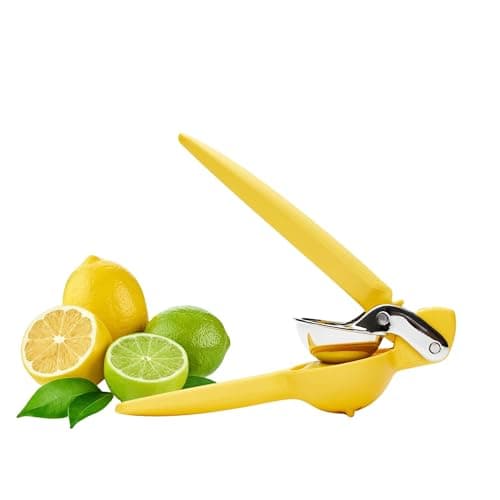
The same logic decides the citrus pick. The Chef'n FreshForce Citrus Juicer is geared: Chef’n states the FreshForce mechanism gives extra squeezing power, and the practical result is more juice out of a lemon for less closing force. The bare aluminum squeezers that cost a third as much have no gearing at all, and we say so plainly on the citrus juicer roundup: the budget option asks more of your hand.
Handles, and why diameter matters more than material
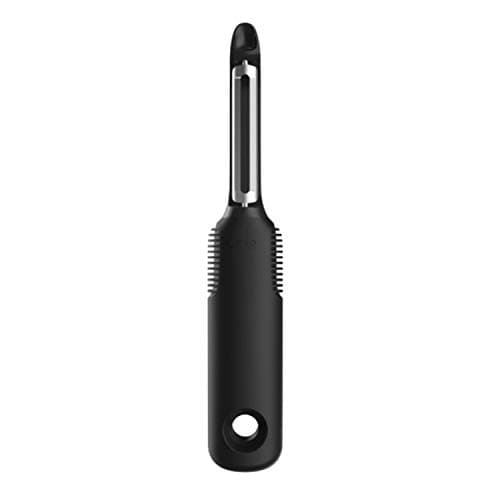
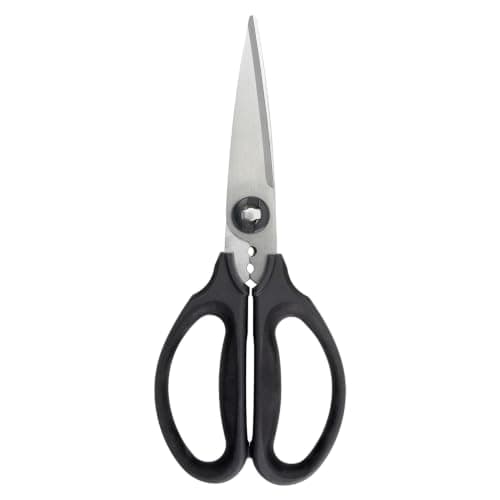
A thin, hard handle concentrates load into the thumb and index finger. A thick, soft one spreads it across the whole palm, which is why the same job can be fine with one tool and painful with another that does exactly the same thing. Three picks here state a cushioned or oversized handle in their own listings: the OXO Good Grips Swivel Peeler (soft oversized handle with a non-slip grip), the OXO Good Grips Multi-Purpose Kitchen Shears (cushioned pads that absorb pressure while cutting) and the OXO Good Grips Salad Spinner (Large) (a non-slip ring on the base).
The peeler earns its place for a second reason that has nothing to do with the handle: it has a built-in potato eye remover. That sounds like a triviality until you notice what it replaces, which is picking up a small paring knife and doing fine, forceful work with a blade tip. A tool that means one fewer knife in the routine is worth more than its handle.
If most of your peeling is squash, celeriac or anything big and hard, the Y-peeler in our peeler roundup may suit you better than this swivel model — a Y-peeler is pulled toward you in long strokes from the shoulder rather than pushed with the fingers, which is a different motion entirely and some people find it much easier.
One hand at a time
A surprising amount of kitchen pain comes from the hand that is not doing the job: the one gripping the bowl, steadying the board, or holding a pot still. Tools that hold themselves are worth looking for.
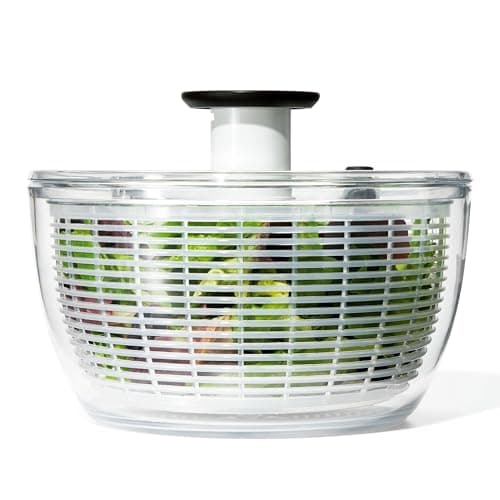
The OXO Good Grips Salad Spinner (Large) is the clearest example on this page. It has a pump you press with the heel of one hand, a brake button to stop it, and a non-slip ring so the bowl stays where you put it. There is no twisting, no cranking and no pulling — the three motions the other spinner designs use. Its honest weakness is that the pump is the part most likely to wear out over years, and it is bulky to store. The pull-cord alternative on our salad spinner roundup is faster but asks for a sharp repeated yank, which is the opposite of what this reader wants.
A non-slip cutting board belongs in the same paragraph. Our cutting board roundup ranks the OXO first largely on its non-slip feet, and the reason is exactly this: a board that does not move is a board your other hand does not have to hold down.
The tools to skip, and why
Push-down dicers are the most heavily marketed prep gadget in the category and they are the wrong buy for this reader. Fullstar’s own skip line in our catalog says it: pushing hard vegetables through a dicing grid takes real force, concentrated in a downward press through both wrists. A carrot or a sweet potato through a fine grid is one of the highest- force things you can do in a kitchen. Our manual chopper roundup recommends them warmly to people with strong hands, and that is the point — it is a genuinely good tool for a different buyer.
Mandolines are a more nuanced no. The slicing motion itself is light, but it is done at speed over an exposed blade with a food holder that has to be gripped firmly. If grip reliability is the issue, that is the wrong combination — and the honest alternative is the slicing disc on a food processor, which does the same cut with no hand near a blade at all. Our mandoline versus food processor comparison makes that case at length.
The last skip is a category rather than a product: anything with a screw-top lid you are expected to open, and any tool whose only claim is that it is “ergonomic.” That word appears on listings with no supporting design feature at all. A lever, a gear, a motor and a stated handle geometry are claims. Ergonomic, on its own, is not.
How they compare
Every entry is the maker’s own published claim from the product’s Amazon listing. No maker publishes a required grip force, so that column does not exist.| Tool | What replaces hand force | Stated handle | One-handed |
|---|
| Ninja Express Chop (NJ110GR) | A 200-watt motor; one-touch pulse | Press-down lid, no grip | Yes, with the bowl steadied |
|---|
| Kuhn Rikon Epicurean Garlic Press | Long-handled, high-leverage design | Stainless, uncushioned | No — two-handed squeeze |
|---|
| Chef'n FreshForce Citrus Juicer | Geared FreshForce press | Plastic, uncushioned | No — two-handed squeeze |
|---|
| OXO Good Grips Swivel Peeler | Swivelling blades follow the shape | Soft oversized, non-slip | Yes, with the produce held |
|---|
| OXO Good Grips Salad Spinner (Large) | Pump-and-brake mechanism | Non-slip base ring | Yes — stated one-hand pump |
|---|
| OXO Good Grips Multi-Purpose Kitchen Shears | Blade length and pivot | Cushioned pressure-absorbing pads | Yes |
|---|
Which to buy first
If you buy one thing, buy the Ninja Express Chop (NJ110GR). Chopping is the most repetitive hand work in a kitchen and it is the job an electric chopper removes outright. Read its honest limits first: the bowl is two cups, so a big pot of soup means batches, and it minces rather than dices — the neat cubes come from a push-dicer, which is the tool we just told you to avoid. If dice is what you need, a mini food processor with a dicing kit is the hands-off route to it.
If you buy two, add whichever of the garlic press, the citrus squeezer or the peeler matches what you actually cook. A tool for a job you do twice a year is not worth the drawer space no matter how well designed it is, and the honest truth about most “kitchen aids for arthritis” lists is that they are long because length looks thorough, not because you need eleven tools.
What to look for, in order
A motor, where a motor will do. Electric choppers, food processors and stick blenders remove hand force completely rather than reducing it. They cost more and they take up counter space, and for this reader that is usually a good trade. The whole chopper hub splits exactly along this line: electric bowls on one side, hand-powered push-dicers on the other.
A stated lever or gear.“Long-handled,” “high leverage,” “geared” and “multiplies force” are claims a maker has chosen to publish and you can hold them to. They also tend to appear on the more expensive tool in a category, which is the one exception to buying the cheap version.
Handle diameter over handle material. A thick handle needs less pinch force than a thin one of the same material. Soft over hard, wide over narrow, and a non-slip surface so you are not gripping harder to stop it turning in a wet hand.
Something that holds itself. Non-slip feet, a base ring, a pot hook, a weighted body. Every one of those is a job your second hand does not have to do.
Dishwasher safe, and few parts. Washing up is hand work too, and it is the part of cooking people forget to count. A tool with three pieces that all go in the machine is easier on your hands than a two-piece tool you have to scrub. The take-apart shears on this page are here partly for that reason.
Technique that costs nothing
Sharp beats strong, every time. A dull peeler, a dull knife and a dull grater all demand more force, and force is exactly what you are trying to avoid. Replacing a blunt peeler is the cheapest upgrade on this page. The same is true of blades in a food processor — a machine that struggles is a machine you press harder on.
Warm hands work better than cold ones, so running warm water over them before a long prep session is not folklore, it is just easier. Break long jobs into two sittings rather than powering through. And where a recipe calls for something finely chopped, ask whether it genuinely has to be — a coarse chop from a machine is usually fine, and it is free.
Finally: buy pre-prepped where it is worth it. Peeled garlic, frozen chopped onion and pre-cut squash are not a failure of cooking. They are the same solution as a tool, bought by the bag.
Where to ask someone who knows more than us
An occupational therapist can assess which joints are actually the problem and recommend for your hands specifically, including built-up handle grips that turn a tool you already own into a thicker one. A rheumatology team can tell you which motions to protect. Neither of those is something a kitchen-tools site should be guessing at, and we are not going to.
What we can promise is that the mechanism claims on this page are the makers’ own published words, cited on every product card, and that where we could not find a published figure — grip force, on every single tool — we said so instead of inventing one.