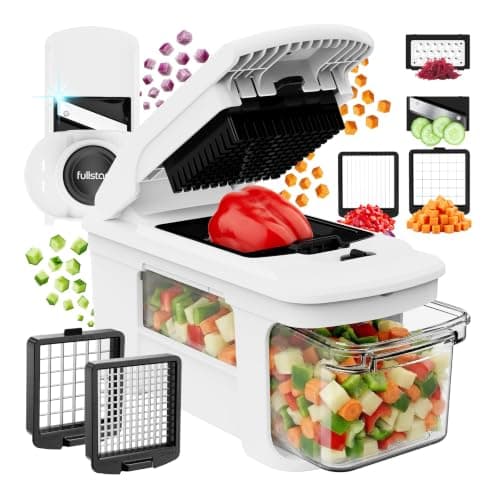
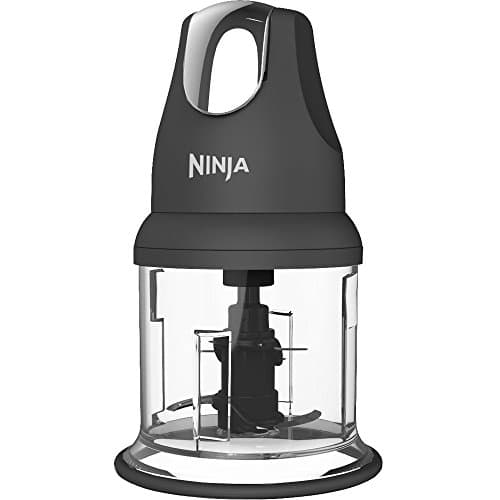
If you want an even dice — onion for a mirepoix, potato for a hash, cubes that look deliberate on a plate — buy a manual push-dicer, and buy the Fullstar Pro XL Vegetable Chopper & Mandoline. If you want things minced fast and you do not care what shape the pieces are — onion for a sauce, herbs, nuts, salsa — buy an electric chopper, and buy the Ninja Express Chop (NJ110GR). That is the whole decision. Power is a side effect of it, not the thing you are choosing.
Why “electric vs manual” is the wrong question
A food chopper is one of two machines wearing one name, and the difference is mechanical.
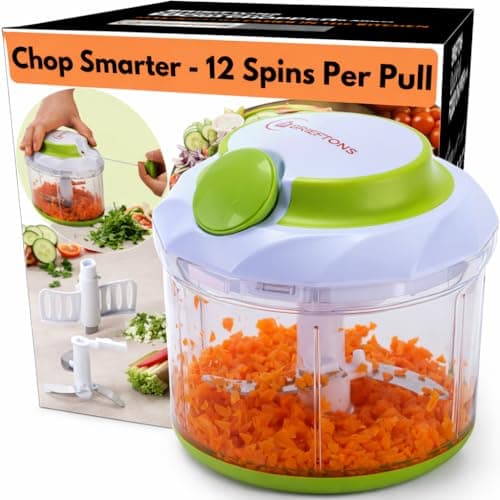
A bladed chopper spins a stacked stainless blade through a bowl. Every piece of food gets hit a random number of times, so what comes out is a mince— mostly fine, with some larger pieces and some near-puree. Pulse it twice and it is coarse; pulse it eight times and it is wet paste. There is no setting that produces cubes, because the mechanism cannot produce cubes. Almost every electric chopper is this machine, and so is one of the manual ones: the Brieftons QuickPull Manual Food Chopper (4-Cup) drives the same stacked blade from a pull cord instead of a motor.
A push-diceris the other machine. You put food on a grid of blades and push the lid down, and the food is pressed through once. Each piece is cut exactly as many times as the grid has edges, which is why the output is genuinely even cubes and why the size is set by which grid you fitted rather than by how long you ran it. Every pick here with the word dicer attached is this mechanism, and none of them have a motor — which is the only reason this comparison looks like a power question at all.
The one question that settles it.Will you be able to see the pieces in the finished dish? If yes — a salad, a salsa, a hash, anything where the cube is part of the look — you want a push-dicer. If no, because it is going into a sauce, a soffritto, a burger mix or a dressing, you want a bladed chopper, and electric is the faster version of that. Our dicer roundup goes deeper on the cube side; the electric roundup and the manual roundup rank each camp on its own terms.
The comparison, factor by factor
| Factor | Electric bladed chopper | Manual push-dicer | Manual pull-cord chopper |
|---|
| What the cut looks like | Uneven mince, texture set by pulse count | Even cubes, size set by the grid | Uneven mince, texture set by pull count |
|---|
| Hand force needed | None — press a button | Real force on carrot and sweet potato | Several firm pulls per batch |
|---|
| Speed for one onion | Seconds | Seconds, plus trimming to fit the grid | Under a minute |
|---|
| Needs an outlet | Yes | No | No |
|---|
| Noise | Loud for a few seconds | A thump | Near silent |
|---|
| Parts to wash | Bowl, blade, lid — dishwasher safe on all three electric picks here | Grid, container, pusher, plus a cleaning tool for the edges | Bowl, blade, lid — hand wash on the Brieftons |
|---|
| Storage | A motor base that cannot be nested | Stores flat; the container doubles as storage | A bowl with a lid mechanism on top |
|---|
| What eventually fails | The motor | Nothing powered — the blades dull | The pull cord, which can fray |
|---|
| Published motor figure | Only sometimes — Ninja publishes 200 W, Cuisinart publishes none for the ECH-4 | Not applicable | Not applicable |
|---|
That last row is worth dwelling on, because it is the reason you cannot settle this on paper. Of the three electric picks here, only Ninja publishes a wattage (200 W, printed in the listing title). Cuisinart publishes no watt figure for the ECH-4SV at all, and neither does Hamilton Beach for its 3-cup chopper. Any site ranking electric choppers by motor power across the whole category is comparing numbers that two of three manufacturers never published.
Which one to buy, by who you are
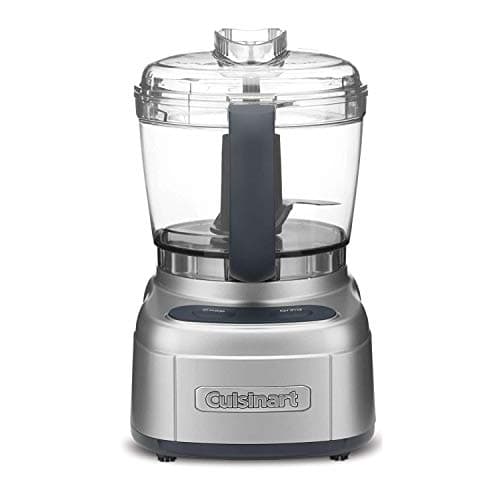
You cook a lot of sauces, soups and curries. Electric, and the Ninja Express Chop (NJ110GR)— a 16 oz bowl, a published 200 W motor and dishwasher-safe parts. The small bowl is the honest catch: a big pot of soup means two or three batches. Step up to the Cuisinart Elemental 4-Cup Chopper/Grinder (ECH-4SV) for a 4-cup bowl with a separate grind pad if spices and nuts are also on the list.
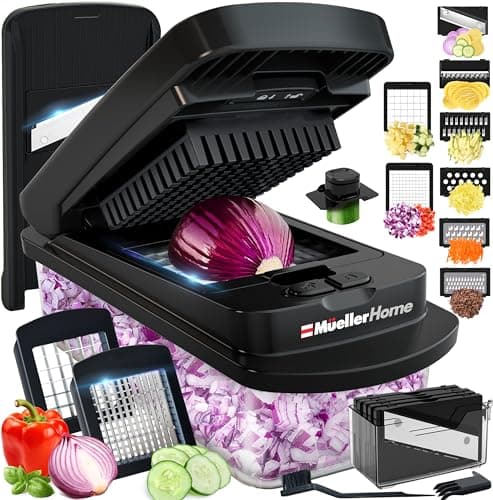
You want your vegetables to look like vegetables. Manual push-dicer, and the Fullstar Pro XL Vegetable Chopper & Mandoline— interchangeable dicing and slicing grids, a catch container with a lid that doubles as storage, and a cut-resistant glove in the box. If you want the widest blade set rather than the best-known one, the Mueller Pro-Series 10-in-1 Vegetable Chopper publishes eight inserts and a 1.2 L container.
You have no spare outlet, or you want quiet. The Brieftons QuickPull Manual Food Chopper (4-Cup)is the only pick here that minces without electricity: a pull cord spins the same stacked blade an electric chopper uses. It is a 4-cup bowl, bigger than most mini electrics, and it is close to silent. You trade a learning curve — texture is set by how many times you pull — and a cord that is a wear part.
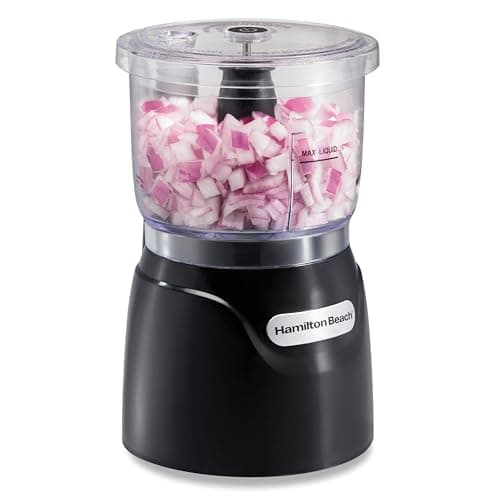
You want the cheapest thing that works. The Hamilton Beach 3-Cup Electric Vegetable Chopper is a 3-cup one-touch electric with dishwasher-safe removable parts, and its own listing positions it for soft-to-medium foods rather than a daily diet of almonds. Buy it knowing that.
Your hands or wrists are the limiting factor.Buy electric, and do not let anyone talk you into a push-dicer. Pressing hard vegetables through a dicing grid takes genuine force — it is the first line in the Fullstar’s own skip-this-if, and it is why our prep tools for arthritis and weak grip page recommends powered tools for exactly this work.
The case for owning one of each
These two tools cost about the same as one mid-range food processor between them, and they do not overlap. A lot of kitchens end up with a small electric chopper for the mince jobs and a push-dicer for the cube jobs, and that is a more useful pair than any single machine at the same money. If you find yourself wanting both and a slicing disc anddough, that is the point at which the answer is a different category entirely — food processor vs chopper is the page for that decision, and our vegetable chopper roundup is the one for batch volume across both camps.
What to check before you buy either kind
Bowl or container volume, in cups, not in adjectives.This is the single number that decides whether you batch. The picks here run from 16 oz (the Ninja) to 4 cups (the Cuisinart and the Brieftons) and a 1.2 L catch container (the Mueller). “Large capacity” on a listing with no figure is not a specification.
Whether the parts are dishwasher safe, stated by the maker. A chopper is a tool you use because it is faster than a knife, and hand-washing a blade and a grid gives that time straight back. All three electric picks here publish dishwasher-safe removable parts. The Brieftons publishes hand wash. The push-dicer grids have many small edges and both ship a cleaning tool for exactly that reason.
On a push-dicer: how many grids you will actually fit. Eight blades sounds better than three until you count the ones you will use. Dice and slice get used; the spiralizer insert and the julienne grid usually do not. More inserts also means more small sharp parts to store, which is a real cost in a drawer.
On an electric: whether there is any speed control. One button means the only variable you have is how long you hold it. The KitchenAid 3.5-Cup Food Chopper (KFC3516) is the one in this category that publishes two speeds plus a pulse, which is the difference between coarse salsa and tomato soup. It is also the most expensive chopper of its size, and that is the trade.
What it will not do, in both camps.Neither machine slices, shreds a block of cheese, kneads dough or makes nut butter. A bladed chopper will not cube and a push-dicer will not mince. If your mental list of jobs crosses those lines, you are shopping for a food processor and this is the wrong page — which is a better outcome than buying two tools that each do half of what you wanted.