There is a specific disappointment that comes with buying a “chopper” when what you wanted was a dicer. A bladed chopper hits food repeatedly until the pieces are small; the result is a mince of mixed sizes with liquid released. A dicer presses food through a stationary grid, so it comes out the other side in even cubes. Both are useful. Only one gives you onion that looks like the picture in the recipe.
Why almost nothing electric dices
This is the question behind every search for a “dicing machine” or a “food processor that dices vegetables”, so it is worth answering plainly: a food processor chops with a spinning S-blade or slices with a disc, and neither mechanism produces a cube. A handful of processors offer a dicing kit — a grid that sits under a slicing disc, so food is sliced and then pushed through the grid — but it is an accessory on a small number of models, not a standard feature, and it adds a set of parts to clean.
The practical result is that the cheapest route to an even dice is a manual push-dicer costing a fraction of any processor. If you already own a processor with a dicing kit, use it. If you do not, buying a whole machine to get a cube is the expensive way round. Our food processor vs chopper comparison works through the rest of that decision. The same grid mechanism, stretched longer, is what a french fry cutter uses to turn a whole potato into batons in one stroke.
The two worth buying
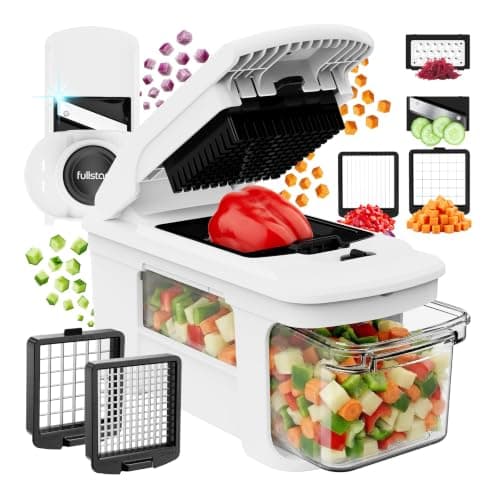
The Fullstar Pro XL Vegetable Chopper & Mandolineis the pick for most kitchens. It is the design everyone else copies: four interchangeable blades, a lidded 1.8 L catch container that goes straight into the fridge, and a finger guard and brush in the box. What is not in the box is a glove, and you want one — the grid is a field of exposed blades and the likely moment to get caught is while rinsing it, not while using it. Our full Fullstar review goes through it in detail.
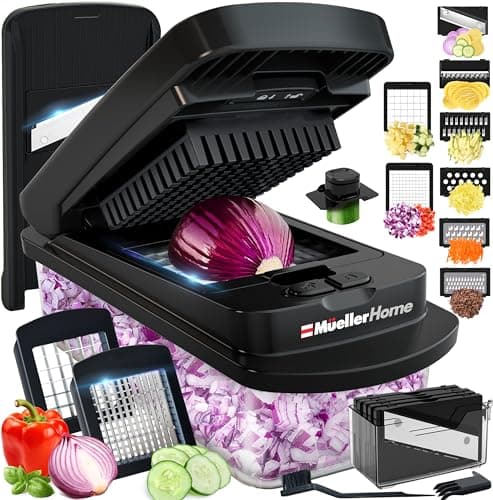
The Mueller Pro-Series 10-in-1 Vegetable Chopperis the one to buy if you want the widest range of cuts from a single tool: eight interchangeable stainless blades covering dice, slice, julienne and grate, in a lighter, lower body than the Fullstar’s. The honest caveat is in its own skip line — if you only ever dice onions and tomatoes you will never touch six of the eight blades, and every one of them is a small sharp thing to store. The Mueller Pro-Series review breaks the blade set down insert by insert.
The trade nobody puts on the box: force. A soft onion goes through the grid easily. A raw carrot, a sweet potato or a chunk of squash takes a genuine, committed push with your body weight behind it. If you have weak grip strength, wrist trouble or arthritis, this whole category is the wrong answer and an electric chopper is the right one, even though it minces rather than dices.
How they compare
| Dicer | Blades | Catch container | Best for |
|---|
| Fullstar Pro XL Vegetable Chopper & Mandoline | 4: fine dice, medium dice, 2 mm slice, grate | 1.8 L, lidded, doubles as storage | Most kitchens; finger guard included |
|---|
| Mueller Pro-Series 10-in-1 Vegetable Chopper | 8 stainless blades | 1.2 L | The widest set of cuts |
|---|
What a dicer is genuinely better at
Anything where the pieces are visible in the finished dish. Salsa and pico de gallo, a mirepoix that browns evenly instead of steaming, a chopped salad, stir-fry vegetables that cook at the same rate, potato for a hash. Even cubes are not a cosmetic preference — uniform pieces cook uniformly, which is the actual argument.
It is also the tidiest tool in this category to use, because everything lands in the catch box rather than on the board. That removes the step most people find tedious about prep: scraping a board into a container without losing half of it down the side.
What it is worse at
Herbs, garlic and anything you want finely minced. A grid cannot cut smaller than its own squares, so parsley goes through as ribbons and garlic mostly squashes. For those jobs a bladed electric chopper or a mezzaluna is the right tool, and a garlic press beats both for cloves.
Cleaning is the other cost. A dicing grid has dozens of small edges and food lodges in them. The supplied cleaning tool pushes most of it through, but this will never be as fast to wash as a bowl and a blade — call it a minute rather than fifteen seconds.
Which one to buy
Buy the Fullstar Pro XL Vegetable Chopper & Mandolineunless you have a specific reason not to: it is the well-sorted version of this design, and its four blades are the four you will use — the full head-to-head is in Fullstar vs Mueller. Buy the Mueller Pro-Series 10-in-1 Vegetable Chopperif you want julienne and grating from the same tool and do not mind storing eight blades — the Mueller review covers what the “10-in-1” on the box is actually counting. And buy neither if the force is a problem — that is a real limitation, not a quibble, and the manual chopper roundup says the same thing.
And if the cut itself is what you are after rather than the tool, how to dice vegetables covers the flat-plank-baton-cube method, what the sizes in recipes mean, and the short list of machines that genuinely dice rather than mince.
Two things that come up constantly with these grids have their own pages. Tomatoes are the worst case — ripe ones burst rather than cube, and the best chopper for tomatoes sorts the answer by what you actually want out of the fruit. And cleaning is the reason people abandon a dicer rather than a dull blade, so how to clean a vegetable chopper is worth the five minutes before your first onion.