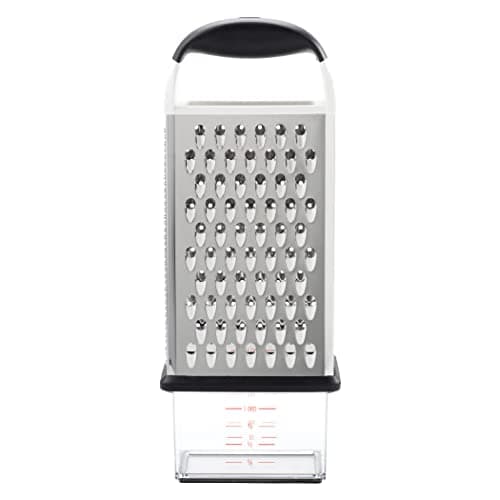
The OXO Good Grips Box Grateris the best box grater for most kitchens because it gets the boring things right: four sharp surfaces, a soft handle, a non-slip foot that keeps it planted while you bear down on a block of cheese, and a container that catches the shreds and measures them. A box grater is the versatile choice — it handles hard cheese, soft cheese, vegetables, chocolate and citrus zest — and if you own one grater, this is the one to own.
Box grater vs. rotary grater: two different jobs
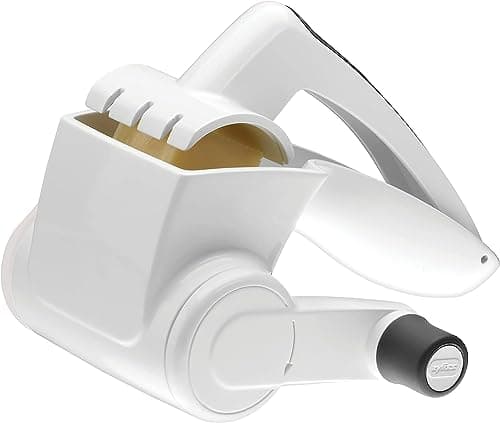
These are not competing versions of the same tool, so pick by the job. A box grater is the generalist: you press food against a flat perforated face and it shreds or grates almost anything, in real volume, for pennies. A rotary grater is the specialist: you load hard cheese into a small drum and turn a crank, which grates it quickly and — the real point — keeps your fingers nowhere near the cutting surface. The Zyliss Classic Rotary Cheese Grater is the pick when your grating is mostly parmesan at the table and finger safety or restaurant-grade convenience matters. It is not the tool for a pile of vegetables or a block of mozzarella; a box grater is.
Which box grater for which buyer
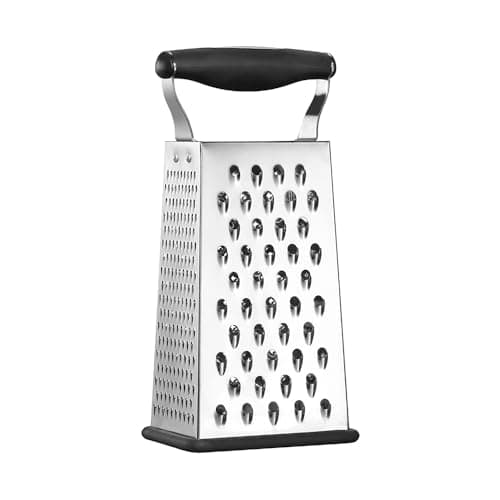
Buy the OXO Good Grips Box Grater if you want the most comfortable, most stable grater with the gratings caught and measured for you. Buy the Cuisinart Box Grater (CTG-00-BG)if you want the same four-sided job for less money and do not mind losing the non-slip base and the container — it is sharp, simple and there is nothing extra to store. Choose the Zyliss Classic Rotary Cheese Grater only if hard cheese, grated safely and often at the table, is genuinely your main need. Each pick below carries its surfaces and a plain line on who should skip it.
The knuckle rule for box graters. The danger with any box grater is the last inch of a shrinking block, where your knuckles run out of room above the teeth. Stop grating while there is still a good handful to hold, and save the nubs for melting or the food processor. A rotary grater sidesteps that risk entirely, which is much of its appeal.
One job a box grater is genuinely clumsy at is the finest work: citrus zest without the bitter pith, whole nutmeg, garlic paste, parmesan fine enough to melt on contact. The zesting side of a four-sided grater will do it, awkwardly, on a face that was designed for something else. That is what a handheld rasp or zester is for, and it is the tool most kitchens end up owning alongside a box grater rather than instead of one.
The other question people arrive with is whether a mandoline replaces this entirely. It does not — one slices and one shreds, and the overlap is narrower than it looks. Our mandoline versus box grater comparison draws the line properly, and our julienne guide covers the third cut neither of them is ideal for.
One step up from this page: if what you typed was “best cheese grater” rather than the name of a mechanism, our cheese grater pagesorts all four — box, rotary drum, fine rasp and dual-surface handheld — by the cheese you actually buy, then sends you back to the roundup for whichever one wins.
How we picked
Tools we claim to have lab-tested: 0
Every site in this category tells you they ran twenty machines through a lab. We have not, and we say so. Here is what we do instead: read the manufacturer's manual and spec sheet, record the published bowl capacity, motor rating, blade and disc counts and materials, cross-check the warranty against the manufacturer's own warranty document, and cite all of it so you can check the work. Prices come live from Amazon's API and disappear rather than go stale.
The scores above are judgments from that documented research — not test results. The full rubric, including what disqualifies a product, is published in full.