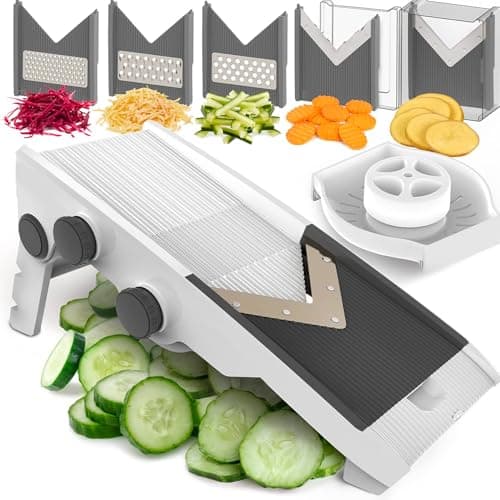
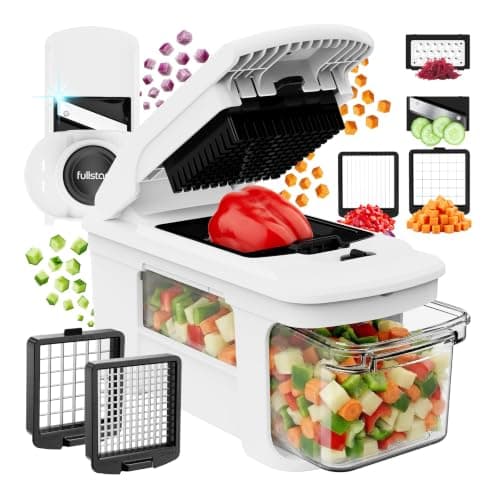
Buy a vegetable chopper first, and the Fullstar Pro XL Vegetable Chopper & Mandoline is the one, if most of what you cook starts with diced or minced vegetables — stews, curries, soups, salsa, meal-prep boxes. Buy a mandoline first, and the OXO Good Grips Chef's Mandoline Slicer 2.0 is the one, if what you make needs flat even slices — gratins, crisps, slaw, scalloped potatoes, a tart. There is no overlap worth arguing about: a chopper cannot make a slice and a mandoline cannot make a cube. Everything below is about matching the output to your cooking and knowing which of the two is genuinely more dangerous.
Three outputs, not two tools. A mandoline drags food across one fixed blade and produces a flat slice of a set thickness. A push-down chopper presses food through a grid of blades and produces an even cube. A bladed electric chopper spins blades through food in a bowl and produces an uneven mince. Naming the shape you want settles the purchase in about five seconds, which is why this page leads with it.
What each tool class actually does
The mandoline: one thickness, repeated perfectly
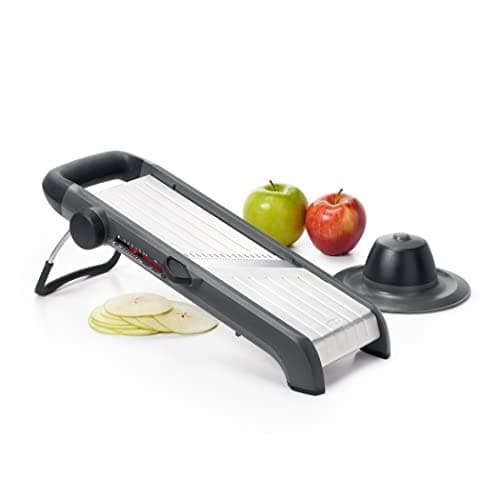
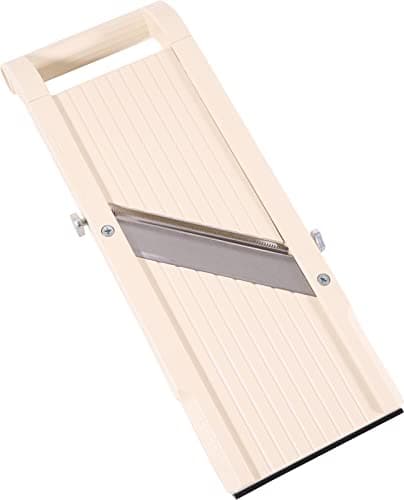
A mandoline’s whole value is repeatability. Set the dial, and every slice is the same — which is not a cosmetic benefit: a gratin where the potato is 2 mm in one place and 6 mm in another cooks unevenly, and crisps of mixed thickness burn and stay raw in the same batch. The OXO publishes 21 thickness settings on a dial and includes a food holder and a runway guard. The Benrineris the sharper, simpler Japanese design professionals use, with a flat blade plus three julienne inserts and a screw-set dial — and a minimal guard, which is the trade.
A mandoline also does one thing choppers cannot touch: it slices things that are too hard or too large to press through a grid. Cabbage for slaw, a whole sweet potato, a butternut squash, hard cheese. If you have ever shredded a cabbage by hand, that job alone is the argument.
The push-dicer: one motion, even cubes
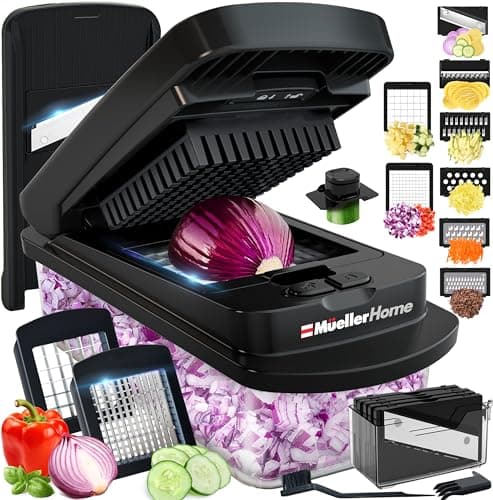
A push-down chopper is the only tool in a home kitchen that makes genuinely even cubes without knife skill. You load, you press, and the grid decides the size. The Fullstarships four blades in 420J stainless — a fine dicer, a medium dicer, a 2 mm slicer and a grater — with a 1.8 L catch container, and the Muellerships eight inserts and a 1.2 L container. Both are ranked against each other in detail in Fullstar vs Mueller.
Note that both of those include a slicing insert, which is where the two categories brush against each other. A 2 mm slicing insert on a push-dicer is a real slicer for a cucumber or a courgette. It is not a mandoline: one fixed thickness, a small aperture, and no runway for anything the size of a cabbage.
The bladed chopper: mince, fast
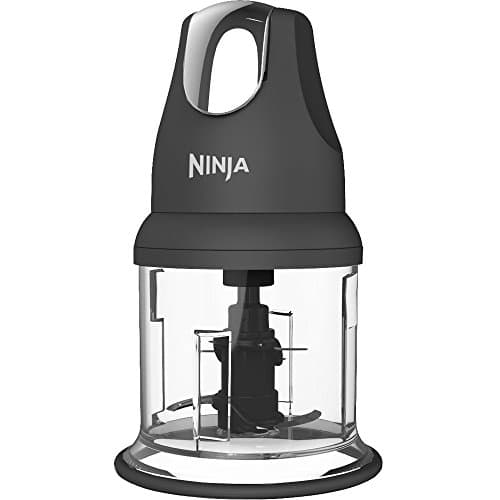
The Ninjais the third shape and the one people forget they want. 200 W, a 16 oz bowl, one button, and an onion is a fine mince in two pulses. Nothing here beats it for the base of a sauce or for ginger and garlic, and nothing here is faster to wash. It also cannot make a cube or a slice, at all, ever. The full field is on the best electric choppers, and the fork between it and the push-dicer is settled in electric vs manual.
The published comparison
| Tool | Class | Output | Published adjustability | Hand safety as published |
|---|
| Fullstar Pro XL Vegetable Chopper & Mandoline | Push-down chopper | Even cubes, plus one 2 mm slice and a grate | 4 blades: fine dice, medium dice, 2 mm slicer, grater | Finger guard and cleaning brush in the box |
|---|
| OXO Good Grips Chef's Mandoline Slicer 2.0 | Countertop mandoline | Straight and crinkle slices, julienne, French-fry cut | 21 thickness settings via a dial | Food holder plus a runway guard |
|---|
| Ninja Express Chop (NJ110GR) | Electric bladed chopper | Uneven mince | None — pulse length is the only control | Enclosed bowl; blades only exposed at washing |
|---|
| Benriner Super Slicer (Japanese Mandoline) | Japanese mandoline | The thinnest slices here, plus 3 julienne widths | Screw-set thickness dial | Minimal included guard — stated as the trade-off |
|---|
| Mueller Pro-Series 10-in-1 Vegetable Chopper | Push-down chopper | Cubes, slices, julienne, grate | 8 interchangeable stainless blades | Food holder listed; no glove included |
|---|
| Mueller Austria Multi-Blade Adjustable Mandoline | Folding mandoline | Slice, julienne, grate | 5 blade inserts plus an adjustable dial | Hand-guard food holder included |
|---|
The row to read twice is the last column. These two tool classes are not equally dangerous. A chopper’s blades sit inside a body and the food is pressed through them — your hand is on a lid, not near an edge, and the moment of risk is at the sink. A mandoline is a bare blade in a frame that you deliberately drag food across, with your hand getting closer to it on every pass. That is why we rank first mandolines on how rarely you touch the blade in the best mandoline for beginners, and why a cut-resistant glove is not optional with one.
Which to buy first, by what you cook
Buy the chopper first if your week contains stews, curries, chilli, soups, salsa, mirepoix or meal-prep containers. Those are cube-and-mince dishes and a chopper removes the single most time-consuming step in all of them.
Buy the mandoline first if your week contains gratins, scalloped potatoes, crisps, slaw, pickles, a potato tart, or anything where the vegetable is visible on the plate. A knife can do those; it cannot do them identically, and identical is the point.
Buy the bladed electric chopper first if what you actually resent is chopping onions and crushing garlic, full stop. It is the cheapest fix for the most common complaint, and it is the fastest of the three to clean.
Buy neither if hard produce is most of your prep and grip strength is a problem. A mandoline needs a controlled, repeated push and a push-dicer needs real force; the electric chopper is the only one of the three that asks nothing of your hands. Start from prep tools for weak grip instead.
What we are not claiming
We have not used any of these six. Every blade count, thickness setting, container volume, wattage and included-accessory claim above is the manufacturer’s own published wording, cited below. Nobody here has measured slice thickness or cube evenness, and the argument on this page is a mechanism argument you can verify from the same listings we read. Live prices come from Amazon with the date attached.
Where the two overlap, honestly
Both push-dicers here include a slicing insert, and both mandolines here include a julienne blade. So there is a thin band of jobs either can do: a sliced cucumber, a courgette, a julienned carrot. In that band the mandoline gives you thickness control and the chopper gives you a catch container and no exposed blade. Neither is wrong.
Outside that band they do not substitute at all. A mandoline will never dice an onion. A chopper will never slice a cabbage. If you are hoping one purchase covers both, the honest answer is that it does not, and the two together still cost less than one mid-range food processor — which is the third option and the subject of mandoline vs food processor.
Three things that decide how much you use either one
Where it lives. A tool in a cupboard behind other things gets used a third as often as one on a shelf at eye level. The folding mandoline and the handheld slicers exist for exactly this reason.
How it washes. A dicing grid has dozens of small edges and holds onto starch and skin; a mandoline is one blade and a flat body. The chopper is better at the job and worse at the sink, every time. Our chopper cleaning guide is the mitigation.
Whether you own a glove. People stop using mandolines after a near miss. A cut glove costs less than a takeaway and it is the difference between a tool you trust and one you avoid — see what the glove ratings actually mean.