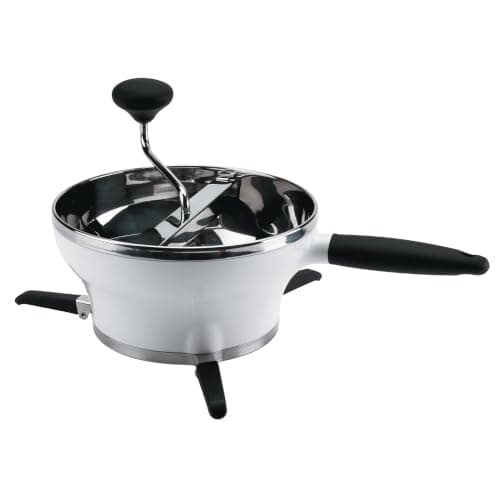
A food mill does one thing that no blender, no food processor and no immersion blender can do: it separates. Everything else on this site cuts food smaller. A mill pushes the soft part through a perforated disc and leaves the skins, seeds, cores and fibers behind in the hopper. That is the whole reason it still exists, and it is why the OXO Good Grips Food Mill earns cupboard space in a kitchen that already owns three machines.
The job nothing else does
Put whole tomatoes in a blender and you get tomato sauce with the skins and seeds in it, blitzed into flecks and bitterness that no amount of blending removes. Put them through a mill and you get smooth sauce in the bowl and a dry mat of skins and seeds in the hopper. Same for applesauce made from whole apples, for raspberry coulis without the pips, for roasted squash with its fibers, and for a soup you want silky without straining it through a sieve with a ladle and bad language.
It is also the honest answer to “do I need a food mill if I have a food processor”: those are different tools that happen to sit in the same drawer.
Three discs, and which you will actually use
OXO ships fine, medium and coarse stainless discs. In practice most kitchens live on two of them. The fine disc is for anything you want smooth and seedless — coulis, passata, baby purees. The medium is the everyday choice for applesauce and tomato sauce with a little body. The coarse disc is the one people forget, and it is genuinely useful for a rustic mash or a chunky vegetable soup where you want texture rather than a puree.
Swapping them is a thirty-second job. Doing it mid-batch is not, so decide the texture before you fill the hopper.
The frame is what makes it usable
OXO lists wide legs and a hook that straddle the pot, and that is the difference between a mill you use and one that lives at the back of a cupboard. A milling session is one hand cranking and one hand feeding, which leaves no hand for holding the mill steady. A frame that sits on the rim of a pot or a bowl without sliding is not a luxury; it is the thing that makes the tool a one-person job.
The soft non-slip crank and grip matter for the same reason. Milling four pounds of tomatoes is several minutes of continuous turning, and a bare metal handle is felt long before the end.
Cook it soft first, and reverse the crank when it packs.A mill is not a grinder — it presses cooked food through holes. Raw or undercooked fruit and vegetables jam it. And when the crank starts getting hard, turn it backwards half a revolution: that lifts the blade and redistributes the packed pulp instead of you leaning harder on it.
Where the Cuisipro wins
The Cuisipro Deluxe Food Mill is the alternative, and its case is straightforward: an all-stainless build with fold-down legs and three discs, aimed at people doing heavy seasonal batches. If you process bushels of tomatoes every August, the extra rigidity is worth having.
For everyone else the OXO is the better buy, and its own comparison line says why: the Cuisipro is noticeably more expensive and its metal handle is less cushioned than OXO’s soft grip. Our food mill roundup sets the two against each other properly.
Mill or ricer?
They overlap on exactly one job — smooth mashed potato — and diverge everywhere else. A ricer extrudes potato and nothing else; a mill separates skins and seeds, which a ricer does not. If mash is the only reason you are shopping, the ricer is simpler and cheaper. If tomato sauce or applesauce from whole fruit is on the list, only the mill will do it, and you rarely need both.
Who should buy it
Anyone who cooks from whole tomatoes or whole apples, anyone making seedless purees or coulis, and anyone who wants very smooth soup without owning a chinois. It is a seasonal tool for most people and an indispensable one in that season.
Skip it if you buy passata and applesauce, in which case this solves a problem you do not have. And skip it if the volumes are large and annual — the sturdier Cuisipro is the better long-term choice for that.