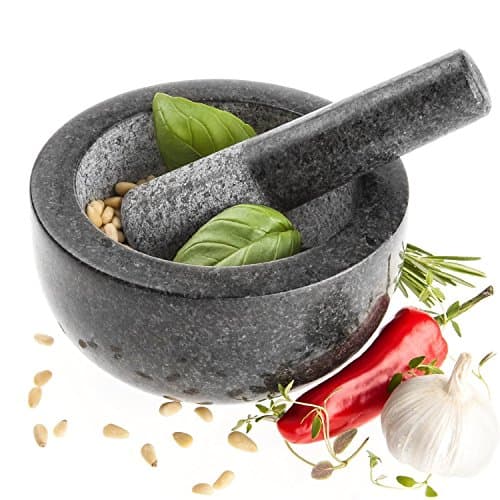
For most kitchens the best mortar and pestle is the Kota Japan Large Black Granite Mortar & Pestle: unpolished granite, stated outright, and the only set here whose maker publishes the interior bowl dimensions rather than a cup rating that tells you nothing about what fits. If you want the same stone and the same two cups for a little less, the ChefSofi Granite Mortar and Pestle Set (2 cups) is the one people actually buy. And if you want the pestle tipleft unpolished as well as the bowl — the half of the equation almost every maker leaves out — the Cole & Mason Granite Mortar & Pestle (5.5 in) is the only listing in this group that says so, though it is also the dearest.
The one question that decides it
A mortar works by friction. You are not hitting food with a stone club; you are trapping it between two rough surfaces and dragging one across the other until the cell walls tear. If the inside of the bowl is smooth, there is nothing for the food to catch on, and a peppercorn simply skates ahead of the pestle in a circle. That is the entire difference between a mortar that works and a heavy ornament, and it has nothing to do with price.
So the first thing to look for on any listing is the word unpolished. Four of our five picks use it. The Cole & Mason listing goes furthest and states that both the mortar interior and the pestle tip are unpolished; Kota Japan and ChefSofi both state unpolished granite; Fox Run states a “rough interior” in those words. A disappointing number of otherwise handsome sets say the stone is “polished” — some say it as a selling point — and a large 8-inch Thai granite mortar we looked at for this page states plainly that both the pestle and the inside surface are polished, which is why it is not on the list.
How to read a listing in ten seconds.Search the page for “polish”. If it says unpolished or rough, the tool grinds. If it says polished, it does not — that is a serving bowl with a stick. And if the listing does not mention the interior surface at all, assume it is smooth: a maker who has left the inside rough on purpose will tell you, because it is the only thing worth saying about a lump of stone.
Stone by stone
Graniteis the default and the right answer for most people. It is hard enough that the pestle does not wear a hollow in the bowl, heavy enough to stay put, and cheap enough that a good set costs less than a mid-range chef’s knife. All three of our granite picks state that the working surface is unpolished.
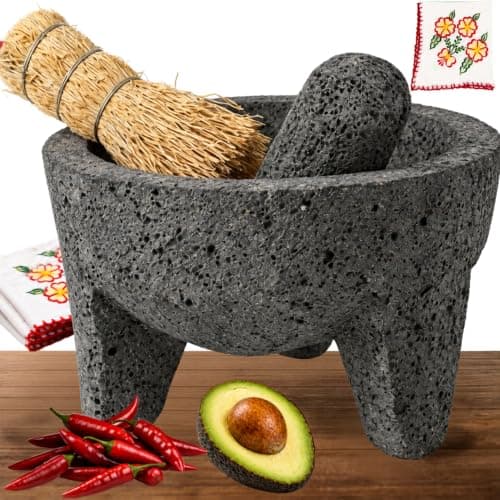
Lava rock— the Mexican molcajete — is naturally porous, so the grip is built into the material rather than applied to it. That makes it superb on soft, wet ingredients, which is why guacamole and roasted salsa are its home ground and why the Cuitaxi 8-inch Molcajete, Mexican Lava Rock ships with a tortilla warmer rather than a spice spoon. The trade is that porous stone must be cured before first use or the first two batches come with grit in them, and its maker says so on the listing.
Marble is denser and finer-grained. It looks better on a counter and it is easier to wipe clean, but the same density that makes it handsome makes it slippery unless the maker deliberately leaves the inside rough. The Fox Run Marble Mortar and Pestle Set (4 in) does say it leaves the interior unpolished, which is why it is here; plenty of marble sets do not.
Ceramic and porcelain sets are the ones you see in laboratories and in small apothecary-style bowls. They are light, cheap and fine for a teaspoon of dry seed, and hopeless at anything that needs weight behind it. None made this list because a mortar that moves while you lean on it is a mortar you stop using.
The five sets
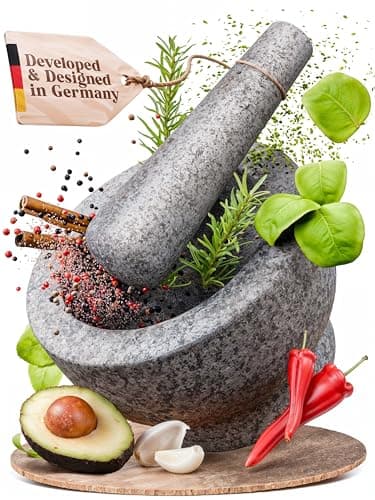
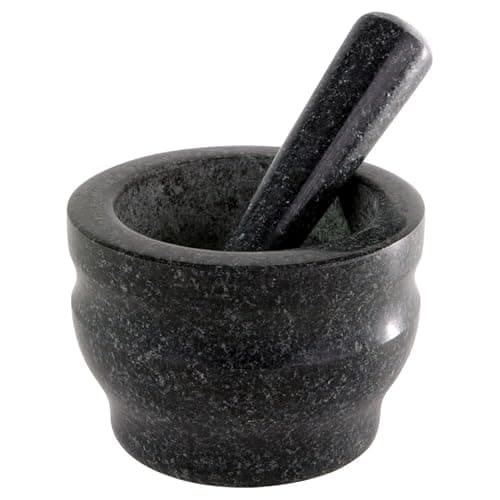
The Kota Japan Large Black Granite Mortar & Pestleis the pick because it is the one that shows its working. Kota Japan states solid unpolished granite, a 2-cup capacity, and then the numbers nobody else gives you: an interior bowl of 3-3/4 by 2-3/4 inches, a mortar body of 5-1/4 inches square, a pestle of 6-3/4 by 1-3/4 inches, and 8 lb of stone. That interior figure is the one that matters, because a mortar is never filled more than about a third — anything above that goes over the rim on the first stroke — so “2 cups” overstates the working volume of every set on this page. The honest marks against it: 8 lb is a two-hand lift and this will never live in a drawer, and the listing manages to say both “rinse with warm water and let air dry” and “dishwasher safe” about a stone it also tells you to season. Follow the first instruction.
The ChefSofi Granite Mortar and Pestle Set (2 cups)is the volume seller and it earns the place. It states unpolished granite, describes the friction that surface gives in terms of a metate, and publishes a 500 ml capacity — about 2 cups — on roughly 7 lb of stone. In use it is the same tool as the Kota Japan for a little less money. What you give up is information: ChefSofi publishes no bowl diameter, no depth and no pestle length, so you cannot compare it dimension for dimension with anything. Its listing also says nothing about seasoning, which every unpolished stone set needs before it stops shedding grit.
The Cole & Mason Granite Mortar & Pestle (5.5 in)is the one that has thought about the pestle as well as the bowl. Cole & Mason states that the mortar interior andthe pestle tip are unpolished, which no other listing here does, and that matters more than it sounds: a polished pestle in a rough bowl still slides, because only one of the two surfaces is doing any work. The listing backs it up with a finish type of “unfinished”, publishes 5.5 inches across a 5.9-inch bowl diameter on 8 lb of stone with thick walls, and prints the seasoning routine — white rice, garlic, cumin, salt and pepper — rather than leaving you to look it up. Two honest marks against it: it is the most expensive set on this page by a clear margin for a capacity the cheaper granite sets also state, and its own listing cannot decide what that capacity is — 2 cups in the spec table, 3 cups (20 oz) in the bullets.
The Cuitaxi 8-inch Molcajete, Mexican Lava Rock is the specialist, and the only pick here that is a different tool rather than a different size. It is hand-carved lava rock from the Popocatepetl volcano in Puebla, 8 inches across and 5 inches high, weighing somewhere between 7.0 and 8.8 lb because no two hand-made pieces are the same. The porous surface grips soft, wet ingredients in a way smooth stone cannot, the bowl is wide enough to mash and serve in, and a tortilla warmer comes with it. Two things to know before you buy: it must be cured before first use and the maker emails you the method, and its published weight is a range rather than a number, which is what hand-made honestly means.
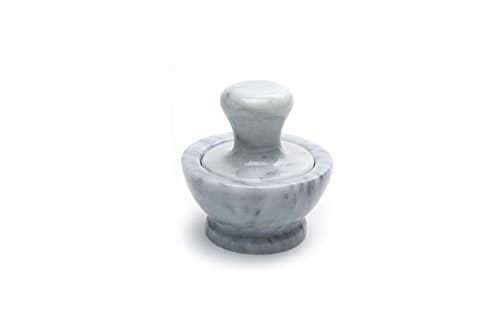
The Fox Run Marble Mortar and Pestle Set (4 in)is the cheap, small one that still gets the important part right. Fox Run states a rough, unpolished interior “with just enough of an edge to get great grinding results”, in a 4-inch bowl weighing 1.9 lb, and it is the least expensive set here by a clear margin. At that size and weight it lives in a drawer, which is the difference between a tool you use on a Tuesday and one you admire on a shelf. Two caveats, one of them unusual: 1.9 lb will shift on the counter if you lean into something hard, and Fox Run’s own listing calls the set marble in its title and granite in two of its bullets, so the material claim is not one we can pass on with a straight face.
Size: the bowl, not the cup rating
Capacity on a mortar is measured to the brim and used at about a third. Fill it further and the first firm stroke sends half of it onto the counter, because unlike a food processor there is no lid. That is why the interior diameter is the useful number: you need room for the pestle plus room for the food to move sideways, and a bowl narrower than about three and a half inches leaves the pestle touching the walls with nowhere to push.
As a rough guide to bowl size: a 4-inch bowl is a spice grinder and nothing more. A 5-inch bowl with a cup of capacity does spice pastes, a small pesto and a couple of garlic cloves. A 2-cup granite set handles a full batch of pesto or curry paste. And an 8-inch molcajete is a guacamole and salsa vessel that you serve out of. Buy for the job you do most often rather than the biggest one you can imagine — the same rule that governs food processor bowl size, for the same reason.
How they compare
Every figure below is the maker’s own published claim from the product’s Amazon listing. Where a maker publishes nothing, the cell says so rather than guessing.| Set | Stone | Grinding surface | Published size | Weight |
|---|
| Kota Japan Large Black Granite Mortar & Pestle | Granite | Unpolished (bowl) | Bowl 3-3/4 x 2-3/4 in; 2 cups | 8 lb |
|---|
| ChefSofi Granite Mortar and Pestle Set (2 cups) | Granite | Unpolished (bowl) | 500 ml, about 2 cups | About 7 lb |
|---|
| Cole & Mason Granite Mortar & Pestle (5.5 in) | Granite | Unpolished (bowl and pestle tip) | 5.5 in; 2 cups stated (bullets say 3) | 8 lb |
|---|
| Cuitaxi 8-inch Molcajete, Mexican Lava Rock | Lava rock | Naturally porous; must be cured | 8 in wide, 5 in high | 7.0–8.8 lb |
|---|
| Fox Run Marble Mortar and Pestle Set (4 in) | Listing says marble and granite | Rough, unpolished | 4 x 4 x 4.25 in | 1.9 lb |
|---|
Which one to buy
Buy the Kota Japan Large Black Granite Mortar & Pestle if you want one mortar to cover everything and you would rather know the dimensions before it arrives. Buy the ChefSofi Granite Mortar and Pestle Set (2 cups) if you want the same stone and the same capacity and the saving matters more than the spec sheet. Buy the Cole & Mason Granite Mortar & Pestle (5.5 in) if you want the one set here whose maker has thought about the pestle as well as the bowl, and paying the most on this page for it does not bother you.
Buy the Cuitaxi 8-inch Molcajete, Mexican Lava Rock if guacamole and salsa are the point and you are happy to cure it properly first. And buy the Fox Run Marble Mortar and Pestle Set (4 in)if you want to spend the least and grind dry spices in something that stores in a drawer — as long as you are not buying it for the stone it claims, because its own listing cannot decide what that is.
Season a new stone mortar before you cook with it
Every unpolished stone set arrives with loose grit in the pores from the carving, and the first thing you make in it will carry that grit unless you take it out first. Cole & Mason publishes the standard method on its own listing: grind white rice to a powder, discard it, and repeat until the powder comes out white rather than gray. Then grind a batch of garlic, cumin, salt and pepper and throw that away too, which seasons the surface and takes the raw stone edge off the first real thing you make. The molcajete needs the same treatment; its maker sends the method by email.
It takes twenty minutes and two cups of cheap rice, and it is not optional. A mortar that was never seasoned is the single most common reason people decide their mortar “does not work” and put it at the back of a cupboard.
Technique: press and drag, do not pound
The instinct is to hammer. Hammering bruises what is on top and leaves what is underneath untouched, and on a hard stone it is also how you chip a pestle. The working motion is a press followed by a drag — put weight on the pestle and turn it, so the food is rolled between two rough surfaces rather than struck. Start with a firm crack to break things open if you must, then switch to grinding.
Two habits make a bigger difference than the tool. Work in small amounts: half full is already too much, and a thin layer grinds far faster than a deep one. And add salt early when you are working something soft like garlic or basil — the crystals act as an abrasive and do half the work for you, which is exactly why traditional pesto and aioli recipes both start with salt in the mortar.
Cleaning it without ruining it
Water, a stiff brush, and air drying. Unsealed stone is porous, so detergent soaks in and comes back out into the next thing you grind, which is why the makers here that give one cleaning instruction give that one — Kota Japan’s is “rinse with warm water and let air dry”. For a bowl that has held garlic or chilli, grind a spoonful of coarse salt and dry rice, tip it out, and rinse; that lifts residue out of the pores in a way a sponge on the surface does not.
Store it dry and uncovered. A stone bowl put away damp is how a mortar ends up smelling of the last thing that went in it.
Where a mortar beats a machine, and where it does not
It genuinely wins on three jobs. Whole dry spices, because crushing releases the volatile oils rather than heating and scattering them the way a spinning blade does. Small amounts of anything, because a blade in a bowl needs a certain volume before it makes contact at all — the problem behind small-batch pesto in a food processor. And garlic paste, where crushing with salt gives a smooth paste that a garlic press cannot and a knife takes longer to reach.
It loses on volume and on time. Fifteen minutes of arm work for one bowl of pesto is a real cost, and a mini food processor does an honest job in thirty seconds. Nuts are the interesting middle: a mortar gives you complete control over how coarse they end up, but for a full batch a chopper with a grind setting is the sane choice. The mortar is the tool for when the result matters more than the clock.
Three follow-on questions come up often enough to have their own pages. Whether a machine should do this at all is settled on mechanism in mortar and pestle vs food processor. Which stone to start from is in granite vs marble, where the hardness figures do most of the arguing. And whichever set you buy, season it with ricebefore the first thing you make in it — two of the makers here publish that instruction themselves.
Three more, if this ranking is not the question you arrived with. For dry spices specifically the order above inverts, because a small deep bowl traps seed under the pestle where a wide one lets it roll away — that page is the best mortar and pestle for spices. How big a bowl any given job actually needs is worked through from the published interior dimensions in our mortar and pestle size guide. And what belongs in one at all — spices and garlic yes, coffee and flour no — is in what you can grind in a mortar and pestle. The lava-rock molcajete above is a specialist rather than a general mortar, and molcajete vs mortar and pestle explains exactly what it specialises in.