HUB 06 · Guides
How to Sharpen Vegetable Chopper Blades
Start here: most choppers that feel blunt are not blunt. A dicing grid clogs in ways you cannot see, and the force that feels like a dull blade is usually food packed in the cells. Here is how to tell, and what is genuinely possible on each blade type.
We earn a commission if you buy through our links. It does not change the price you pay, and it does not decide our picks — our selection criteria are published in full. How this works.
The honest answer first: a push-dicer’s blade grid is not designed to be sharpened, and nine times out of ten a chopper that has become hard to push is clogged rather than blunt. The blades sit in a moulded frame, riveted or crimped in place, ground on both sides and set at an angle you cannot present to a stone without dismantling something that does not dismantle. What you can do is clean it properly, which usually restores it; treat the edge gently so it stays sharp; and replace the insert when it genuinely has worn out. Electric chopper blades are a different case and we cover them below.
The thirty-second test: dull, or dirty? Hold the grid up to a window and look through the cells from the underside. Clean cells show daylight as clean squares with crisp corners. A clogged grid shows cloudy, soft-edged squares, or corners filled in with a pale deposit — that is compacted starch and plant fibre, and it is what your hand is actually fighting. Now run a fingernail across the top edge of one blade. A sharp edge catches the nail; a worn one lets it slide. Most choppers people describe as blunt fail the first test and pass the second.
Why a dicing grid cannot be sharpened the normal way
Sharpening means removing metal from one or both faces of an edge at a consistent angle. A dicing grid makes that geometrically impossible for three reasons. The blades cross each other, so there is no clear run for a stone or a rod — each cell is a box about a centimetre square. They are fixed into the housing, so you cannot take one out, work it and put it back. And they are thin, hardened stainless ground on both sides; on the Fullstar the published material is 420J stainless across its four blades, and on the Mueller the listing states eight interchangeable stainless blades without naming a grade. Neither maker publishes a sharpening procedure, which is itself informative.
You will find videos suggesting you drag folded sandpaper or a diamond card through each cell. It can take the burr off, and it can also round the edge, scratch the cell walls so food sticks worse, and leave abrasive grit in a tool you eat from. We are not going to recommend it. The exception is a visible rolled edge or burr on an outer blade you can reach cleanly — a couple of light passes with a fine diamond card, in one direction, away from you, then a thorough wash.
What to do instead, in order
1. Back-flush the grid, from underneath
Run hot water through the grid in the opposite direction to the food, so the debris exits the way it went in rather than being pushed further into the cell. This is the single most effective thing on this page. Fullstar ships a cleaning brush for precisely this, and it is the part most people lose in a drawer. Full routine, including the soak that shifts baked starch, is in how to clean a vegetable chopper.
2. Soak in warm water with a drop of dish soap
Twenty minutes, then brush again. Starch from potato and sweet potato sets like a weak glue and rehydrates readily; most “my chopper got blunt after I did potatoes” cases are this and nothing else.
3. Check the housing, not the blade
If a grid rocks in its frame or the lid hinge has worn, the blades meet the food at the wrong angle and the tool feels blunt while being perfectly sharp. Press the insert in from the underside: any movement at all is the fault. No sharpening fixes it; a new insert does.
4. Replace the insert
This is the real answer for a genuinely worn grid, and it is also the strongest argument for buying a chopper from a brand that sells its blades separately. Check the maker’s own store listings for a blade or insert set for your exact model before you buy a replacement tool — an insert generally costs a fraction of the whole chopper. If no spare exists for your model, the insert is the consumable, and the tool is a few-years purchase. We say the same thing in are vegetable choppers worth it.
By blade type, what is possible
| Blade type | Found on | Sharpenable? | Do this instead |
|---|---|---|---|
| Dicing grid | Push-down dicers | No — crossed, fixed, double-ground | Back-flush, soak, then replace the insert |
| Single slicing insert | Push-dicer slicing blade; handheld mandolines | Rarely, and only on an accessible straight edge | One or two light diamond-card passes, then wash |
| Julienne comb | Mandoline and dicer inserts | No — standing teeth, no clear run | Replace; a torn strip means a worn comb |
| Powered S-blade | Electric bowl choppers | Not practically — curved, hardened, often riveted | Buy the replacement blade for the model |
| Grater plate | Dicer and mandoline grater inserts | No — punched teeth, not ground edges | Replace; a punched tooth cannot be restored |
Electric chopper blades
A bowl chopper such as the Ninja Express Chop (NJ110GR) uses stacked stainless blades on a spindle, and they are a genuinely different proposition: curved, hardened, and mounted so that presenting them to a stone at a consistent angle is awkward and dangerous in roughly equal measure. They also need far less sharpness than they look like they do — a bladed chopper tears food apart at speed as much as it cuts, which is why its mince is slightly uneven by design. A powered chopper that seems to have lost its edge is usually one of three things: an overfilled bowl, food too big to be caught, or a blade assembly that is not seating fully on its spindle. Check all three before you conclude anything about the steel. If the blade truly is damaged — chipped, bent, visibly rolled — replace the assembly rather than grind it; a blade spinning at speed is the wrong place for an uneven edge.
Four habits that keep an edge longer than any sharpening
Rinse before you cook, not after you eat. Wet residue brushes off in ten seconds. Dry residue is a ten-minute job, and it is the cause of most clogged grids.
Never force food that is too big. Cut it narrower than the grid first. The force you save goes into the housing and the blade seats rather than into the edge.
Keep hard stones and bones out. An avocado stone, a peach pit, a frozen vegetable or a chicken bone will chip a thin stainless blade in one pass, and a chip cannot be fixed by anything in your kitchen.
Air-dry fully before storing. A grid put away damp develops pitting around the rivets, and pitting is what eventually ends an insert.
Why this page is not the mandoline page
Sharpening a mandoline blade answers a genuinely different question, because a mandoline’s main blade is one long, straight, accessible edge — the one case in this category where careful sharpening is sometimes possible and sometimes worth it. A chopper’s grid is the opposite: crossed, enclosed and riveted. Keeping the two pages separate is deliberate, because the right advice for one is the wrong advice for the other.
What we are not claiming
We have not sharpened, tested or dismantled these tools. The blade counts, materials and included cleaning accessories referred to above are each maker’s own published wording, cited below. Where no maker publishes a sharpening procedure or a blade grade, we say so rather than supply one. The diagnostic test and the maintenance habits are mechanism and ordinary kitchen practice, offered as reasoning you can check. Prices come live from Amazon with the date attached.
The hardware
The hardware this guide is about
The products this guide refers to, with prices pulled live from Amazon and dated on every card. Full rankings live in the roundups linked above.
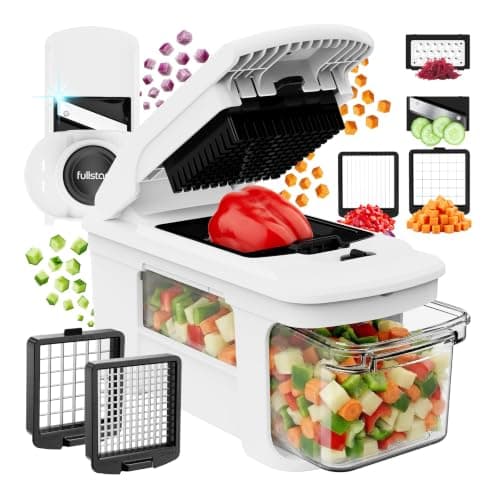
Even manual dicing
Fullstar Pro XL Vegetable Chopper & Mandoline
The best-selling push-down dicer: press the lid and vegetables fall through a grid into neat, even cubes.
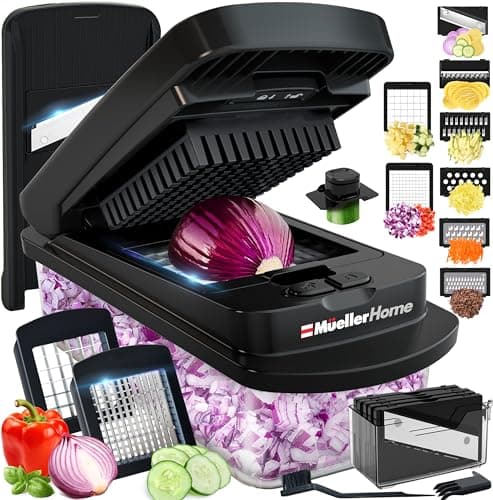
Most blade options
Mueller Pro-Series 10-in-1 Vegetable Chopper
A push-dicer with the widest blade set here — eight inserts covering dice, slice, grate and spiralize.
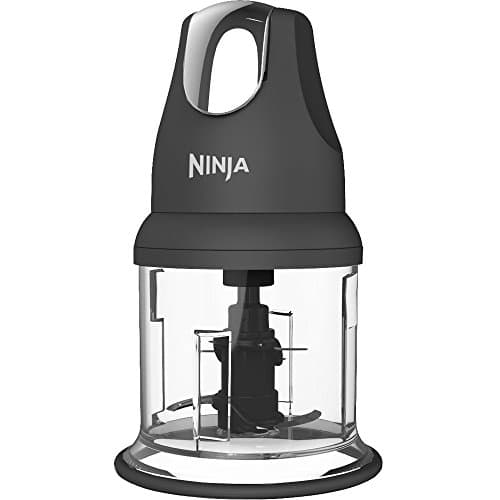
Fast electric chopping
Ninja Express Chop (NJ110GR)
The electric chopper to beat: a 200-watt, one-touch bowl that turns onions and nuts to an even mince in seconds.
#ad · As an Amazon Associate we earn from qualifying purchases.
Questions
Frequently asked
Can you sharpen vegetable chopper blades?
Why is my vegetable chopper suddenly hard to push?
Can you buy replacement blades for a vegetable chopper?
Does running a chopper blade through foil or sandpaper work?
How long should a chopper blade last?
Keep reading
Related
Receipts
Sources
- Amazon listing - Fullstar Pro XL Vegetable Chopper & Mandoline (4 blades in 420J stainless - fine dicer, medium dicer, 2 mm slicer, grater - finger guard and cleaning brush included)
- Amazon listing - Mueller Pro-Series 10-in-1 Vegetable Chopper (8 interchangeable stainless blades; no steel grade and no sharpening procedure published)
- Amazon listing - Ninja Express Chop NJ110GR (16 oz bowl, 200 W, stacked stainless blades on a spindle, dishwasher-safe bowl, blades and lid)
We do not run a testing lab and we do not pretend to. Specifications come from the manufacturer's own published documents and from published standards; prices come from the live Amazon API. Where a figure is not published, the page says “not published” rather than guessing. Read the full method.